


In short ⚡
Just in Time II (JIT II) is an advanced supply chain model where a supplier's representative works on-site at the buyer's facility, managing inventory replenishment and procurement activities in real-time. This integrated approach eliminates traditional purchasing barriers, reduces response times, and creates seamless vendor-managed inventory systems that significantly lower operational costs.
Introduction
Many companies struggle with procurement delays, inventory mismatches, and communication gaps between buyers and suppliers. Traditional JIT systems reduced waste, but JIT II revolutionizes this concept by embedding the supplier directly into the customer’s operations.
Developed by Lance Dixon at Bose Corporation in the 1980s, this model addresses critical supply chain inefficiencies. In international logistics, where coordination across borders and time zones complicates procurement, JIT II creates unprecedented visibility and responsiveness.
Key characteristics of JIT II include:
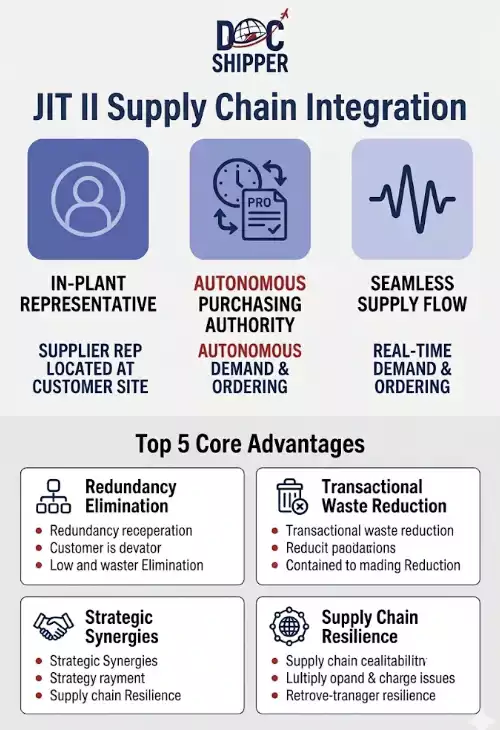
- On-site supplier presence – A vendor representative physically works at the customer’s location
- Direct system access – Suppliers access production schedules, inventory levels, and forecast data
- Proactive replenishment – Materials arrive precisely when needed without formal purchase orders
- Relationship transformation – Adversarial buyer-seller dynamics shift to collaborative partnerships
- Cost transparency – Shared financial visibility eliminates markup negotiations and hidden costs
JIT II Mechanisms & Operational Expertise
The operational framework of JIT II eliminates traditional purchasing functions by integrating the supplier into the customer’s workflow. The supplier representative, called an “in-plant,” occupies desk space within the buyer’s facilities and assumes responsibility for monitoring material requirements.
This model requires comprehensive data integration. Suppliers receive real-time access to Enterprise Resource Planning (ERP) systems, Material Requirements Planning (MRP) data, and production forecasts. This visibility enables anticipatory ordering rather than reactive procurement.
The legal and contractual structure fundamentally differs from conventional agreements. Framework contracts establish pricing, quality standards, and service levels while eliminating individual purchase order approvals. According to the UN/CEFACT guidelines, such arrangements require robust legal frameworks addressing liability, intellectual property protection, and termination procedures.
Risk management protocols become paramount in JIT II implementations. Without traditional inventory buffers, supply disruptions directly impact production. Companies must establish contingency plans, dual-sourcing strategies for critical components, and force majeure provisions in international contexts.
At DocShipper, we facilitate JIT II arrangements for clients importing components from Asia and Europe. Our logistics specialists coordinate with on-site supplier representatives to ensure customs compliance, optimize shipping schedules, and maintain documentation accuracy that prevents border delays.
The cultural transformation required for JIT II success cannot be understated. Traditional purchasing departments often resist relinquishing control to suppliers. Successful implementations require executive sponsorship, change management programs, and performance metrics that reward collaboration over adversarial negotiation tactics.
Implementation Models & Performance Data
Real-world JIT II implementations demonstrate measurable improvements across operational metrics. The following comparative analysis illustrates performance differences between traditional procurement and JIT II models:
| Metric | Traditional Procurement | JIT II Model | Improvement |
|---|---|---|---|
| Order Processing Time | 5-7 days | Same day | 85% reduction |
| Inventory Carrying Costs | 20-30% of value | 5-10% of value | 67% reduction |
| Stockout Incidents | 3-5% monthly | 0.5-1% monthly | 80% reduction |
| Administrative Costs | $150 per order | $30 per order | 80% reduction |
| Supplier Response Time | 3-4 weeks | 3-5 days | 75% reduction |
Practical Implementation Case: A European automotive manufacturer importing electronic components from Taiwan implemented JIT II with three key suppliers. The supplier representatives occupied workstations within the production planning department, accessing the company’s SAP system directly.
Results after 18 months showed inventory levels decreased by 62% while production uptime improved from 87% to 96%. Purchase order processing staff was reduced from 12 to 3 employees, generating annual savings of approximately €680,000. Most significantly, product development cycles shortened by 30% due to early supplier involvement in design specifications.
International logistics considerations for JIT II require specialized expertise. When implementing cross-border JIT II arrangements, companies must address:
- Customs brokerage coordination – Pre-clearance procedures and bonded warehouse utilization
- Incoterms selection – DDP (Delivered Duty Paid) terms often preferred for seamless delivery
- Documentation standardization – Electronic data interchange (EDI) systems for commercial invoices and packing lists
- Freight optimization – Consolidated shipments and dedicated transport lanes reduce transit variability
- Quality assurance protocols – Pre-shipment inspections prevent defective material arrivals
DocShipper supports JIT II implementations by providing integrated logistics services that align with on-site supplier operations. Our team coordinates with in-plant representatives to schedule shipments, manage customs clearance, and provide real-time tracking visibility that maintains the zero-buffer principles of JIT II.
Conclusion
Just in Time II represents the evolution of supply chain collaboration, transforming adversarial buyer-supplier relationships into integrated partnerships. Its success depends on technological integration, cultural readiness, and robust logistics coordination.
Need assistance implementing JIT II logistics for your international supply chain? Contact DocShipper for expert guidance on customs compliance, freight optimization, and supplier coordination strategies.
📚 Quiz
Test Your Knowledge: Just in Time II (JIT II)
1. What is the defining characteristic of JIT II that distinguishes it from traditional Just in Time manufacturing?
2. A company claims their JIT II arrangement is successful because their supplier visits their facility monthly to review inventory needs. Is this a correct implementation of JIT II?
3. Your company imports electronic components from Taiwan and wants to implement JIT II. Which scenario represents the correct application?
🎯 Your Result
📞 Free Quote in 24hFAQ | Just in Time II (JIT II): Definition, Implementation & Concrete Examples
Traditional JIT focuses on minimizing inventory through precise production scheduling and supplier coordination. JIT II advances this by embedding the supplier's representative directly within the buyer's facility, granting system access and procurement authority. This eliminates purchase order processing, reduces communication delays, and creates proactive rather than reactive material management.
Automotive manufacturing, electronics assembly, aerospace, and pharmaceutical production realize the greatest benefits. These industries require high-volume component consumption with stringent quality requirements and complex supply networks. JIT II's real-time visibility and rapid response capabilities align perfectly with their operational demands and tight production tolerances.
Comprehensive non-disclosure agreements (NDAs), restricted system access protocols, and data compartmentalization protect sensitive information. Supplier representatives receive access only to material requirements and production schedules, not product designs or customer data. Legal frameworks should include penalties for confidentiality breaches and clear intellectual property ownership provisions.
Initial costs include ERP system modifications for supplier access ($50,000-$150,000), legal contract development ($20,000-$40,000), facility workspace allocation, and change management programs ($30,000-$80,000). However, most companies recover these investments within 12-18 months through reduced inventory carrying costs and eliminated purchasing overhead.
Yes, though it requires enhanced logistics coordination. International JIT II implementations utilize cloud-based systems for real-time collaboration across time zones. The supplier representative may be based at the customer's regional hub rather than overseas. Predictable shipping schedules, bonded warehouse facilities, and experienced customs brokers become critical success factors.
JIT II's embedded supplier presence enables faster disruption detection and resolution. When issues arise, the on-site representative has immediate awareness and direct communication channels with their manufacturing facilities. Contingency protocols include backup suppliers, safety stock for critical components, and alternative transportation routing. The collaborative relationship facilitates transparent problem-solving.
Key performance indicators include order-to-delivery cycle time, inventory turnover ratio, stockout frequency, administrative cost per transaction, on-time delivery percentage, and total cost of ownership. Successful implementations typically show 60-80% reductions in inventory levels, 50-70% faster replenishment cycles, and 30-40% lower total procurement costs within the first year.
Most companies begin with 2-5 strategic suppliers representing high-volume, high-value, or critical path components. Expanding to 10-15 suppliers provides optimal benefits without creating management complexity. The Pareto principle applies—focusing on suppliers representing 80% of material spend generates maximum impact while maintaining manageable relationships.
Integrated ERP systems, real-time data exchange via EDI or API connections, and cloud-based collaboration platforms form the technological foundation. Suppliers require access to material requirements planning modules, production schedules, quality management systems, and inventory dashboards. Advanced implementations incorporate IoT sensors for automated reorder triggering and blockchain for transaction transparency.
Successful transitions follow phased approaches: pilot programs with one trusted supplier, proof-of-concept over 6-12 months, gradual expansion to additional vendors, and eventual full-scale deployment. Change management addresses employee concerns about job security, provides training on collaborative workflows, and redefines purchasing department roles toward strategic supplier relationship management.
Contracts must address liability for stockouts or quality issues, intellectual property protection, data security requirements, termination procedures, and dispute resolution mechanisms. International arrangements require compliance with data privacy regulations like GDPR, consideration of foreign corrupt practices acts, and clarity on applicable jurisdiction. Force majeure clauses become especially important given zero-inventory operations.
SMEs can implement simplified JIT II models by leveraging virtual collaboration tools rather than physical on-site presence. Cloud-based inventory management platforms, vendor-managed inventory programs, and frequent communication replace full system integration. While cost savings may be proportionally smaller, SMEs benefit from improved supplier relationships, reduced inventory investment, and enhanced operational agility that levels competitive playing fields against larger enterprises.
Need Help with
Logistics or Sourcing ?
First, we secure the right products from the right suppliers at the right price by managing the sourcing process from start to finish. Then, we simplify your shipping experience - from pickup to final delivery - ensuring any product, anywhere, is delivered at highly competitive prices.


Fill the Form
Prefer email? Send us your inquiry, and we’ll get back to you as soon as possible.
Contact us




:%20Definition,%20Implementation%20&%20Concrete%20Examples)