


In short ⚡
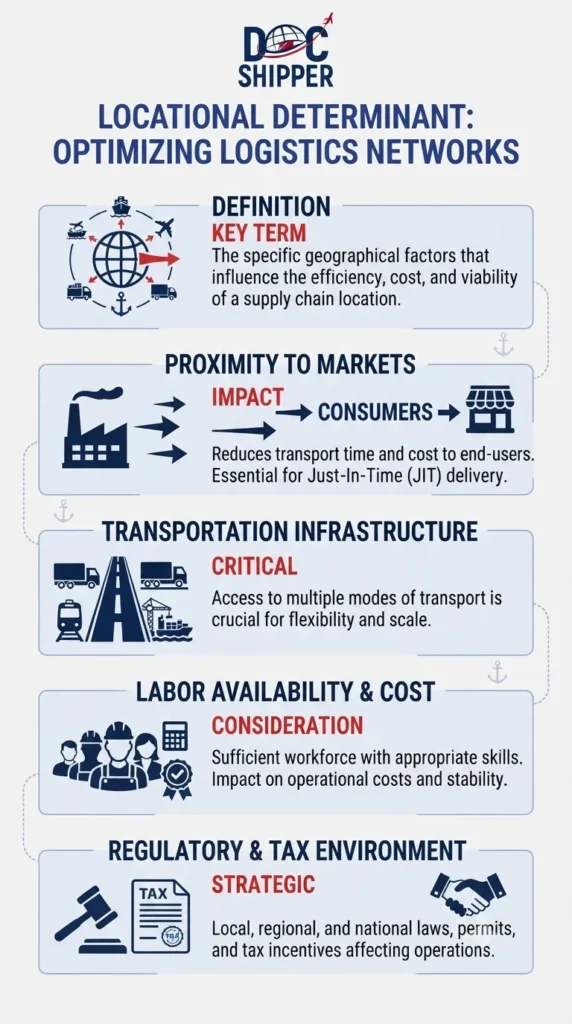
The locational determinant is a strategic factor influencing the placement of distribution centers, warehouses, or production facilities within a supply chain network. It encompasses quantitative and qualitative criteria—such as transportation costs, labor availability, market proximity, and regulatory environment—that guide businesses in optimizing their logistical footprint to reduce expenses and improve service levels.
Introduction
Many importers struggle to decide where to establish warehouses or consolidation hubs. Choosing the wrong location can inflate freight costs by 30% or more while delaying deliveries.
Locational determinants provide a structured methodology to evaluate site options. They transform subjective guesses into data-backed decisions, ensuring that every node in your supply chain contributes to operational efficiency.
Key considerations include:
- Transportation costs: Proximity to ports, airports, rail terminals, and highway networks.
- Labor market: Availability of skilled warehouse staff and wage levels.
- Demand geography: Distance to end customers or retail distribution points.
- Regulatory environment: Customs procedures, tax incentives, free-trade zones.
- Infrastructure quality: Road conditions, digital connectivity, utility reliability.
Technical Framework & Strategic Impact
Locational determinants are analyzed through center-of-gravity models, weighted scoring matrices, and simulation tools. The goal is to minimize total landed cost while maintaining acceptable service windows.
Transportation cost typically represents 50–70% of the decision weight. Facilities near major ports—such as Rotterdam, Singapore, or Los Angeles—reduce drayage fees and transit times. Conversely, inland locations may offer lower real estate and labor costs but increase last-mile expenses.
Labor availability influences warehouse scalability. Regions with high unemployment or vocational training programs provide steady hiring pipelines. Labor costs vary dramatically: Eastern European warehouses may charge €8–12/hour, while Western European hubs exceed €20/hour.
Market proximity affects order fulfillment speed. E-commerce giants place fulfillment centers within 50 km of major metro areas to guarantee same-day or next-day delivery, a decisive competitive advantage.
Regulatory factors include customs efficiency, duty drawback programs, and special economic zones. For instance, the European Union’s customs warehousing regime allows duty deferral until goods enter free circulation, improving cash flow.
At DocShipper, we conduct multi-criteria location audits for clients establishing Asian or European distribution hubs, ensuring every variable—from freight rates to local compliance requirements—is quantified and optimized.
Practical Examples & Data-Driven Insights
Consider a U.S. importer of consumer electronics sourcing from Shenzhen, China. The company evaluates three warehouse locations:
| Location | Annual Transport Cost | Labor Cost/m² | Avg. Delivery Time (days) | Weighted Score |
|---|---|---|---|---|
| Los Angeles, CA | $420,000 | $18/m² | 2–3 | 8.2/10 |
| Kansas City, MO | $380,000 | $10/m² | 4–5 | 7.5/10 |
| Savannah, GA | $405,000 | $12/m² | 3–4 | 7.9/10 |
Los Angeles scores highest due to direct ocean freight routes and rapid West Coast distribution. However, if the customer base is concentrated in the Southeast, Savannah offers a competitive balance of cost and service.
Another case: A European fashion brand importing textiles from Bangladesh evaluates Hamburg versus Warsaw. Hamburg’s advanced port infrastructure reduces container dwell time to 12 hours, but Warsaw’s lower labor costs (€9/hour vs. €22/hour) and EU customs warehouse status justify the additional 400 km of inland transport for bulk storage.
Key takeaways:
- Port proximity cuts 15–25% off inbound freight when handling containerized cargo.
- Centralized hubs (e.g., Memphis, Leipzig) excel for parcel distribution, minimizing air freight legs.
- Free-trade zones defer duties, improving working capital by 8–12%.
- Labor cost differentials can offset higher transport expenses when volumes exceed 50,000 m³/year.
- Service-level agreements (SLAs) often override pure cost optimization—clients pay premiums for guaranteed 48-hour delivery windows.
Conclusion
Locational determinants transform facility placement from guesswork into strategic advantage. By quantifying transport, labor, and market factors, businesses reduce total supply chain costs while meeting customer expectations. Need expert guidance on warehouse site selection or customs warehousing strategies? Contact DocShipper for a tailored feasibility study.
📚 Quiz
Test Your Knowledge: Locational Determinant
What primary purpose do locational determinants serve in supply chain management?
Which statement correctly describes transportation cost's role in locational analysis?
An electronics importer must choose between a port-proximate facility and an airport-adjacent warehouse. Which locational determinant should drive this decision?
🎯 Your Result
📞 Free Quote in 24hFAQ | Locational Determinant: Definition, Calculation & Concrete Examples
Proximity to population centers dominates e-commerce decisions. Facilities within 50 km of metro areas enable same-day delivery, a critical differentiator. Transportation cost savings from port proximity matter less than fulfillment speed for high-margin consumer goods.
Customs warehouses allow duty-free storage until goods are sold domestically. This defers VAT and import duties, improving cash flow. The EU's Type D warehouses are particularly attractive for importers serving multiple member states from a single hub.
Yes. Facilities near rail terminals or short-sea shipping routes cut truck miles by 30–40%. Consolidating regional distribution centers also reduces packaging waste and empty backhaul runs, aligning cost savings with sustainability goals.
Critical for scaling operations. Regions with vocational training programs or high unemployment provide steady hiring pipelines. Seasonal peaks require 20–30% workforce flex; locations with temp agency networks offer operational resilience.
Free-trade zones (FTZs) defer duties and reduce administrative burdens. U.S. Foreign-Trade Zones and EU Special Economic Zones allow value-added activities—such as labeling or light assembly—without triggering import taxes until final sale.
Center-of-gravity calculators, weighted scoring matrices, and network optimization software (e.g., LLAMASOFT, AnyLogic) model transport costs, service levels, and facility expenses. Sensitivity analysis tests how demand shifts or fuel price changes impact optimal location.
Not for air freight or high-value goods. Electronics importers prioritize airport proximity (e.g., Louisville, Hong Kong) over seaports. Time-sensitive pharmaceuticals justify premium air cargo costs, making port distance irrelevant.
Tax breaks, reduced utility rates, and infrastructure grants lower total ownership costs. U.S. states like Texas and Tennessee offer 10-year property tax abatements. Eastern European countries provide EU structural funds for logistics park development.
Challenging but feasible. B2B shipments use full pallets and scheduled deliveries; B2C requires piece-picking and parcel carriers. Hybrid facilities need dual automation systems—pallet racking for wholesale, modular shelving for e-commerce.
Refrigeration infrastructure, airport cargo capacity, and cold-chain compliance. Perishable importers cluster near airports with dedicated cool storage (e.g., Amsterdam Schiphol, Miami International) to minimize temperature excursions during transit.
Every 3–5 years or after major demand shifts. E-commerce growth, tariff changes, or new free-trade agreements alter cost structures. Annual network audits identify opportunities—such as relocating 200 km inland to cut real estate costs by 40% without sacrificing service.
Absolutely. 3PL facility locations determine your effective supply chain footprint. Evaluate 3PL hubs using the same criteria—transport costs, labor quality, customs capabilities—as you would for owned warehouses. Multi-site 3PLs offer geographic flexibility without capital investment.
Need Help with
Logistics or Sourcing ?
First, we secure the right products from the right suppliers at the right price by managing the sourcing process from start to finish. Then, we simplify your shipping experience - from pickup to final delivery - ensuring any product, anywhere, is delivered at highly competitive prices.


Fill the Form
Prefer email? Send us your inquiry, and we’ll get back to you as soon as possible.
Contact us




