In short ⚡
The best supply chain magazines and digital platforms help professionals track disruptions, benchmark practices, and turn industry trends into operational decisions.
They cover topics like logistics, technology, risk, and trade, and are most useful when matched to your role, from strategic leadership to hands-on warehousing and transportation management.
We hope you’ll find this article genuinely useful, but remember, if you ever feel lost at any step, whether it’s finding a supplier, validating quality, managing international shipping or customs, DocShipper can handle it all for you!
Why supply chain magazines are essential for modern professionals
If you’re trying to keep up with disruptions, cost swings, and new regulations, best supply chain magazines aren’t “nice to have”, they’re your early warning system.
You’ve probably dealt with that moment where a supplier suddenly slips lead times, or a carrier changes a surcharge, and nobody on your team saw it coming.
We’ve seen the difference it makes when you follow a few authoritative supply chain publications consistently, you start reacting less and planning more.
DocShipper Info
Let DocShipper translate market signals into sourcing and logistics action plans tailored to your flows.
How curated industry news supports better supply chain decisions
Last year, we worked with an importer who relied on group chats for “news”, and they missed a key update on port congestion and blank sailings.
Result, their PO timing was off by weeks, and they paid expedite costs that could’ve been avoided with basic monitoring from trusted logistics magazines.
Here’s the thing, curated reporting in the best supply chain magazines doesn’t just tell you what happened, it helps you spot what’s likely to happen next.
To make that practical, here’s a simple workflow you can reuse weekly.
Weekly “news-to-decision” workflow:
- Scan headlines from 3 to 5 trusted supply chain magazines (10 minutes).
- Tag items by impact, cost, lead time, compliance, or customer service.
- Translate each tag into a question, “Do we need a buffer?”, “Do we renegotiate?”, “Do we change routing?”
- Assign one owner per question (buyer, planner, logistics, finance).
- Act on one change only, then measure the result next week.
When you do this consistently, you’ll notice fast that reading becomes decision support, not content consumption.
And because global trade touches rules and documentation, it also helps to keep an eye on updates referenced by bodies like the World Customs Organization (WCO) when magazines cite them.
Key topics you can follow in specialized supply chain publications
Direct tip: don’t follow magazines “by brand”, follow them by the topics you’re accountable for, then pick the titles that cover those areas best.
You’ll find the best supply chain magazines typically organize content around predictable pillars, even if the headlines change every week.
Use this list as your filter when you’re choosing what to read and what to skip.
- Procurement and sourcing, supplier capacity, negotiation benchmarks, cost drivers.
- Demand planning and forecasting, S&OP maturity, inventory strategy.
- Manufacturing and operations, lead time compression, quality management, lean.
- Logistics and transportation, ocean and air market shifts, last-mile constraints.
- Trade compliance, customs, restricted goods, documentation, HS codes.
- Technology, WMS/TMS/ERP, visibility tools, automation, AI use cases.
- Risk, geopolitics, supplier diversification, resilience playbooks.
One practical move, keep a running note titled “themes we keep seeing”, because repetition across multiple publications usually signals a real trend.
How to choose the right supply chain magazine for you
Choosing from the best supply chain magazines gets tricky because many sound similar on the surface.
This is the moment most importers and ops teams get stuck, you subscribe to everything, then you read nothing.
We’ve helped teams trim their reading list down to a few trustworthy supply chain blogs and magazines that actually match their day-to-day decisions.
DocShipper Advice
We help you filter insights that match your real operational priorities, sourcing, freight, compliance, so you read less and decide faster.
Matching content depth and format to your role and goals
Question: are you looking for strategic thinking, or do you need tactical execution tips you can apply this week?
We’ve seen a common mismatch, a warehouse lead subscribing to highly strategic content, then getting frustrated because it doesn’t help with slotting, labor, or dock scheduling.
Use this quick comparison to pick the right “content depth” from the best supply chain magazines.
| Your role | What you should prioritize | Best format to look for |
| Supply chain director, head of ops | Resilience, network design, cost-to-serve | Long-form analysis, research summaries |
| Procurement, sourcing, category manager | Supplier risk, pricing signals, negotiation | Market updates, benchmarks, case studies |
| Logistics manager, freight buyer | Capacity, rates, service reliability | Weekly newsletters, carrier and port coverage |
| Planner, inventory manager | Forecasting methods, inventory policy | How-to articles, practitioner interviews |
| Warehouse, distribution, fulfillment | Automation, labor, slotting, safety | Operational playbooks, tech deep dives |
Once you pick the depth and format, you’ll stop chasing “popular” magazines and start following the right ones.
Evaluating credibility, editorial quality, and update frequency
Bold statement: a magazine isn’t trustworthy just because it’s well-known, you need to verify how it earns its authority.
We’ve seen readers take an opinion piece as “market truth”, then overreact with panic buying or rushed supplier switches.
This short checklist helps you vet best supply chain magazines before you commit your time.
Credibility checklist you can use in 5 minutes:
- Does the publication clearly separate editorial from sponsored content?
- Do articles cite data sources like the World Bank or industry surveys, not just unnamed “experts”?
- Are authors identifiable, with real roles and track records?
- Is the update cadence consistent, weekly or daily for news-heavy topics?
- Do they publish corrections when they get something wrong?
One more inside trick, check whether headlines match the body, clickbait is usually a sign you’ll waste time.
Top supply chain magazines for end‑to‑end supply chain strategy
If you want big-picture thinking with practical takeaways, this is where the best supply chain magazines really shine.
These titles tend to cover end-to-end supply chain strategy, from procurement and planning to manufacturing and distribution.
DocShipper Info
DocShipper supports your end to end supply chain, from supplier selection to final delivery, turning insights into measurable performance.
SupplyChainBrain
A few quarters ago, we saw a client’s leadership team disagree on whether to invest in visibility tech or renegotiate supplier terms first.
They brought a handful of articles from SupplyChainBrain into the meeting, and it helped structure the discussion around ROI, risk, and adoption realities.
This is why many readers consider it one of the best supply chain magazines for broad coverage with a practitioner angle.
To get value fast, focus your reading on the sections that map to your current project list.
- Digital transformation and supply chain visibility
- Risk management and resilience planning
- Case studies that show what worked and what didn’t
When you’re evaluating tools, pay attention to adoption stories, not just the technology claims.
Supply Chain Management Review
Direct tip: if you’re working on S&OP maturity, inventory policy, or operating model changes, Supply Chain Management Review is often more useful than pure news outlets.
We’ve watched teams use one well-argued framework from this publication to align finance and operations, which is usually where projects stall.
It’s frequently cited among the best supply chain magazines because it goes deeper into methods and management thinking.
Here’s a smart way to read it without getting buried.
Implementation workflow for “strategy-heavy” articles:
- Extract one model or framework from the article.
- Map it to your current KPI pain, service level, cash, or capacity.
- Pilot one change in a single product line or site.
- Review results after 2 to 4 weeks, then scale or drop.
If an article doesn’t lead to a pilot idea, it’s probably not the right read for your current goals.
Supply & Demand Chain Executive
Question: do you need more coverage on trends like automation, AI, and new logistics services, without losing sight of execution?
We’ve seen operations teams use Supply & Demand Chain Executive to track vendor ecosystems and benchmark what peers are adopting.
It’s commonly listed among the best supply chain magazines for leaders who want both market awareness and applied insights.
When you read it, keep an eye on these recurring topic clusters.
- Warehousing and fulfillment technology and automation
- Transportation service models and network shifts
- Leadership and change management in supply chain teams
As a reality check, compare big claims against hard constraints like labor availability and system integration timelines.
Best logistics and transportation magazines you should read
If your world revolves around rates, capacity, and service reliability, you’ll want logistics-first titles, not general business news.
The best supply chain magazines in transportation help you anticipate constraints before they show up in your OTIF metrics.
DocShipper Info
Our logistics experts monitor capacity, rates, and risks so you can secure reliable transport before disruptions hit your OTIF.
DC Velocity
During a peak season crunch, we saw a distributor scramble because their DC throughput assumptions were based on last year’s labor availability.
They started following DC Velocity more closely, and it pushed them to test alternate picking methods before volumes spiked.
If warehousing and distribution sit at the heart of your operation, this publication often ranks among the best supply chain magazines for that slice of the industry.
Use it to stay grounded in what’s happening inside the four walls.
- Warehouse operations and DC process design
- Material handling equipment and automation
- Labor productivity trends and safety topics
Logistics Management
Direct tip: read Logistics Management when you need a balance of transportation, warehousing, and logistics tech coverage in one place.
We’ve seen procurement teams use its content to frame RFP questions more intelligently, especially around service levels and data visibility.
It belongs on many lists of best supply chain magazines because it stays close to operational realities.
Before you renew a 3PL or carrier, use a short checklist like this to turn reading into action.
3PL and carrier review checklist inspired by what you read:
- Do you have clear SLAs tied to measurable KPIs (OTIF, dwell time, claims rate)?
- Are surcharges defined, predictable, and auditable?
- Can the provider share lane-level performance and exceptions data?
- Do you have an escalation path that works in real time?
Transport Topics
Bold statement: if trucking affects your margins, you can’t afford to follow it casually.
We’ve seen shippers get caught by sudden capacity tightening, then accept bad spot rates because they lacked market context.
Transport Topics is often referenced among the best supply chain magazines for transportation, especially if you care about trucking and policy-driven shifts.
It also helps when you want to track how broader economics might hit freight demand, a topic frequently discussed in OECD logistics and mobility analyses.
Niche supply chain magazines by sector and function
General publications are great, but niche titles are where you’ll pick up the details that actually change your SOPs.
When you’re searching for the best supply chain magazines, sector-specific coverage can save you from expensive assumptions.
DocShipper Advice
Get specialized support for perishables, cross-border trade, or automation projects to avoid costly assumptions in your SOPs.
Food Logistics
We once saw a brand ship temperature-sensitive products with a “good enough” packaging spec, and claims started piling up within weeks.
They began tracking Food Logistics, and the recurring cold-chain content pushed them to tighten SOPs and carrier requirements.
If you touch perishables, compliance, or cold chain, this is regularly considered one of the best supply chain magazines in that niche.
Keep your reading focused on what reduces spoilage and disputes.
- Cold chain packaging, monitoring, and handoff control
- Food safety risk, traceability, and recall readiness
- Distribution strategies for grocery and DTC
Global Trade
Direct tip: if you import or export, read Global Trade with your contracts and Incoterms in mind, not just “interesting headlines”.
We’ve seen buyers choose the wrong Incoterm, then act surprised when duty, brokerage, and delivery responsibilities landed on them.
This is one reason Global Trade shows up on lists of best supply chain magazines for cross-border operations.
When trade terms come up, it’s worth aligning your understanding with guidance referenced by the ICC Incoterms Committee.
Looking for a Reliable Shipping & Sourcing Partner?


DocShipper Platform
One platform. Your entire supply chain
Sourcing, freight, customs & documents — all centralised, all visible, 24/7.

Material Handling & Logistics
Question: are you optimizing flow, or are you just buying equipment because a vendor demo looked impressive?
We’ve seen warehouses invest in automation that didn’t match SKU profiles, and they spent months working around the system instead of benefiting from it.
Material Handling & Logistics is often considered among the best supply chain magazines for material handling decisions because it covers equipment, systems, and operational design.
Use it to pressure-test ROI assumptions before you commit capex.
 Leading digital supply chain blogs and online platforms
If you’re serious about following the best supply chain magazines, you can’t ignore the digital-native platforms that publish faster, react quicker, and often go deeper into operational realities.
These online blogs and portals don’t just report trends, they dissect disruptions, analyze policy shifts, and give you tools you can apply this week. Let’s break down the ones you should keep on your radar.
Supply Chain Dive
A few years ago, during the peak of port congestion in Los Angeles, we watched how Supply Chain Dive covered the crisis almost daily, breaking down container dwell times, chassis shortages, and carrier strategy shifts.
If you were sourcing in Asia at that time, those updates weren’t “news”. They were decision-making inputs.
Supply Chain Dive stands out among the best supply chain magazines online for its concise reporting and strong focus on:
- Logistics disruptions and port performance
- Supply chain technology and SaaS solutions
- Regulatory updates affecting trade flows
- Executive interviews and corporate strategy shifts
You’ll appreciate its short, digestible format if you don’t have time for 3,000-word reports. The editorial tone is data-driven and often references macro insights aligned with institutions like the World Economic Forum, especially on resilience and sustainability topics.
If you manage operations or procurement, this platform helps you stay reactive. Fast.
All Things Supply Chain
Here’s a practical tip. When you need tactical guidance rather than breaking news, open All Things Supply Chain.
This blog leans heavily into applied knowledge, making it a valuable complement to the best supply chain magazines that focus more on macro trends.
You’ll find content around:
- Inventory optimization methods
- ERP and WMS implementation insights
- Demand planning frameworks
- Process improvement strategies
We’ve seen importers struggling with forecasting errors because they relied only on supplier MOQs instead of real consumption data. Articles like those on safety stock formulas or lead time variability can immediately shift how you structure your replenishment model.
If you’re hands-on with KPIs, this blog feels practical and grounded. Less theory, more execution.
Association for Supply Chain Management (ASCM) blog
Want content that connects directly to professional standards and certifications?
The ASCM blog, backed by the Association for Supply Chain Management, offers a more institutional perspective and clearly earns its place among the best supply chain magazines in digital format.
You’ll notice strong alignment with frameworks like:
- APICS certifications (CSCP, CPIM, CLTD)
- Structured supply chain maturity models
- Risk management and resilience planning
- Ethical sourcing and ESG integration
From experience, when you’re preparing for certification or building internal SOPs, this type of structured content helps you formalize processes instead of improvising them.
If you’re leading a team or aiming for strategic roles, ASCM content gives you language and frameworks that resonate at executive level.
DocShipper resources for sourcing and global logistics
If you’re sourcing internationally, generic supply chain news won’t solve your operational headaches.
That’s exactly why we built practical resources at DocShipper, focused on sourcing in Asia, supplier verification, freight management, and customs compliance.
Unlike broad best supply chain magazines, our content dives into step-by-step execution:
- How to audit a Chinese supplier before mass production
- Choosing the right Incoterm for your risk profile
- Calculating total landed cost, not just FOB price
- Preparing documentation for customs clearance
We’ve worked with clients who chose EXW terms without understanding inland trucking risks, then faced unexpected costs and delays. Through our guides, you learn how to prevent that before signing a proforma invoice.
If your challenges are operational and global, you’ll benefit from resources that combine sourcing strategy, freight expertise, and customs knowledge in one place.
How to get more value from the best supply chain magazines
Reading the best supply chain magazines is useful. Turning that reading into measurable improvement is what actually moves your supply chain forward.
Most professionals consume content passively. You shouldn’t.
DocShipper Advice
Turn insights into concrete actions with expert support that aligns sourcing, freight, and compliance to measurable KPIs.
Turn reading into action with note‑taking and implementation
We once worked with a procurement manager who read extensively about supplier risk diversification but still relied on a single factory in Guangdong.
The insight was there. The execution wasn’t.
If you want real value from the best supply chain magazines, use this simple workflow after each relevant article:
- Step 1: Identify one operational risk mentioned
- Step 2: Compare it to your current supply chain setup
- Step 3: Define one corrective action
- Step 4: Assign responsibility and deadline
To help you systematize this habit, use this quick checklist after weekly reading:
- Did you extract at least one actionable idea?
- Did you quantify potential financial impact?
- Did you discuss it with your team?
- Did you integrate it into an SOP or KPI review?
This approach transforms information into operational leverage. That’s the real ROI.
Use magazines to support networking, benchmarking, and career growth
Are you just reading headlines, or are you positioning yourself as a thought leader?
The best supply chain magazines often feature interviews, case studies, and benchmark data that you can reuse strategically.
Here’s how you can extract more value:
- Share relevant articles internally to spark strategic discussions
- Reference industry benchmarks during supplier negotiations
- Connect with featured executives on LinkedIn
- Use case studies to justify automation investments
We’ve seen logistics directors leverage published warehouse productivity benchmarks during 3PL renegotiations, strengthening their argument with industry-backed data.
When you combine curated content with your field experience, you move from reactive operator to informed decision-maker.
Conclusion
The best supply chain magazines and digital platforms are more than information sources. They are strategic tools.
If you use them intentionally, you sharpen your forecasting, reduce sourcing risks, and anticipate disruptions before they hit your margins.
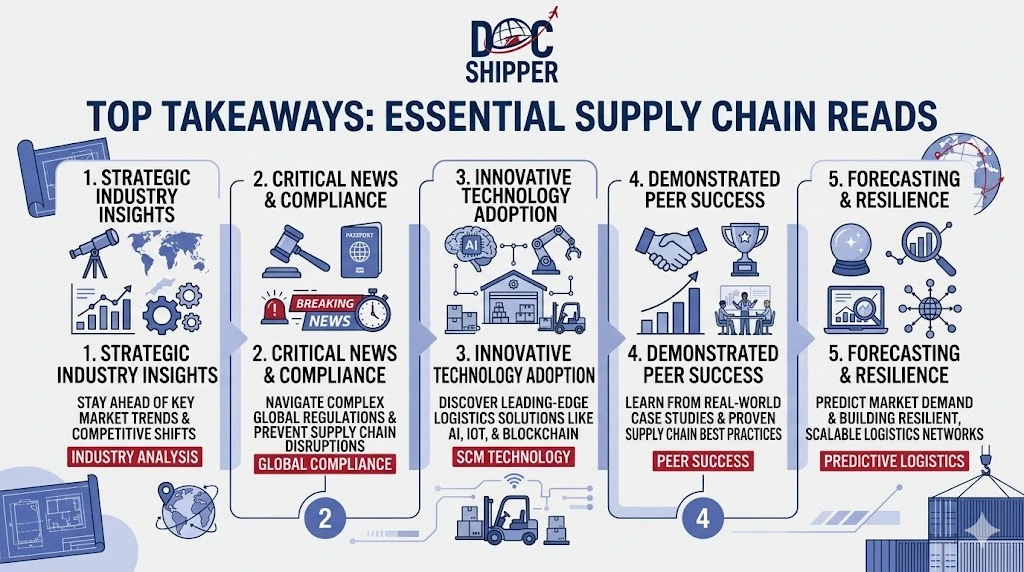
Let’s summarize the key takeaways:
- Digital platforms like Supply Chain Dive provide fast, disruption-focused insights
- Specialized blogs deliver tactical frameworks you can apply immediately
- Institutional sources like ASCM reinforce structured, certification-aligned knowledge
- Operational resources, including ours at DocShipper, help you execute sourcing and global logistics correctly
- Actionable reading habits transform information into measurable supply chain improvements
If you stay consistent, selective, and analytical in how you consume content, you won’t just follow trends. You’ll anticipate them.
FAQ | Best supply chain magazines to stay ahead of logistics and operations trends
Treat your reading list like a supplier base: curated and limited. You can do this in a structured way:
- Cap your active list to 3–5 sources: e.g., 2 strategy-focused, 2 operations-focused, 1 niche (sector or mode).
- Create “reading roles”: one source for macro trends, one for transportation, one for tech, one for your sector.
- Set a fixed weekly timebox (e.g., 30–45 minutes) and stick to it. If an article doesn’t relate to a current project, archive it.
- Use rules:
- “If it doesn’t impact cost, service, or risk in the next 12 months, I skip it.”
- “If two different magazines mention the same issue, I flag it as a trend.”
- Review your list every quarter and drop titles that didn’t trigger any concrete decisions or changes.
You don’t need an in‑house “research team” to use these resources effectively. Focus on leverage, not volume:
- Assign one “content champion” (often the ops or logistics manager) to skim 2–3 key sources weekly.
- Ask them to share only:
- 1–2 bullet points on what’s changing (rates, regulations, capacity, lead times).
- 1 specific recommended action (e.g., “quote an extra LCL option for Q4”).
- Use a simple monthly ritual:
- List 3 articles that mattered.
- Write 1 sentence per article: “What we changed because of this.”
- Repurpose insights into SOPs: if a magazine highlights a recurring risk (e.g., port disruption), add a small contingency step into your purchasing or booking process.
- If you work with a forwarder or sourcing partner, send them 1–2 links and ask, “Does this apply to us?” and “What would you do differently?”
The biggest errors aren’t about what you read, but how you react:
To avoid this:
- Overreacting to a single article: changing suppliers or networks based on one opinion piece without checking your own data.
- Confusing thought leadership with your reality: copying a case study from a Fortune 500 while you run a mid‑size, low-volume operation.
- Ignoring lead time to implement: reading about automation or AI and underestimating integration, training, and change‑management effort.
- Treating sponsored content as neutral advice: not checking whether an “expert insight” is actually a vendor pitch.
- Always ask, “What’s different between this case and our context?”
- Validate big moves (new lane, new provider, new tech) against your current KPIs and constraints.
- Cross‑check critical claims across at least two independent publications.
Trends worth acting on usually show both repeated coverage and local impact signals:
If the data from your tests confirms the external narrative, then scale your response.
- Look for repetition: the same topic (e.g., capacity tightening on a specific trade lane) showing up in 2–3 unrelated magazines over several weeks.
- Check if the trend touches your key variables:
- Cost (rates, surcharges, duties)
- Service (lead times, OTIF, reliability)
- Compliance (new rules, documentation, product controls)
- Confirm with your partners: ask your freight forwarder, 3PL, or key suppliers, “Are you seeing this? How is it affecting your operations?”
- Start small:
- Add buffers (inventory or lead time) on one product or lane.
- Test an alternative route, carrier, or mode on a small portion of volume.
Industry content is powerful ammunition if you structure it:
- Use benchmarks: when an article cites typical lead times, on‑time performance, or rate ranges, use those numbers as a sanity check against your current deals.
- Prepare negotiation briefs:
- Attach 1–2 short articles or charts to your RFP or quarterly review.
- Highlight 2–3 data points that support your ask (e.g., “industry claims accessorial transparency as standard”).
- Translate insights into questions:
- “How are you planning for [X congestion or regulation] we’re seeing reported?”
- “What are other shippers doing in response to [rate trend or service issue]?”
- Anchor terms in external reality: if a magazine shows declining spot rates or new service offerings, use that to justify re‑benchmarking or adding performance clauses.
Think 70/30, then adjust by risk:
- General (around 70% of your reading): use these to track:
- Macro risks (geopolitics, major port issues, regulatory shifts)
- Big technology shifts (visibility platforms, automation waves)
- Broad best practices (S&OP, network design, resilience)
- Niche (around 30%): pick 1–2 titles that align with your biggest exposure:
- By mode: trucking, ocean, air, warehousing.
- By sector: food, pharma, retail, industrials.
- By geography: Asia sourcing, EU regulations, US transport policy.
- If your business is highly regulated or temperature‑sensitive (e.g., pharma, food), invert the ratio: 60–70% niche, 30–40% general.
- Revisit this split yearly as your product mix, sourcing footprint, or primary bottlenecks change.
Need Help with
Logistics or Sourcing ?
First, we secure the right products from the right suppliers at the right price by managing the sourcing process from start to finish. Then, we simplify your shipping experience - from pickup to final delivery - ensuring any product, anywhere, is delivered at highly competitive prices.


Fill the Form
Prefer email? Send us your inquiry, and we’ll get back to you as soon as possible.
Contact us