Understanding the ETS 100% coverage impact on voyages to and from the EU
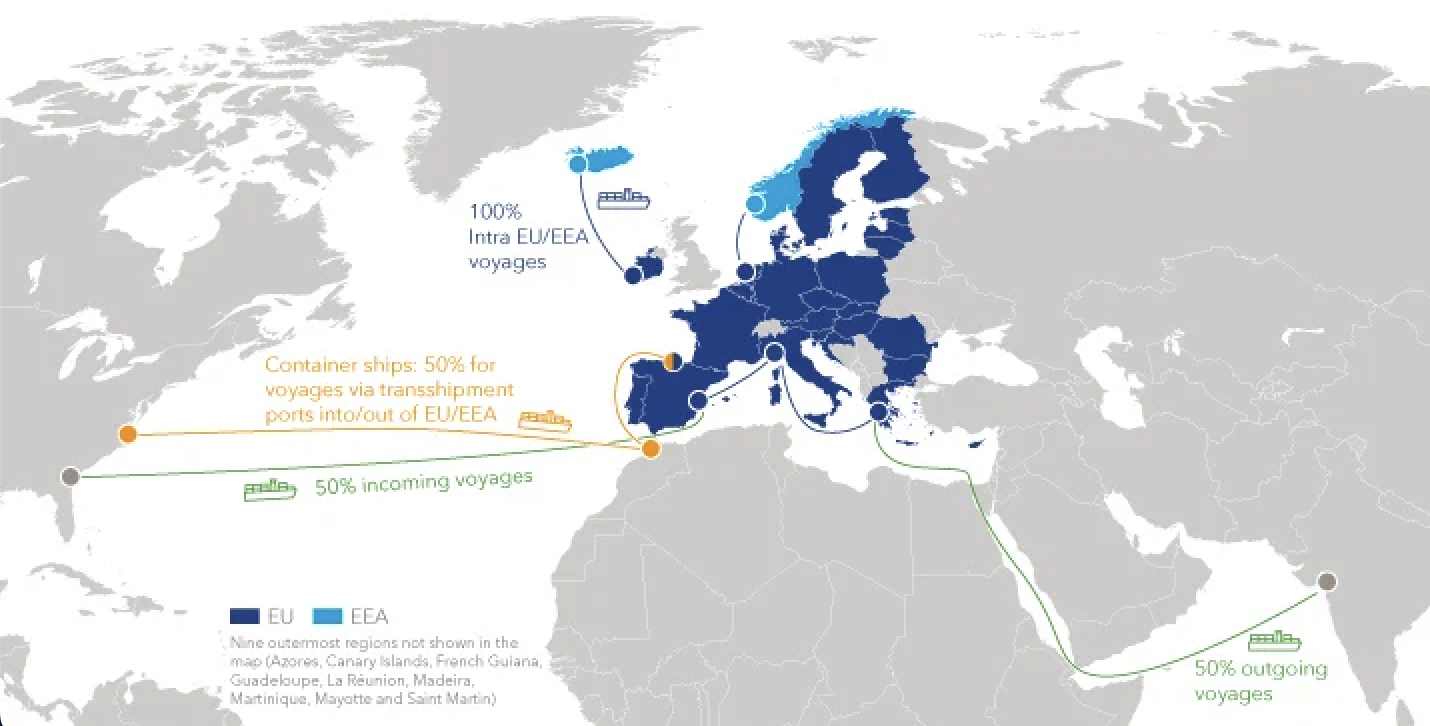
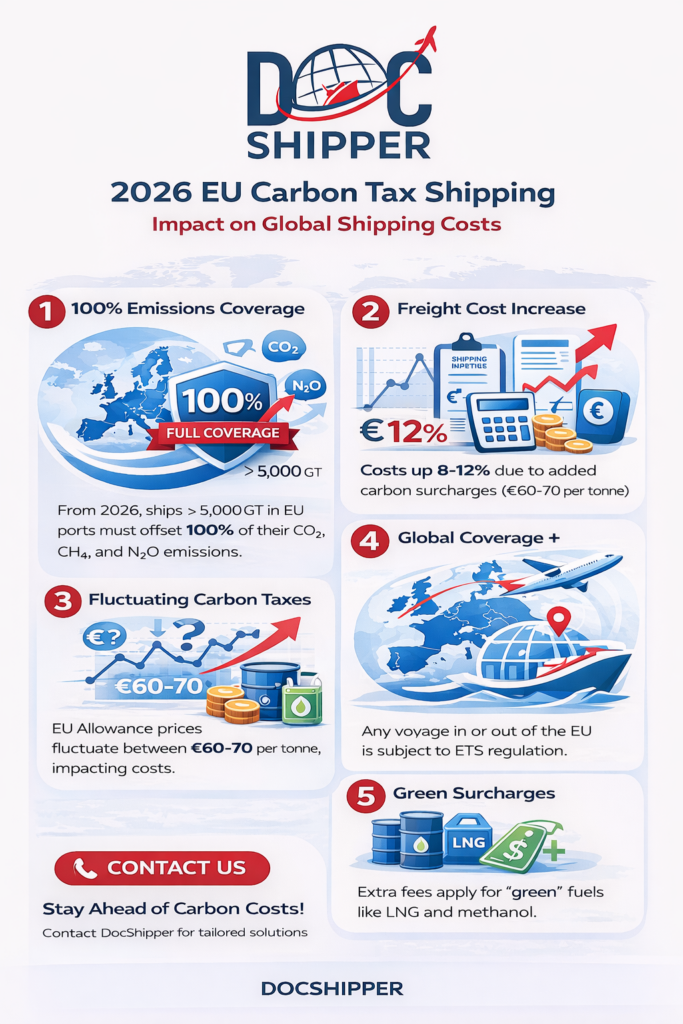
The integration of maritime shipping into the EU ETS followed a phased schedule: 40% in 2024, 70% in 2025, and 100% from 2026 onwards. This graduated approach gave shipowners time to adapt, but 2026 marks the end of that grace period. From now on, every voyage touching a European port, whether in the North Sea, the Mediterranean, or the Baltic, is fully subject to carbon allowance obligations.
For shippers (importers and exporters), this translates directly into a new line item on every freight invoice: the EU ETS maritime surcharge 2026. This surcharge varies based on the fuel type used, the distance sailed, and the market price of EUAs, which hovered around €60–€70 per tonne in early 2025.
2024 40% ETS Coverage | 2025 70% ETS Coverage | 2026 100% ETS Coverage |
How EU ETS maritime surcharges 2026 Affect Your Invoices
Carbon costs are no longer abstract figures buried in carrier reports, they now appear as concrete line items on your freight invoices. This section breaks down exactly where these charges come from, how they are calculated, and what to watch out for in every quotation you receive.
Breaking down the 12% increase in total carbon emission costs shipping
According to estimates from leading maritime research institutions (including Bureau Veritas and UNCTAD), the average impact of the 2026 EU Carbon Tax shipping represents an increase of 8 to 12% on total freight costs for Europe-Asia and Europe-North America trade lanes. This increase stems from several components:
- Direct EUA cost: calculated on the vessel’s actual emissions multiplied by the spot EUA price (variable, between €50 and €80/tonne in 2025).
- Administration and compliance fees: shipowners pass through their internal MRV (Monitoring, Reporting, Verification) costs.
- Risk margin: related to EUA price volatility and regulatory uncertainty.
On a Shanghai–Rotterdam route, for example, the carbon surcharge can reach $150 to $300 per TEU depending on the vessel class and its energy efficiency rating.
Sample Freight Invoice Breakdown — 2026 vs 2025
Cost Item | 2025 (70%) | 2026 (100%) |
Ocean Freight (Base Rate) | $1,800 | $1,800 |
Bunker Adjustment Factor (BAF) | $200 | $200 |
EU ETS Carbon Surcharge | $105 | $150 |
Port & Handling Fees | $120 | $120 |
TOTAL per TEU | $2,225 | $2,270 |
Managing volatility: How EUA prices 2026 fluctuate on your bill of lading

The EUA prices 2026 (European Union Allowances) are traded on the EEX (European Energy Exchange) and fluctuate according to climate policy decisions, energy price movements, and macroeconomic conditions.
Between 2021 and 2024, the EUA price surged from €25 to over €100/tonne before stabilizing between €60 and €75 in early 2025.
This volatility has a direct impact on your carbon emission costs shipping. Some shipowners offer fixed quarterly surcharges, while others apply floating surcharges indexed to the EUA spot rate at the time of Bill of Lading issuance. Understanding this mechanism is critical to avoid billing surprises.
Fuel adjustments and “Green Levies”: What to look for in 2026 EU Carbon Tax shipping quotes
In 2026, freight quotations often include several green-related cost components:
- BAF (Bunker Adjustment Factor): reflects fuel costs, including alternative fuels such as green methanol, ammonia, and LNG.
- ETS Surcharge: the specific EU ETS charge, sometimes labeled ‘Carbon Levy’ or ‘Green Levy’ on invoices.
- FuelEU Maritime Compliance Fee: from 2025, shipowners must meet carbon intensity reduction targets; penalties are passed on to shippers.
DocShipper recommends its clients always request a line-by-line itemized quotation, explicitly listing each green component. This enables proper invoice auditing and carrier benchmarking.
Enhance efficiency, cut costs, and gain 24/7 visibility  over your entire supply chain.
- Cut your shipping costs and maximize your margins
- Manage sourcing, freight, & customs on one platform
- Get real-time tracking and analytics
Strategies to Mitigate carbon emission costs shipping

Higher carbon costs don’t have to mean a higher freight bill, if you know where to act. From smarter route planning to sharper contract negotiations, there are proven levers that importers and exporters can pull right now to protect their margins.
Route optimization: Avoiding high-tax “transshipment” hubs
Not all transshipment hubs generate the same ETS obligations. Voyages between two non-EU ports are not covered. However, every call at an EU port triggers the coverage requirement. Certain itineraries via non-EU hubs (such as Tanger Med in Morocco or Port Said in Egypt) can reduce the number of European port calls subject to ETS, thereby lowering EU ETS maritime surcharges 2026.
This strategy must nonetheless be assessed case by case: additional transit times and extra handling costs may offset the carbon savings achieved. A cost/benefit analysis by route is essential before committing to alternative itineraries.
Negotiating “All-in” rates vs. floating EU ETS maritime surcharges 2026

Two contractual approaches currently coexist in the market:
- All-in rate: the shipper pays a fixed price covering all surcharges. Advantage: budget predictability. Disadvantage: if EUA prices 2026 drop, you don’t benefit from the decrease.
- Rate with floating ETS surcharge: the shipper bears real-time carbon market volatility. Advantage: potential savings if EUAs fall. Disadvantage: exposure to upside risk.
For high-volume shippers, negotiating an EUA price cap corridor with the carrier can offer the optimal compromise between cost certainty and market opportunity.
Future Outlook: Green Shipping Compliance Beyond 2026
The 2026 milestone is significant, but it is only one chapter in a much longer story. The decarbonization of global shipping is accelerating, and the businesses that look beyond today’s surcharges will be the ones best positioned for the decade ahead.
The transition to zero-emission vessels and long-term cost benefits

The 2026 EU Carbon Tax shipping is not an end in itself, it is the beginning of a structural transformation of the global maritime sector. The IMO (International Maritime Organization) targets a 50% reduction in shipping GHG emissions by 2050, while the EU aims for full maritime carbon neutrality by 2040 through the FuelEU Maritime strategy.
Shipowners who invest now in alternative propulsion technologies, green methanol, ammonia, hydrogen, and battery-electric systems, will benefit from a durable competitive advantage. These vessels, exempt from or lightly taxed under ETS, will ultimately offer more competitive freight rates than their fossil-fuel counterparts, reversing today’s carbon cost premium over the medium term.
How 2026 EU Carbon Tax shipping sets the standard for global trade
The EU is leading the way, but other regions are following suit. The United Kingdom has announced the integration of maritime shipping into its own ETS for 2026. The United States and China are watching closely. In this context, companies that build a carbon strategy into their supply chain today will be best positioned when these regulations go global.
DocShipper supports its clients through this transition with carbon footprint reporting tools, green carrier selection advisory, and ongoing regulatory monitoring.
Conclusion
The 2026 EU Carbon Tax on shipping signals a permanent shift in maritime trade. With full ETS coverage, new emissions included, and volatile EUA prices, unprepared companies face rising costs and compliance risks.
Businesses that embed carbon strategy into logistics today, through optimized routes, greener carriers, and smarter ETS surcharge management, will stay competitive.
DocShipper audits invoices, optimizes shipping choices, and ensures full transparency on carbon surcharges, so you don’t have to navigate the complexity alone.


Fill the Form
Prefer email? Send us your inquiry, and we’ll get back to you as soon as possible.
Contact us