


In short ⚡
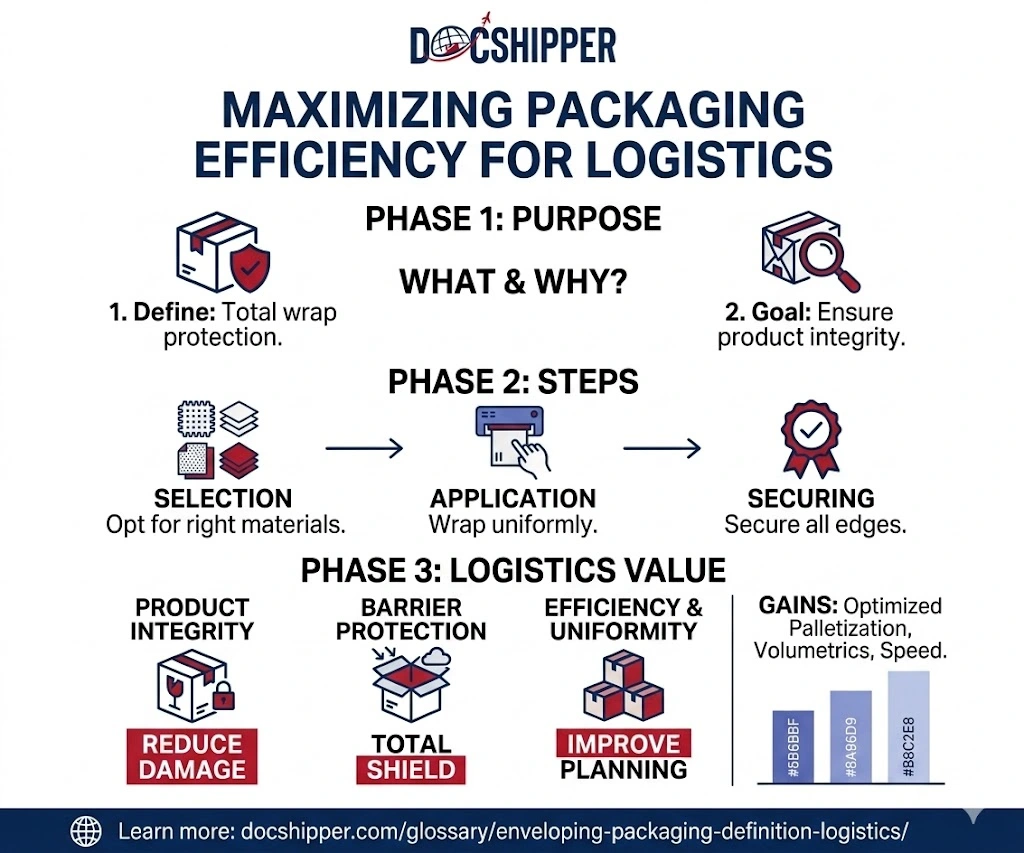
Enveloping is a packaging technique that consists of wrapping goods or cargo units in a protective material (film, paper, fabric) to secure, consolidate, and protect them during storage and transport. This method ensures load stability while preventing damage from external elements such as dust, moisture, or impacts.Introduction
In international trade, cargo damage during transit represents a major financial risk. Many importers underestimate the importance of proper load protection, leading to claims that can reach 15-20% of shipment value. Enveloping addresses this challenge by creating a physical barrier around goods.
This packaging method is essential in the logistics chain for several strategic reasons:
- Physical protection: Shield against scratches, shocks, and environmental contamination
- Load unitization: Groups multiple items into stable handling units
- Tamper evidence: Reveals unauthorized opening attempts
- Regulatory compliance: Meets international packaging standards (ISPM-15, IATA regulations)
- Cost optimization: Reduces secondary packaging needs and handling time
From pallet wrapping in warehouses to shrink-wrapping machinery for ocean freight, enveloping techniques vary according to cargo type, destination, and transport mode. Understanding these variations is crucial for choosing the right protection method.
Technical Deepening & Expertise
Enveloping encompasses several distinct methodologies, each responding to specific logistical constraints. The selection depends on cargo characteristics, handling requirements, and environmental exposure during transit.
Stretch wrapping involves applying stretchable plastic film around palletized goods. The film’s elasticity creates containment force that stabilizes the load. Pre-stretch ratios typically range from 200% to 300%, meaning the film extends two to three times its original length. This technique dominates warehouse operations due to its speed and cost-effectiveness.
Shrink wrapping uses heat-activated polymer films that contract tightly around products when exposed to elevated temperatures. This method creates a hermetic seal ideal for moisture-sensitive goods. According to Packaging Digest, shrink wrapping reduces contamination risks by up to 98% compared to open packaging.
VCI enveloping (Vapor Corrosion Inhibitor) integrates chemical protection within the wrapping material. The film releases volatile molecules that form a protective molecular layer on metal surfaces, preventing oxidation. This technique is mandatory for maritime shipments of steel components or machinery.
Controlled atmosphere enveloping replaces oxygen inside the wrap with inert gases (nitrogen, CO2). This technique extends shelf life for perishable goods and prevents oxidation in reactive materials. Food-grade applications must comply with FDA regulations for modified atmosphere packaging.
At DocShipper, we systematically assess cargo vulnerability before recommending enveloping solutions. Our quality control teams verify film thickness (measured in gauge or microns), puncture resistance, and UV stability for outdoor storage scenarios. This preventive approach eliminates 90% of transit damage claims for our clients.
Material selection involves critical trade-offs. Linear low-density polyethylene (LLDPE) offers superior puncture resistance but less cling compared to low-density polyethylene (LDPE). For heavy industrial goods exceeding 1,000 kg per pallet, we specify reinforced films with minimum 80-gauge thickness combined with edge protectors.
Concrete Examples & Data
Real-world applications demonstrate how enveloping methodology directly impacts supply chain efficiency and cost structures. The following scenarios illustrate decision-making factors across different cargo categories.
Case Study 1: Electronics Manufacturing
A French importer receiving LCD panels from South Korea faced 12% damage rates using standard cardboard boxing. By implementing anti-static shrink wrapping with desiccant integration, damage dropped to 0.8%. The enveloping cost represented €2.40 per unit compared to €180 average claim value per damaged panel. ROI achieved within three shipments.
Case Study 2: Automotive Parts Export
A Spanish manufacturer shipping engine blocks to Mexico switched from wooden crating to VCI stretch wrapping combined with pallet strapping. This reduced packaging weight by 65%, lowering air freight costs by €8,500 per container. The VCI film prevented rust formation during 45-day ocean transit despite 85% humidity exposure.
| Enveloping Method | Ideal Application | Cost per Unit | Protection Level |
|---|---|---|---|
| Manual Stretch Wrap | Small loads, irregular shapes | €1.20 – €2.50 | Moderate (dust, light impacts) |
| Machine Stretch Wrap | Standardized pallets, high volume | €0.40 – €0.90 | High (secure unitization) |
| Shrink Wrap | Hermetic sealing, retail display | €2.80 – €5.20 | Very high (moisture barrier) |
| VCI Enveloping | Metal parts, maritime shipments | €4.50 – €8.00 | Maximum (corrosion prevention) |
| Biodegradable Film | Eco-conscious brands, EU markets | €3.20 – €6.50 | Moderate to high |
Quantitative Impact Analysis:
- Proper enveloping reduces product returns by 78% in e-commerce logistics
- Automated stretch wrapping machines process 120-150 pallets/hour versus 15-20 manually
- UV-resistant films extend outdoor storage viability from 3 weeks to 6 months
- Multi-layer enveloping systems can withstand -40°C to +60°C temperature ranges
- Theft deterrence increases by 65% with opaque wrapping versus clear films
Industry data from the International Safe Transit Association shows that 42% of cargo damage occurs during the last-mile delivery phase. Enveloping provides critical protection during this vulnerable stage, particularly for goods transferred between multiple carriers.
Conclusion
Enveloping represents a fundamental cargo protection strategy in modern logistics, balancing cost efficiency with damage prevention. Selecting the appropriate method requires analyzing cargo characteristics, transit conditions, and regulatory requirements.
Need expert guidance on packaging solutions for your shipments? Contact DocShipper for customized enveloping recommendations that protect your cargo and optimize logistics costs.
📚 Quiz
Test Your Knowledge: Enveloping
What is the primary definition of enveloping in logistics?
Which statement correctly describes the difference between stretch wrapping and shrink wrapping?
A manufacturer is shipping metal engine components via ocean freight for 45 days in high humidity conditions. Which enveloping method should they choose?
🎯 Your Result
📞 Free Quote in 24hFAQ | Enveloping: Definition, Applications & Concrete Examples in Logistics
While both terms describe cargo covering processes, "enveloping" specifically refers to complete enclosure within protective material, creating a sealed environment. "Wrapping" is broader and includes partial coverage methods. Enveloping always involves full containment, whereas wrapping may leave portions exposed. In technical documentation, enveloping implies hermetic or near-hermetic sealing, critical for moisture-sensitive or contamination-prone goods.
Film thickness selection depends on three factors: load weight, shipment distance, and handling intensity. Standard guidelines recommend 60-80 gauge (15-20 microns) for loads under 500 kg with minimal handling, 80-100 gauge for 500-1000 kg with moderate handling, and 100-120 gauge for heavy industrial goods exceeding 1000 kg or international shipments with multiple transfers. Sharp edges or protruding components require additional 20% thickness margin. Always conduct drop tests before finalizing specifications.
No universal mandate exists, but specific scenarios require enveloping. ISPM-15 regulations for wooden packaging often necessitate protective wrapping to prevent pest contamination. Hazardous materials (IMDG, IATA classifications) frequently require sealed enveloping to contain potential leaks. Certain destination countries impose fumigation or treatment requirements that enveloping facilitates. Customs authorities may inspect inadequately protected cargo more rigorously, causing delays. Insurance policies often stipulate minimum packaging standards that enveloping fulfills.
Modern biodegradable films (PLA, PHA-based) now achieve 85-90% of conventional polyethylene performance in puncture resistance and tensile strength. However, limitations exist: biodegradable options typically degrade faster under UV exposure (3-6 months versus 12-18 months), offer less moisture barrier for extended storage, and cost 40-60% more per square meter. They excel in short-cycle supply chains with controlled environments. For maritime shipments exceeding 30 days or extreme temperature exposure, traditional films remain superior. EU regulations increasingly favor biodegradable options despite higher costs.
Manual stretch wrapping averages 4-6 minutes per pallet with labor costs of €2.50-€4.00 per unit (based on European wage standards). Automated systems reduce this to 45-90 seconds with labor costs under €0.60 per unit. Initial investment for semi-automatic wrappers ranges €8,000-€15,000, while fully automated inline systems cost €35,000-€80,000. Break-even typically occurs at 40-60 pallets daily for semi-automatic and 150+ pallets for fully automated systems. Automated enveloping also provides consistent film tension, reducing material waste by 20-30%.
Polyethylene films exhibit temperature-dependent characteristics. Below 0°C, films become brittle, reducing puncture resistance by 40-50% and increasing tear risk. Above 45°C, adhesion properties degrade, causing premature unwrapping. Specialized formulations exist: cold-storage films maintain flexibility down to -30°C, while heat-resistant variants withstand 70°C. For multi-climate shipments (e.g., refrigerated containers in tropical ports), hybrid films with stabilizers are essential. Always verify manufacturer specifications against anticipated temperature ranges throughout the supply chain journey.
Standard documentation includes: material safety data sheet (MSDS) for the enveloping film, especially if containing VCI or chemical additives; packing declaration specifying enveloping method and materials used; compliance certificates for biodegradable or recycled content films if claiming environmental preferences; fumigation certificates when enveloping serves as pest barrier; and photographic evidence of pre-enveloping cargo condition for insurance purposes. Some countries require translated documentation. DocShipper prepares comprehensive customs documentation packages to prevent clearance delays related to packaging materials.
Enveloping alone rarely substitutes structural crating but serves as complementary protection. For machinery weighing under 500 kg with stable geometry, reinforced enveloping combined with foam edge protection and pallet mounting can replace crating, reducing costs by 60-70%. Heavier equipment requires hybrid approaches: steel frames or skid bases for structural support, supplemented by VCI enveloping for corrosion prevention and shrink-wrap for contamination barriers. The decision depends on handling method (forklift versus crane), transit mode (air versus ocean), and destination infrastructure. Engineering assessments prevent inadequate protection choices.
Post-consumer stretch film recycling programs exist in most developed markets. Clean, dry polyethylene films can be recycled through specialized facilities that process them into pellets for new products. Contaminated films (oil, chemicals) require hazardous waste protocols. VCI films often contain additives preventing standard recycling and need separate disposal channels. Biodegradable films should be composted in industrial facilities, not landfilled. EU Directive 2018/852 mandates extended producer responsibility for packaging waste. Many logistics providers, including DocShipper, offer take-back programs ensuring compliant disposal and circular economy integration.
Marine cargo insurance policies (ICC A, B, C clauses) typically require "proper packaging" as a coverage prerequisite. Inadequate enveloping can lead to claim denials under exclusions for "insufficiency of packing." If damage results from inappropriate packaging rather than insured perils, insurers may reject liability entirely or apply substantial deductibles (often 20-40% of claim value). Pre-shipment surveys documenting enveloping quality serve as evidence. Some insurers offer premium discounts (5-15%) for certified packaging protocols. Always review policy conditions with your provider before finalizing enveloping specifications to ensure full coverage.
Hermetic enveloping creates a microenvironment where moisture management becomes critical. Without intervention, condensation forms inside wraps due to temperature fluctuations, promoting corrosion and mold. Solutions include: integrating desiccant sachets (silica gel, clay) inside the envelope before sealing, absorbing moisture to maintain 40-50% relative humidity; using barrier films with low moisture vapor transmission rates (MVTR under 1.0 g/m²/24hr); incorporating one-way moisture membranes allowing internal humidity escape while blocking external moisture; and VCI films providing both corrosion inhibition and moderate moisture buffering. For long-distance ocean freight, multi-layered approaches combining these methods yield optimal results.
Systematic quality assurance includes: visual inspection for complete coverage with no exposed areas; tactile verification of film tension (proper stretch creates firm resistance without deformation); edge examination ensuring film extends below pallet base to prevent forklift damage; corner integrity checks where tearing most commonly initiates; seal verification for shrink-wrapped loads confirming hermetic closure; and random destructive testing on sample wraps measuring puncture force and tear propagation. Automated systems should undergo daily calibration checks on film tension settings and wrap cycle parameters. Documentation of quality checks provides traceability and continuous improvement data for optimizing enveloping procedures.
Need Help with
Logistics or Sourcing ?
First, we secure the right products from the right suppliers at the right price by managing the sourcing process from start to finish. Then, we simplify your shipping experience - from pickup to final delivery - ensuring any product, anywhere, is delivered at highly competitive prices.


Fill the Form
Prefer email? Send us your inquiry, and we’ll get back to you as soon as possible.
Contact us




