


In short ⚡
The Export Rate is a key economic indicator measuring the proportion of a country's or company's production that is sold to foreign markets. It reflects international competitiveness, trade balance dynamics, and strategic positioning in global supply chains. Understanding export rates is essential for logistics planning and market expansion decisions.
Introduction
Many businesses struggle to evaluate their international market performance without understanding export rate metrics. This confusion leads to poor strategic decisions and missed opportunities in cross-border trade.
The export rate serves as a fundamental barometer for assessing how effectively companies penetrate foreign markets. For freight forwarders and exporters, this metric directly impacts logistics planning, inventory management, and customs strategy.
Key characteristics of export rates include:
- Measurement flexibility: Can be calculated at national, industry, or company level
- Economic indicator: Reflects trade competitiveness and currency impact
- Strategic tool: Guides market expansion and resource allocation decisions
- Temporal variation: Changes based on seasonal demand, regulations, and economic cycles
- Sector specificity: Varies significantly across industries and product categories
In-Depth Analysis & Expertise
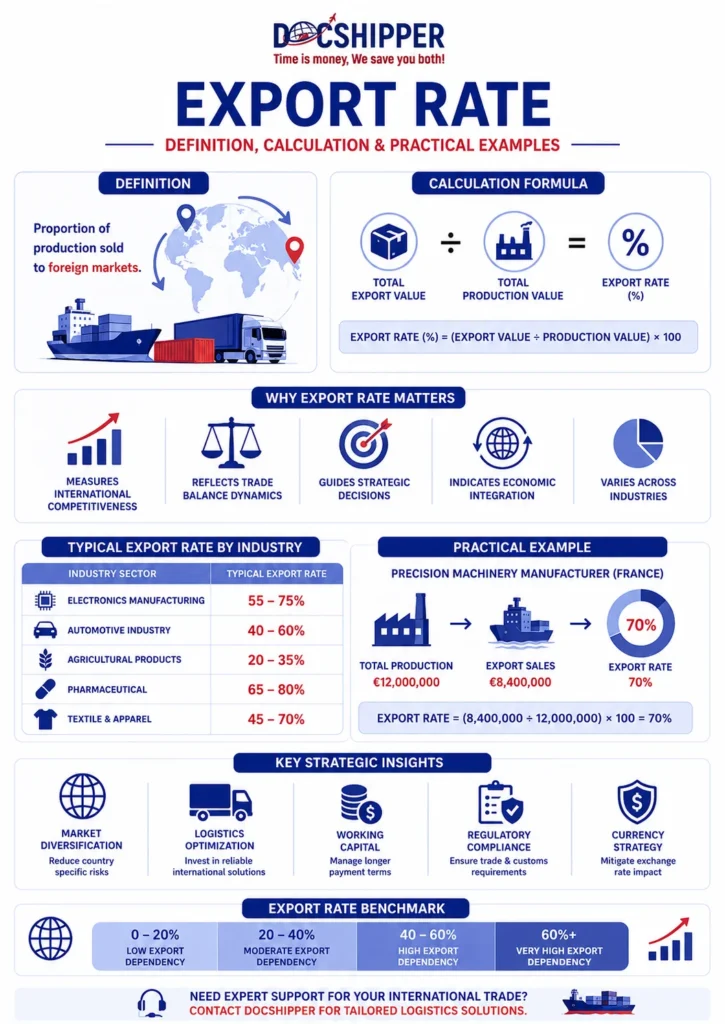
The export rate calculation involves dividing total export value by total production value, then multiplying by 100 to obtain a percentage. This simple formula reveals complex market dynamics and competitive positioning.
National-level calculations aggregate all exported goods and services as a percentage of GDP. The World Trade Organization monitors these figures to assess global trade patterns and economic integration. Countries with export rates exceeding 40% typically demonstrate high trade dependency.
Company-level metrics focus on individual business performance in international markets. A manufacturing firm exporting 60% of production demonstrates strong foreign market penetration. This metric influences financing decisions, currency hedging strategies, and supply chain optimization.
Regulatory implications vary by jurisdiction. Export rates above certain thresholds may trigger government incentives, tax benefits, or compliance requirements. The European Union’s customs regulations, detailed at European Commission Taxation and Customs Union, outline reporting obligations for exporters.
Currency volatility directly impacts export rates. When domestic currency depreciates, exported goods become more competitive internationally, potentially increasing the export rate. Conversely, currency appreciation may reduce export competitiveness and lower the rate.
Logistics considerations become critical as export rates increase. At DocShipper, we help businesses optimize their international shipping strategies when export volumes represent significant production shares, ensuring cost-effective freight solutions and compliant documentation processes.
Practical Examples & Data
Understanding export rates through real-world scenarios helps businesses benchmark their international performance and identify growth opportunities.
Comparative Analysis by Industry
| Industry Sector | Typical Export Rate | Key Drivers |
|---|---|---|
| Electronics Manufacturing | 55-75% | Global supply chains, specialized components |
| Automotive Industry | 40-60% | Regional production hubs, trade agreements |
| Agricultural Products | 20-35% | Local consumption priority, perishability |
| Pharmaceutical | 65-80% | Regulatory approvals, patent protection |
| Textile & Apparel | 45-70% | Labor cost arbitrage, fashion markets |
Use Case: Manufacturing Company Analysis
A French precision machinery manufacturer produces €12 million annually in total output. Their international sales reach €8.4 million, yielding an export rate of 70%.
Calculation breakdown:
- Total production value: €12,000,000
- Export sales value: €8,400,000
- Export rate formula: (8,400,000 / 12,000,000) × 100 = 70%
This 70% export rate indicates strong international dependence. The company must prioritize currency hedging, maintain robust international logistics partnerships, and closely monitor trade regulations affecting their key markets.
Key Strategic Insights
- Market diversification: Companies with export rates above 50% should target multiple regions to reduce country-specific risks
- Logistics optimization: High export rates justify investments in dedicated international freight solutions and customs expertise
- Working capital: Extended international payment terms typically associated with exports require stronger cash flow management
- Regulatory compliance: Export-dependent businesses need dedicated trade compliance teams or external specialists
- Currency strategy: Fluctuations of just 5% can significantly impact profitability when export rates exceed 40%
At DocShipper, we assist companies across all export rate thresholds by providing comprehensive logistics solutions, from documentation management to freight optimization, ensuring your international operations remain efficient regardless of export volume fluctuations.
Conclusion
Export rates serve as essential strategic indicators for businesses navigating international markets. Understanding and monitoring this metric enables better logistics planning, risk management, and market expansion decisions.
Need expert support managing your international shipments and documentation? Contact DocShipper for tailored logistics solutions.
📚 Quiz
Test Your Knowledge: Export Rate
What does the export rate fundamentally measure?
A company produces €10 million worth of goods annually and exports €7 million. What is a common misconception about this 70% export rate?
Your electronics manufacturing client has an export rate of 65% and faces a 10% domestic currency appreciation. What strategic recommendation is most appropriate?
🎯 Your Result
📞 Free Custom QuoteFAQ | Export Rate: Definition, Calculation & Practical Examples
A healthy export rate varies by industry, but typically ranges between 30-60% for manufacturers. Rates below 20% may indicate limited international competitiveness, while rates above 70% suggest high dependency on foreign markets with associated currency and geopolitical risks. The optimal rate depends on company size, industry sector, and strategic objectives.
Export rate measures the proportion of production sold internationally at a specific moment, while export growth rate tracks the percentage change in export volume or value over time. A company might maintain a stable 50% export rate while experiencing 10% annual export growth, indicating both consistent international presence and expanding foreign sales.
Yes, service companies calculate export rates by measuring revenue from foreign clients as a percentage of total revenue. Consulting firms, software companies, and professional services track this metric to assess international market penetration. The calculation methodology remains identical, though service exports face different regulatory frameworks than goods.
Export rates fluctuate due to currency valuation changes, new trade agreements or tariffs, shifts in domestic demand, production capacity modifications, or changes in competitive positioning. Economic crises, political instability, or regulatory changes in key markets can trigger rapid export rate variations. Companies should monitor these factors continuously.
Trade agreements typically increase export rates by reducing tariffs, simplifying customs procedures, and eliminating non-tariff barriers. When new agreements take effect, companies often see export rate increases of 10-25% within two years. Free trade agreements particularly benefit industries with previously high tariff barriers or complex compliance requirements.
Startups should prioritize sustainable growth over high export rates initially. Building domestic market presence provides revenue stability and operational experience. Once established, gradual international expansion allows testing foreign markets without overextending resources. A 15-25% export rate represents reasonable early-stage internationalization for most startups.
Lenders and investors scrutinize export rates when evaluating business risk. High export rates demonstrate international competitiveness but introduce currency and geopolitical risks. Companies with 60%+ export rates may face stricter financing terms or requirements for currency hedging strategies. Conversely, moderate export rates (30-50%) often attract favorable investment terms by balancing growth potential with market diversification.
Accurate export rate tracking requires customs declarations, commercial invoices, shipping documents, and accounting records distinguishing domestic from international sales. Companies need ERP systems capable of segregating revenue by destination country. Monthly reconciliation of sales data against customs filings ensures accuracy and compliance with tax and trade reporting requirements.
E-commerce complicates export rate calculations through direct-to-consumer international sales, marketplace transactions, and dropshipping arrangements. Digital businesses must track cross-border revenue carefully, as small-value shipments may not require traditional export documentation. Companies selling through international platforms should implement systems capturing transaction origin and destination data for accurate export rate measurement.
Export rates serve as leading indicators when analyzed alongside market trends and economic forecasts. Rising export rates during domestic economic slowdowns demonstrate resilience and diversification. However, rates should be evaluated with profit margins, customer concentration, and market stability. An increasing export rate with declining margins may signal unsustainable pricing strategies.
Companies with export rates exceeding 40% should implement systematic currency hedging strategies to protect profit margins. Forward contracts, options, and natural hedging through foreign currency expenses help mitigate exchange rate volatility. A 10% currency movement can eliminate profits entirely for businesses with thin margins and high export dependence, making hedging essential risk management.
Seasonal businesses calculate annualized export rates to smooth quarterly variations and identify true international dependence. Agricultural exporters, fashion companies, and tourism-related services experience dramatic monthly fluctuations. Rolling 12-month averages provide more meaningful metrics than quarterly snapshots. Strategic planning should account for peak season export capacity and off-season domestic market development.
Need Help with
Logistics or Sourcing ?
First, we secure the right products from the right suppliers at the right price by managing the sourcing process from start to finish. Then, we simplify your shipping experience - from pickup to final delivery - ensuring any product, anywhere, is delivered at highly competitive prices.


Fill the Form
Prefer email? Send us your inquiry, and we’ll get back to you as soon as possible.
Contact us




