


In short ⚡
Economy of scale refers to the cost advantage that businesses gain when production increases, resulting in a lower per-unit cost. As output volume rises, fixed costs are spread across more units, and operational efficiencies reduce variable costs, creating significant competitive advantages in international logistics and supply chain management.
Introduction
Many importers struggle to understand why their shipping costs per unit remain high compared to competitors. The answer often lies in volume economics.
In international trade, economy of scale directly impacts profit margins. Whether consolidating shipments or negotiating freight rates, volume creates leverage that small-scale operations cannot achieve alone.
Key characteristics include:
- Fixed cost distribution: Warehouse rent, licensing fees, and administrative overhead spread across more units
- Bulk purchasing power: Suppliers offer discounts for larger orders, reducing material costs
- Operational efficiency: Streamlined processes and specialized labor reduce per-unit handling time
- Transportation optimization: Full container loads (FCL) cost significantly less per unit than less-than-container loads (LCL)
- Negotiation leverage: Higher volumes strengthen bargaining position with carriers and service providers
Understanding Economies of Scale in Logistics
Economy of scale operates through two fundamental mechanisms: internal economies and external economies. Internal economies result from company-specific growth, while external economies stem from industry expansion.
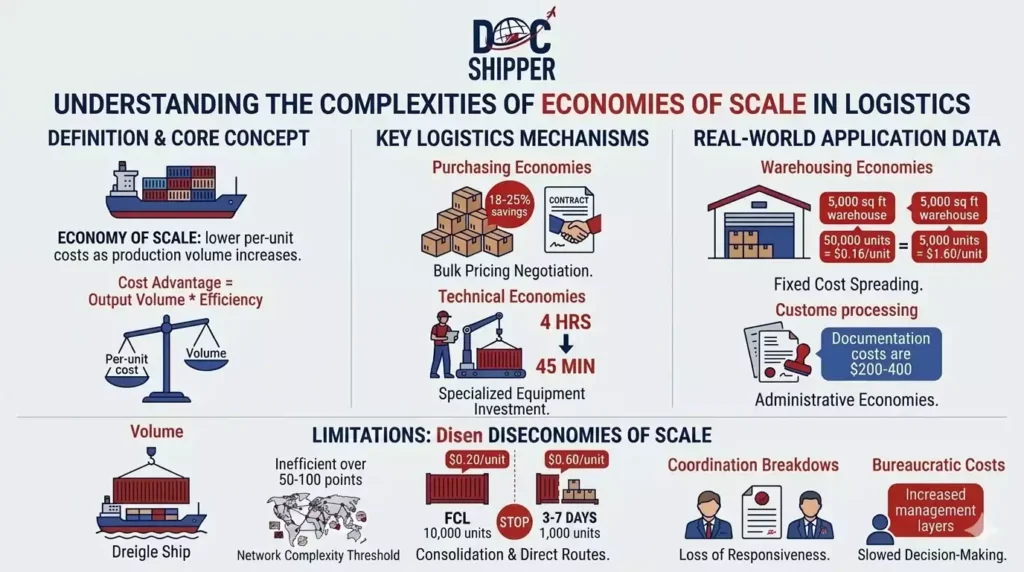
In logistics, technical economies emerge when businesses invest in specialized equipment. A freight forwarder purchasing container handling machinery reduces loading time from 4 hours to 45 minutes per container. This efficiency only becomes profitable at high volumes.
Purchasing economies dominate international sourcing. A manufacturer ordering 10,000 units receives 18-25% better pricing than one ordering 500 units. Suppliers reduce their per-unit production costs and pass savings to large buyers.
The concept faces limitations through diseconomies of scale. Beyond optimal size, coordination costs increase, communication breaks down, and bureaucracy slows decision-making. According to World Trade Organization research, logistics operations become inefficient when networks exceed manageable complexity thresholds.
Financial economies benefit larger operations through better credit terms. Banks offer lower interest rates to established importers with proven volumes. This reduces working capital costs by 2-4% annually compared to smaller competitors.
At DocShipper, we leverage consolidated shipping volumes across multiple clients to negotiate preferential rates that individual businesses cannot access independently. This shared economy of scale reduces costs by 15-30% depending on routes and cargo types.
Real-World Applications & Data
Consider ocean freight between Shanghai and Rotterdam. A 20-foot container costs approximately $2,000, holding roughly 10,000 units of a standard product. The per-unit shipping cost equals $0.20.
The same importer shipping only 1,000 units via LCL pays around $600 for equivalent space, resulting in $0.60 per unit—a 200% increase in transportation costs alone.
| Shipping Method | Total Cost | Units | Cost per Unit | Savings vs LCL |
|---|---|---|---|---|
| FCL (Full Container) | $2,000 | 10,000 | $0.20 | 67% |
| LCL (Partial Load) | $600 | 1,000 | $0.60 | Baseline |
| Air Freight (Small) | $3,500 | 500 | $7.00 | -1067% |
Warehousing economics follow similar patterns. A 5,000 sq ft warehouse costing $8,000 monthly stores 50,000 units at $0.16 per unit monthly. Reducing inventory to 5,000 units maintains the same rent, inflating per-unit storage to $1.60—a tenfold increase.
Customs processing demonstrates administrative economies. Whether clearing 100 or 10,000 units, documentation costs remain relatively fixed at $200-400 per shipment. Larger volumes reduce per-unit customs costs from $4.00 to $0.04.
Manufacturing economies appear in production setup. A factory requires 8 hours to configure machinery for a production run. Producing 1,000 units means 8 hours divided across output, while 50,000 units amortize setup time dramatically.
Packaging economies: Bulk material purchases reduce costs. Buying 100,000 units of packaging costs $0.08 each versus $0.25 for 1,000-unit orders—a 68% reduction through volume commitment.
Conclusion
Economy of scale fundamentally determines competitiveness in international logistics. Businesses maximizing volume efficiencies across transportation, warehousing, and purchasing create sustainable cost advantages.
Understanding these principles allows strategic decisions about consolidation, inventory management, and supplier relationships that directly impact profitability.
Need guidance on optimizing your logistics volume for better economies of scale? Contact DocShipper for expert consultation on reducing your per-unit costs through strategic consolidation.
📚 Quiz
Test Your Knowledge: Economy of Scale
What is the fundamental principle behind economy of scale in logistics?
A company ships 1,000 units via LCL at $0.60 per unit versus 10,000 units via FCL at $0.20 per unit. What does this scenario demonstrate?
When does a logistics operation experience diseconomies of scale?
🎯 Your Result
📞 Free Quote in 24hFAQ | Economy of Scale: Definition, Calculation & Concrete Examples
Economy of scale reduces costs by increasing production volume of a single product, while economy of scope reduces costs by producing multiple related products using shared resources. In logistics, scale focuses on volume efficiency, whereas scope emphasizes diversification benefits across product lines or service offerings.
Diseconomies typically emerge when organizations become too large to manage efficiently. Coordination costs increase, communication delays multiply, and bureaucratic overhead outweighs volume benefits. In logistics, this often occurs when networks exceed 50-100 distribution points or when management layers prevent responsive decision-making.
Small importers access scale economies through consolidation services, freight forwarders, or buying cooperatives. Partnering with logistics providers who aggregate multiple clients' shipments allows small businesses to benefit from bulk rates without requiring individual high volumes. This shared economy model reduces costs by 20-35%.
No. While transportation, warehousing, and bulk purchasing benefit significantly, some costs remain fixed or scale proportionally. Insurance premiums often increase linearly with cargo value. Specialized handling for hazardous materials maintains per-unit costs regardless of volume. Quality control and compliance verification may require consistent per-unit investment.
Standardized containers enable mechanical handling, reducing port labor from days to hours. A 40-foot container moves 2,400 cubic feet for similar handling costs as smaller loads. Intermodal compatibility between ships, trains, and trucks eliminates repackaging. These efficiencies reduce per-unit costs by 60-80% compared to break-bulk shipping.
Yes. Higher volumes justify direct shipping routes rather than hub-and-spoke networks. Dedicated full containers bypass consolidation warehouses, cutting 3-7 days from transit. Large shippers receive priority scheduling at ports. Established volume relationships enable preferential customs processing, reducing clearance times by 40-60%.
Effective inventory management balances bulk purchasing discounts against carrying costs. Economic order quantity (EOQ) formulas determine optimal purchase volumes that minimize combined ordering and storage expenses. Strategic inventory positioning across multiple warehouses creates regional scale advantages while maintaining responsive delivery capabilities.
Freight forwarders consolidate shipments from multiple clients into full containers, negotiating carrier rates based on aggregate volume. They invest in specialized software, customs expertise, and carrier relationships that individual shippers cannot justify economically. This pooled resource model distributes fixed costs across hundreds of clients.
Sustainability depends on market conditions and operational flexibility. Technology disruption, trade policy changes, or shifting consumer demands can erode scale advantages. Successful logistics operations balance scale efficiency with adaptability, maintaining modular systems that scale up or down without catastrophic cost increases during market fluctuations.
Digital platforms enable "network effects" where value increases with user adoption, creating new scale dynamics. Cloud-based systems eliminate infrastructure investment, allowing small operations to access enterprise-level technology. However, data processing, AI optimization, and automated warehousing still favor larger players who can amortize these investments across substantial volumes.
Key metrics include cost per unit shipped, warehousing cost per cubic meter per day, labor cost per order processed, and transportation cost per ton-kilometer. Tracking these ratios as volume changes reveals whether operations achieve genuine economies. Break-even analysis determines minimum volumes required for profitability at various scale levels.
Seasonal businesses face unique challenges, as fixed infrastructure sits underutilized during off-peak periods. Successful strategies include flexible warehousing agreements, shared logistics networks, and production smoothing through inventory build-up. Some achieve scale through complementary product lines that balance seasonal demand fluctuations throughout the year.
Need Help with
Logistics or Sourcing ?
First, we secure the right products from the right suppliers at the right price by managing the sourcing process from start to finish. Then, we simplify your shipping experience - from pickup to final delivery - ensuring any product, anywhere, is delivered at highly competitive prices.


Fill the Form
Prefer email? Send us your inquiry, and we’ll get back to you as soon as possible.
Contact us




