


In short ⚡
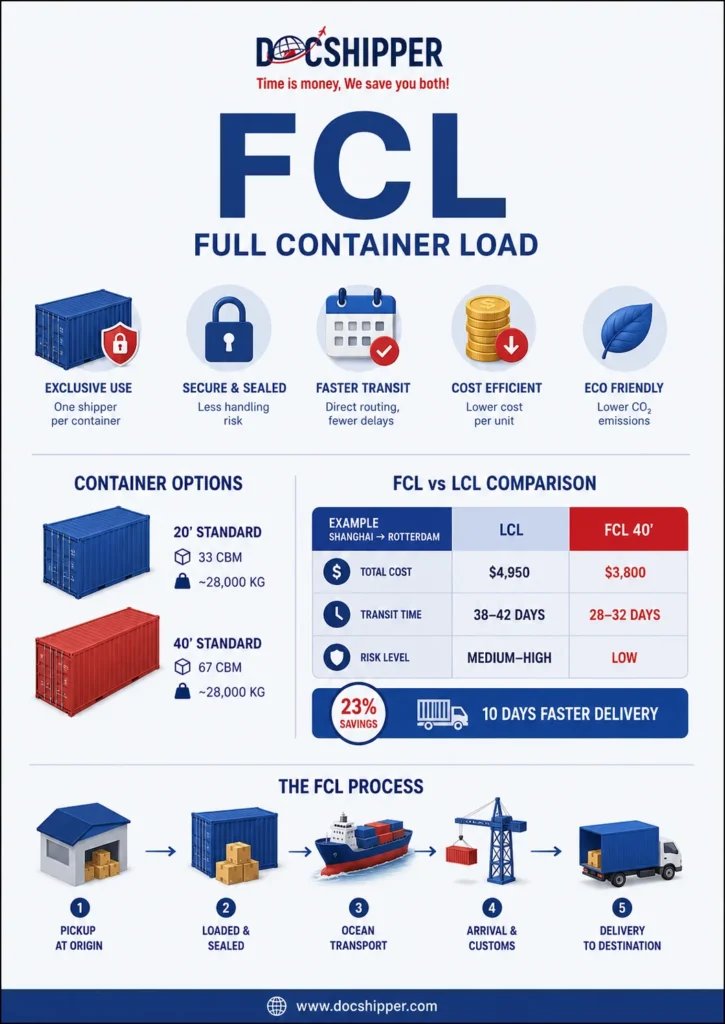
Full Container Load (FCL) is a shipping method where an entire container is dedicated to a single consignee's cargo. Unlike LCL (Less than Container Load), FCL shipments occupy the full capacity of a 20-foot or 40-foot container, offering faster transit times, reduced handling risks, and greater cost efficiency for large volumes.
Introduction
Many importers struggle to determine when shipping a full container becomes more economical than consolidating goods. This confusion often leads to overpaying for LCL services or underutilizing container space, directly impacting profit margins.
In international freight forwarding, FCL represents the backbone of large-scale commerce. It enables manufacturers and distributors to move substantial volumes efficiently while maintaining control over cargo security and transit schedules.
Key characteristics of FCL shipments include:
- Exclusive container use: No cargo mixing with other shippers
- Sealed transport: Container remains locked from origin to destination
- Flexible loading: Ability to optimize space based on cargo dimensions
- Direct routing: Fewer intermediate handling points reduce delays
- Volume threshold: Economically viable from 15 CBM upward in most trade lanes
Technical Deep Dive & Logistics Implications
Understanding FCL mechanics requires analyzing container specifications and their impact on cargo planning. Standard 20-foot containers (TEU) offer approximately 33 cubic meters of capacity, while 40-foot units (FEU) provide 67 cubic meters. High-cube variants add an extra foot in height, crucial for lightweight yet voluminous goods.
The cost-per-unit calculation fundamentally shifts with FCL. Unlike LCL pricing based on cubic meters or weight, FCL operates on a flat container rate. This makes it advantageous when cargo exceeds 50-60% of container capacity, as the per-CBM cost decreases proportionally with volume utilization.
From a regulatory perspective, customs clearance procedures differ significantly. FCL shipments typically benefit from faster processing since the entire container is released to a single consignee. According to the World Customs Organization, sealed FCL containers undergo fewer physical inspections compared to consolidated LCL shipments, reducing clearance times by up to 40%.
The Free Time allocation at ports varies by carrier and destination. Most terminals grant 5-7 days for FCL container retrieval before demurrage charges apply. At DocShipper, we systematically coordinate with our clients’ warehouses to ensure pickup within free time windows, avoiding penalties that can reach $150-300 per day.
Container detention policies require careful management. Shipping lines impose fees when containers aren’t returned within the agreed timeframe, typically 10-14 days. Strategic planning of unloading operations and return logistics prevents these avoidable costs, which can exceed the original freight charge in severe cases.
Concrete Examples & Data Analysis
To illustrate FCL’s economic impact, consider a Shanghai-Rotterdam shipment of electronics accessories weighing 18 tons with 45 cubic meters volume:
| Shipping Method | Total Cost | Transit Time | Risk Level |
|---|---|---|---|
| LCL (45 CBM) | $4,950 | 38-42 days | Medium-High |
| FCL 40′ Container | $3,800 | 28-32 days | Low |
This scenario demonstrates a $1,150 cost savings (23% reduction) plus a 10-day faster delivery when choosing FCL. The break-even point occurs at approximately 15 CBM on this trade lane, where FCL and LCL costs equalize.
Real-world case study: A furniture manufacturer shipping from Vietnam to Los Angeles switched from weekly LCL shipments (averaging 12 CBM each) to bi-weekly FCL containers. The consolidation strategy reduced annual freight costs by $47,000 while improving inventory predictability through fixed sailing schedules.
Key operational metrics for FCL optimization:
- Container utilization rate: Target minimum 80% capacity to maximize value
- Weight distribution: Balance cargo to prevent axle overload (typically 22-24 tons max for 40′ containers)
- Stackability factor: Proper palletization increases usable space by 15-20%
- Seasonal surcharges: Peak season rates (July-October) can inflate FCL costs by 30-50%
- Port congestion impact: Major hubs like Los Angeles and Hamburg add 5-12 days during high-volume periods
Conclusion
Full Container Load shipping represents the optimal solution for medium to large volume imports, offering cost efficiency, security, and speed advantages that LCL consolidation cannot match. Understanding container specifications, customs procedures, and volumetric thresholds enables strategic decision-making in international logistics.
Need assistance optimizing your container shipping strategy? Contact DocShipper for a customized freight analysis tailored to your trade lanes and cargo profiles.
📚 Quiz
Test Your Knowledge: Full Container Load (FCL)
What defines a Full Container Load (FCL) shipment?
At what cargo volume does FCL typically become more economical than LCL on most major trade routes?
A manufacturer has 12 CBM of electronics to ship from Shanghai to Rotterdam. Based on FCL principles, what is the most appropriate shipping decision?
🎯 Your Result
📞 Free Quote in 24hFAQ | Full Container Load (FCL): Definition, Calculation & Concrete Examples
FCL typically becomes cost-effective when your shipment exceeds 15 cubic meters on most major trade routes. However, this threshold varies by lane; Asia-Europe routes may favor FCL from 12 CBM, while shorter regional routes require 18-20 CBM to justify full container booking. Always compare quotes for both methods when approaching this range.
No, by definition FCL containers are dedicated to a single consignee. What you're describing is LCL (Less than Container Load) or buyer consolidation, where multiple shipments share space. Some freight forwarders offer "co-loading" services, but these operate under LCL pricing structures with shared liability frameworks.
You still pay the full container rate, but the unused space represents lost economic efficiency. Solutions include adding slower-moving inventory to the shipment, coordinating with suppliers to consolidate orders, or switching to LCL for smaller volumes. The key is calculating whether the per-unit cost still beats LCL pricing despite underutilization.
Most shipping lines provide 5-7 days of free time at the destination port, followed by 10-14 days for container return after pickup. Demurrage charges (port storage) and detention fees (equipment rental) begin immediately after these periods expire, ranging from $75-300 daily depending on container type and location. Plan unloading operations to complete within 48-72 hours of pickup.
Standard 40-foot containers have a maximum gross weight of approximately 30,480 kg (67,200 lbs), but the actual payload capacity is around 26,500 kg after accounting for the container's tare weight. Road transport regulations further restrict axle weights, typically limiting practical cargo to 22-24 tons for highway compliance in most countries.
Yes, FCL containers generally experience 30-40% faster customs clearance because they involve a single consignee and pre-cleared documentation. LCL shipments require deconsolidation at destination warehouses, individual inspections for each consignee, and coordinated release procedures. This advantage is most pronounced in high-volume ports with dedicated FCL processing lanes.
Absolutely. You can specify container types including standard dry, high-cube (adding 1 foot height), refrigerated (reefer), open-top, or flat-rack configurations. These specialized units cost 20-150% more than standard containers but are essential for specific cargo types like machinery, perishables, or oversized equipment.
Essential documents include commercial invoice, packing list, booking confirmation, shipper's letter of instruction (SLI), and certificate of origin if required. For regulated goods, add licenses, MSDS sheets, or phytosanitary certificates. Carriers require these 48-72 hours before cargo gate-in to generate the Bill of Lading and customs filings.
FCL rates are quoted per container unit, not by weight or volume. Pricing factors include trade lane demand, fuel surcharges (BAF), peak season premiums, port congestion fees, equipment imbalance charges, and currency fluctuations. Rates on major routes fluctuate 15-40% quarterly based on capacity supply and seasonal demand cycles.
Standard marine cargo insurance covers 110% of CIF value against all-risk perils including damage, theft, and general average contributions. For FCL shipments, verify coverage includes container loading/unloading operations, as many policies exclude warehouse-to-warehouse protection. Premiums typically range 0.3-0.7% of insured value depending on commodity and route risk profile.
Most carriers provide online tracking via container number, showing vessel position, port arrivals, and estimated delivery dates. Advanced systems offer GPS-enabled smart containers with temperature, humidity, and shock monitoring. However, tracking granularity decreases during inland transport legs unless your freight forwarder implements supplementary tracking systems.
FCL generates approximately 30% lower CO2 emissions per ton-kilometer compared to LCL because it eliminates intermediate handling, warehousing, and multiple trucking movements required for consolidation/deconsolidation. A fully utilized 40-foot container produces about 15-20 kg CO2 per ton shipped on major Asia-Europe routes, versus 22-28 kg for equivalent LCL cargo.
Need Help with
Logistics or Sourcing ?
First, we secure the right products from the right suppliers at the right price by managing the sourcing process from start to finish. Then, we simplify your shipping experience - from pickup to final delivery - ensuring any product, anywhere, is delivered at highly competitive prices.


Fill the Form
Prefer email? Send us your inquiry, and we’ll get back to you as soon as possible.
Contact us




