


In short ⚡
Groupage (or consolidated shipping) is a logistics method where multiple shippers' goods are combined into a single shipment to optimize transportation costs and space utilization. This practice allows small and medium-sized businesses to access international shipping rates typically reserved for large-volume exporters, reducing per-unit freight expenses by sharing container or truck space.Introduction
Many SMEs face a critical dilemma: their shipment volumes are too small to fill an entire container, yet full container rates remain prohibitively expensive. This creates a significant barrier to international trade competitiveness.
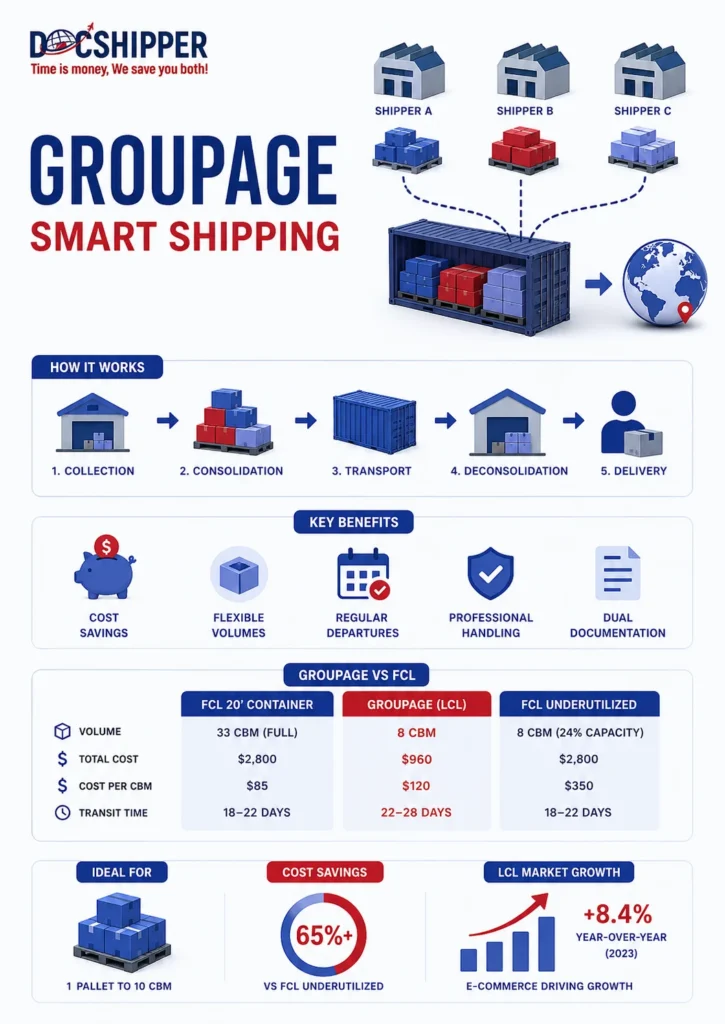
Groupage solves this challenge by pooling shipments from different clients heading to the same destination or region. Instead of paying for unused container space, each shipper pays proportionally for the actual volume or weight occupied.
Key characteristics of groupage include:
- Cost efficiency: Shared transportation expenses among multiple shippers
- Flexible volumes: Suitable for shipments from 1 pallet to 10 CBM
- Regular departures: Consolidated services operate on scheduled routes
- Professional handling: Freight forwarders manage consolidation and deconsolidation
- Documentation complexity: Requires master bills and house bills of lading
In-Depth Analysis & Expertise
Groupage operates through consolidation warehouses strategically located near major ports or logistics hubs. Freight forwarders collect shipments from various clients, verify documentation, and physically combine goods into full containers or trucks.
The process involves two-tier documentation systems. The consolidator issues a Master Bill of Lading (MBL) with the shipping line, while each individual shipper receives a House Bill of Lading (HBL) from the freight forwarder. This dual structure protects each party’s interests while maintaining cargo traceability.
From a customs perspective, groupage presents unique challenges. Each shipment within the consolidated load maintains separate customs declarations, requiring meticulous coordination during deconsolidation. According to EU Customs regulations, consolidated cargo must be clearly identified with individual consignee information to facilitate clearance procedures.
Transit times typically extend 3-7 days compared to full container loads (FCL). This delay occurs because consolidators wait to accumulate sufficient cargo before dispatching, then perform deconsolidation at destination. For time-sensitive shipments, this trade-off between cost and speed requires careful evaluation.
The liability framework differs significantly from FCL shipping. The freight forwarder assumes carrier responsibility under their House Bill, while the ocean carrier’s liability covers only the master shipment. At DocShipper, we systematically verify insurance coverage gaps to ensure comprehensive protection for consolidated cargo.
Pricing mechanisms follow volumetric weight calculations. Carriers charge based on either actual weight or volumetric weight (length × width × height ÷ 6000 for air, ÷ 5000 for sea LCL), whichever is greater. This ensures fair cost allocation across varying cargo densities.
Concrete Examples & Data
To illustrate groupage’s financial impact, consider a practical comparison between consolidated and dedicated shipping:
| Shipping Method | Volume (CBM) | Total Cost (USD) | Cost per CBM | Transit Time |
|---|---|---|---|---|
| FCL 20′ Container | 33 CBM (full) | $2,800 | $85 | 18-22 days |
| Groupage (LCL) | 8 CBM | $960 | $120 | 22-28 days |
| FCL underutilized | 8 CBM (24% capacity) | $2,800 | $350 | 18-22 days |
This comparison reveals that for shipments under 15 CBM, groupage delivers savings exceeding 65% despite higher per-unit rates. The break-even point typically occurs around 18-20 CBM, depending on route and season.
Case Study: European Furniture Retailer
A French furniture importer needed to ship 12 CBM of Indonesian teak furniture monthly. By switching from underutilized FCL to weekly groupage services, they achieved:
- Annual savings: $22,080 (from $33,600 to $11,520 yearly shipping costs)
- Improved cash flow through smaller, frequent orders instead of quarterly bulk shipments
- Reduced warehousing needs by 40% through just-in-time inventory management
- Enhanced flexibility to test new product lines with minimal commitment
According to Drewry Maritime Research 2023, global LCL volumes grew 8.4% year-over-year, with e-commerce driving 43% of this growth. The Asia-Europe route accounts for 34% of worldwide groupage traffic, making it the most competitive corridor.
Volumetric Weight Calculation Example:
For a shipment of electronics measuring 120cm × 80cm × 100cm, weighing 350kg:
- Volumetric weight = (120 × 80 × 100) ÷ 5000 = 192 kg
- Chargeable weight = actual weight (350kg is greater)
- If reversed (lightweight bulky goods): volumetric weight prevails, preventing underpricing of space-consuming cargo
Conclusion
Groupage represents a strategic enabler for international trade democratization, allowing businesses of all sizes to compete globally without capital-intensive logistics commitments. Understanding volumetric calculations, documentation requirements, and cost structures transforms this service from a simple shipping option into a competitive advantage.
Need expert guidance on optimizing your groupage strategy? Contact DocShipper for tailored consolidation solutions that align with your business objectives.
📚 Quiz
Test Your Knowledge: Groupage Shipping
What is the primary definition of groupage shipping?
What is the typical transit time difference between groupage (LCL) and full container load (FCL)?
A furniture importer has 8 CBM of goods to ship monthly. Based on the article's data, which shipping method would be most cost-effective?
🎯 Your Result
📞 Free Quote in 24hFAQ | Groupage: Definition, Calculation & Concrete Examples
Need Help with
Logistics or Sourcing ?
First, we secure the right products from the right suppliers at the right price by managing the sourcing process from start to finish. Then, we simplify your shipping experience - from pickup to final delivery - ensuring any product, anywhere, is delivered at highly competitive prices.


Fill the Form
Prefer email? Send us your inquiry, and we’ll get back to you as soon as possible.
Contact us




