


In short ⚡
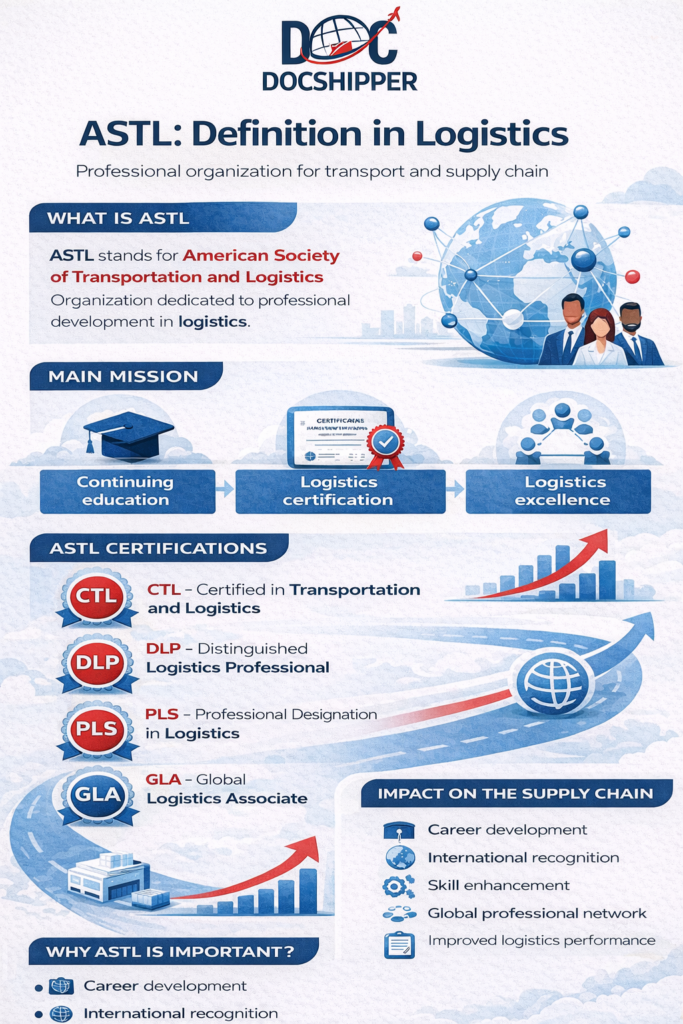
The American Society of Transportation & Logistics (AST&L) is a professional organization dedicated to advancing knowledge and best practices in supply chain management, transportation, and logistics through certification programs, educational resources, and industry networking. Founded to establish professional standards, AST&L provides credentials that validate expertise in logistics operations, inventory management, and distribution strategies.
Introduction
In an industry where operational efficiency can make or break profitability, how do logistics professionals prove their expertise? Many companies struggle to identify qualified candidates with verified knowledge in transportation management, warehousing, and supply chain optimization.
The American Society of Transportation & Logistics addresses this challenge by establishing professional benchmarks. As global trade complexity increases, standardized credentials become essential for career advancement and operational excellence.
Key characteristics of AST&L include:
- Professional certification programs validating logistics competencies across multiple specializations
- Educational resources covering freight management, customs compliance, and inventory control
- Industry networking connecting practitioners with peers and thought leaders
- Standards development for transportation operations and supply chain best practices
- Continuing education ensuring members maintain current knowledge in evolving logistics landscapes
Professional Standards & Certification Programs
AST&L’s certification framework establishes measurable competencies across the logistics spectrum. The organization offers multiple credential levels, from foundational knowledge to executive strategic planning.
The Certified in Transportation and Logistics (CTL) credential validates comprehensive understanding of supply chain operations. This certification covers freight classification, carrier selection, routing optimization, and regulatory compliance. Candidates must demonstrate proficiency in cost analysis, service level agreements, and risk management.
For advanced practitioners, the Certified in Production and Inventory Management (CPIM) focuses on manufacturing logistics. This credential addresses demand forecasting, material requirements planning, capacity management, and just-in-time delivery systems. Professionals gain expertise in balancing inventory costs against service requirements.
The Certified Professional Logistician (CPL) represents the highest achievement level. This designation requires extensive experience plus mastery of strategic logistics planning, global trade management, and supply chain integration. CPL holders typically occupy senior management or consulting roles.
Educational standards align with industry requirements verified by the U.S. Department of Commerce. AST&L curricula incorporate international trade regulations, customs documentation, and cross-border transportation protocols.
At DocShipper, we recognize AST&L certifications as indicators of professional competence. Our team includes certified logistics specialists who apply standardized methodologies to freight forwarding, customs clearance, and supply chain optimization projects.
Industry Impact & Practical Applications
AST&L credentials demonstrate measurable value across logistics operations. Organizations employing certified professionals report improved efficiency metrics and reduced operational costs.
| Certification Level | Primary Focus Area | Typical Role | Average Salary Impact |
|---|---|---|---|
| CTL (Certified in Transportation and Logistics) | Freight operations, carrier management | Transportation Coordinator, Logistics Analyst | +12% to +18% |
| CPIM (Certified in Production and Inventory Management) | Inventory control, production planning | Supply Chain Manager, Inventory Specialist | +15% to +22% |
| CPL (Certified Professional Logistician) | Strategic planning, global logistics | Director of Logistics, VP Supply Chain | +20% to +30% |
Case Study: Import Cost Reduction
A mid-sized electronics importer hired a CTL-certified logistics manager to optimize their Asia-Pacific supply chain. Within six months, the professional implemented consolidated shipping schedules, renegotiated carrier contracts using AST&L cost analysis frameworks, and streamlined customs documentation. Results included 23% reduction in freight costs, 40% faster customs clearance, and 15% improvement in on-time delivery rates.
Key practical applications include:
- Freight cost optimization through carrier selection algorithms and route analysis methodologies taught in AST&L programs
- Regulatory compliance using standardized documentation processes aligned with international trade requirements
- Inventory accuracy improved through cycle counting and ABC analysis techniques from CPIM curriculum
- Risk mitigation applying contingency planning frameworks for supply chain disruptions
- Performance metrics implementing KPIs for transportation efficiency, warehouse productivity, and order fulfillment accuracy
Industry data shows companies with 30% or more AST&L-certified staff experience 18% higher supply chain efficiency scores compared to non-certified teams. These organizations demonstrate superior performance in cost per shipment, inventory turnover, and customer satisfaction metrics.
DocShipper Platform
Cut logistics costs. Not corners.
See exactly where your logistics costs are bleeding — and how to fix it. Book your expert demo.

Conclusion
AST&L certifications provide verifiable proof of logistics expertise, translating directly into operational improvements and career advancement. As supply chains grow more complex, standardized professional credentials become essential competitive advantages.
Need expert logistics support backed by certified professionals? Contact DocShipper for comprehensive freight forwarding and supply chain management services.
📚 Quizz
Test Your Knowledge: American Society of Transportation & Logistics (AST&L)
Q1 — What is the primary purpose of the American Society of Transportation & Logistics (AST&L)?
Q2 — A logistics professional holds a Certified Professional Logistician (CPL) designation. Which of the following best describes what this credential represents?
Q3 — A mid-sized electronics importer wants to reduce freight costs and speed up customs clearance on their Asia-Pacific supply chain. Which AST&L certification would be most directly relevant for the logistics manager they plan to hire?
🎯 Your Result
📞 Free Quote in 24hFAQ | American Society of Transportation & Logistics (AST&L): Definition, Role & Industry Impact
AST&L certifications validate professional competence in logistics, transportation, and supply chain management through standardized testing and experience requirements, helping employers identify qualified candidates and professionals advance their careers.
Most candidates complete CTL certification within 6-12 months, depending on prior experience and study time. The process includes coursework covering freight operations, carrier management, and regulatory compliance, followed by a comprehensive examination.
Yes, AST&L certifications are recognized globally, particularly in North America, Europe, and Asia-Pacific regions. Many multinational corporations prefer candidates with AST&L credentials for logistics management positions.
CPIM certification typically requires 2-3 years of logistics or manufacturing experience, though specific requirements vary. Candidates must complete coursework in production planning, inventory management, and supply chain operations before attempting the certification exam.
Industry surveys indicate AST&L-certified professionals earn 12-30% more than non-certified peers, depending on certification level and role. CPL holders in senior positions see the highest salary premiums.
AST&L requires certified professionals to complete continuing education units (CEUs) every 3-5 years, depending on certification type. This ensures members maintain current knowledge of evolving logistics practices and regulatory changes.
Yes, AST&L curricula include international trade regulations, customs documentation procedures, and compliance frameworks. CTL and CPL certifications specifically address cross-border logistics and regulatory requirements.
CTL focuses on operational logistics competencies like freight management and carrier selection, while CPL represents advanced strategic planning, global supply chain integration, and executive-level decision-making capabilities requiring extensive experience.
Absolutely. Freight forwarders with AST&L credentials demonstrate verified expertise in transportation optimization, documentation accuracy, and regulatory compliance—critical factors for client satisfaction and operational efficiency.
AST&L professional standards complement ISO certifications by focusing on individual competencies rather than organizational processes. Many companies pursue both AST&L-certified staff and ISO-certified systems for comprehensive supply chain excellence.
AST&L offers industry publications, networking events, webinars on emerging logistics trends, and access to professional development resources covering technology adoption, sustainability practices, and supply chain innovation.
Yes, AST&L certifications increasingly address e-commerce logistics challenges including last-mile delivery optimization, returns management, omnichannel fulfillment strategies, and rapid inventory turnover requirements specific to online retail operations.
Need Help with
Logistics or Sourcing ?
First, we secure the right products from the right suppliers at the right price by managing the sourcing process from start to finish. Then, we simplify your shipping experience - from pickup to final delivery - ensuring any product, anywhere, is delivered at highly competitive prices.


Fill the Form
Prefer email? Send us your inquiry, and we’ll get back to you as soon as possible.
Contact us




