


In short ⚡
Class 1 Railroad is a freight railroad classification established by the Surface Transportation Board (STB) based on annual operating revenue thresholds. Currently, a railroad qualifies as Class 1 if it generates at least $900 million in annual operating revenue (adjusted for inflation). These carriers handle the majority of North American rail freight, operating extensive networks across the United States, Canada, and Mexico.
Introduction
Many importers and exporters struggle to understand the difference between railroad classes when planning their freight strategy. Choosing the right carrier impacts transit times, rates, and service reliability across continental routes.
Class 1 Railroads dominate North American freight transportation. They operate the backbone infrastructure that connects ports, distribution centers, and manufacturing hubs across thousands of miles.
Understanding this classification helps businesses:
- Identify carriers with the capacity for high-volume shipments
- Negotiate competitive intermodal rates
- Plan long-haul freight routes with reliable transit schedules
- Access comprehensive tracking and technology platforms
- Ensure regulatory compliance for cross-border shipments
The distinction between Class 1, Class 2, and Class 3 railroads directly affects service options, pricing structures, and geographic coverage for international trade operations.
Classification Criteria & Regulatory Framework
The Surface Transportation Board (STB) establishes railroad classifications based on inflation-adjusted revenue thresholds. This system ensures that the largest freight carriers receive appropriate regulatory oversight while maintaining operational efficiency.
The current threshold of $900 million in annual operating revenue separates Class 1 railroads from smaller regional and short-line carriers. This figure adjusts annually based on the Railroad Transportation Price Index published by the STB.
Class 1 Railroads must comply with enhanced reporting requirements. They submit quarterly financial statements, traffic statistics, and operational metrics to federal regulators. This transparency enables market analysis and competitive rate monitoring.
The infrastructure investment obligations for Class 1 carriers exceed those of smaller railroads. They maintain thousands of miles of track, bridges, and signaling systems. Federal regulations require capital expenditure programs that ensure safety and capacity expansion.
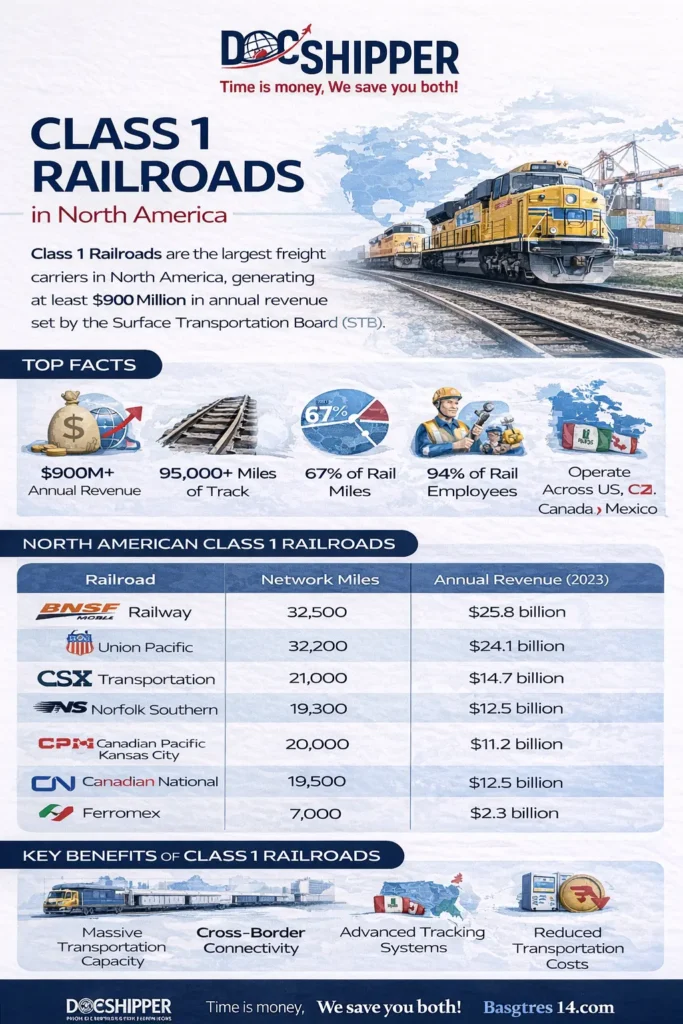
Seven railroads currently hold Class 1 status in North America: BNSF Railway, Union Pacific, CSX Transportation, Norfolk Southern, Canadian Pacific Kansas City, Canadian National Railway, and Ferromex (Mexico).
The interline agreements between Class 1 carriers create seamless coast-to-coast service. These partnerships allow shippers to book single-bill shipments across multiple railroad networks without reloading cargo.
According to the Surface Transportation Board, Class 1 Railroads account for approximately 67% of the industry’s total mileage and 94% of its employees. This concentration reflects their dominant market position.
At DocShipper, we leverage relationships with all Class 1 carriers to secure competitive rates and priority scheduling for our clients’ intermodal shipments across North America.
Operational Examples & Market Data
Class 1 Railroads handle distinct traffic volumes and geographic territories. Comparing their operational metrics helps importers select the optimal carrier for specific trade lanes.
| Railroad | Network Miles | Primary Coverage | Annual Revenue (2023) |
|---|---|---|---|
| BNSF Railway | 32,500 | Western & Midwestern US | $25.8 billion |
| Union Pacific | 32,200 | Western US, Gulf Coast | $24.1 billion |
| CSX Transportation | 21,000 | Eastern US, Southeast | $14.7 billion |
| Norfolk Southern | 19,300 | Eastern US, Atlantic ports | $12.5 billion |
| Canadian Pacific Kansas City | 20,000 | Canada-US-Mexico corridor | $11.2 billion |
Use Case: Automotive Parts from Mexico to Detroit
A manufacturer ships 200 containers monthly from Monterrey to Michigan. Using Canadian Pacific Kansas City’s Class 1 network, the shipment transits 1,850 miles in 72 hours. The single-bill service eliminates customs delays at the border through pre-clearance programs.
Transit time: 3 days. Cost per container: $2,400. Alternative trucking would cost $3,800 with higher carbon emissions.
Intermodal volume statistics show Class 1 Railroads moved 13.2 million containers in 2023, representing 62% of all North American rail freight. This capacity supports just-in-time manufacturing and e-commerce distribution networks.
The average train length for Class 1 carriers exceeds 6,500 feet, carrying 200+ containers per consist. This efficiency reduces per-unit transportation costs compared to regional carriers operating shorter trains.
Technology integration distinguishes Class 1 operations. Real-time GPS tracking, automated yard management systems, and predictive maintenance platforms ensure 95%+ on-time performance for priority shipments.
Class 1 Railroads invest $25 billion annually in infrastructure upgrades. These capital programs expand double-stack clearances, modernize signaling systems, and increase terminal capacity at major intermodal hubs.
Conclusion
Class 1 Railroads provide the infrastructure and capacity essential for high-volume international freight movements across North America. Their regulatory status, extensive networks, and technology platforms deliver reliable service for time-sensitive supply chains.
Need expert guidance on rail freight strategies? Contact DocShipper for tailored intermodal solutions that optimize your logistics costs and transit times.
📚 Quiz
Test Your Knowledge: Class 1 Railroad
1. What is the primary criterion used by the Surface Transportation Board (STB) to classify a railroad as Class 1?
2. A shipper assumes that because a railroad operates thousands of miles of track across two countries, it must be a Class 1 carrier. Is this reasoning correct?
3. A manufacturer needs to ship 200 containers monthly from Monterrey, Mexico to Michigan, USA, with a single-bill service and pre-clearance at the border. Which Class 1 railroad is best suited for this specific trade lane?
🎯 Your Result
📞 Free Quote in 24hFAQ | Class 1 Railroad: Definition, Classification & Concrete Examples
Class 1 railroads generate $900+ million in annual revenue, while Class 2 (regional) railroads earn between $40.4 million and the Class 1 threshold. Class 1 carriers operate larger networks with more extensive infrastructure and technology investments.
The Surface Transportation Board adjusts the threshold annually based on the Railroad Transportation Price Index. This ensures the classification reflects inflation and maintains consistent regulatory oversight of the largest carriers.
Class 1 carriers must provide common carrier service under federal regulations. However, they can decline shipments that violate safety standards, exceed weight limits, or involve prohibited commodities. Rate negotiations occur within STB-approved tariff structures.
Coast-to-coast shipments typically require 5-7 days, while regional routes average 2-4 days. Priority services offer expedited schedules with guaranteed delivery windows for temperature-sensitive or time-critical cargo.
Yes. Ferromex holds Class 1 status in Mexico, and Canadian Pacific Kansas City operates a unified network connecting Canada, the United States, and Mexico following the 2023 merger. These carriers provide seamless cross-border service under USMCA trade agreements.
Class 1 carriers follow strict DOT and Transport Canada regulations for hazmat shipments. They require specialized placarding, routing restrictions, and emergency response plans. Shippers must provide proper documentation and comply with packaging standards.
Major carriers offer proprietary platforms like BNSF Logistics Manager, UP's Customer Portal, and CSX ShipCSX. These systems provide real-time GPS tracking, ETAs, demurrage monitoring, and automated status notifications integrated with TMS software.
The STB oversees rate reasonableness for captive shippers lacking competitive alternatives. Most rates are market-based, determined through contracts negotiated between carriers and customers. Tariffs must be filed publicly for common carrier services.
Class 1 networks connect with 550+ short-line railroads through interchange agreements. These partnerships extend reach to rural industrial facilities and agricultural regions. Billing and liability transfer at designated junction points under standardized interchange rules.
Rail transport produces 75% fewer greenhouse gas emissions per ton-mile than trucking. Class 1 carriers achieve this efficiency through fuel-optimized locomotives, aerodynamic container configurations, and reduced highway congestion. Many operate hybrid and LNG-powered engines.
Yes. Shippers moving 100+ containers monthly typically qualify for contract rates below published tariffs. Volume commitments, consistent routing, and multi-year agreements provide leverage for rate negotiations. Third-party logistics providers often secure better pricing through aggregated volumes.
Carriers maintain contingency routing through parallel lines and alternate gateways. Weather-related delays trigger proactive notifications and rerouting options. Service guarantees include compensation for missed delivery windows on premium intermodal products.
Need Help with
Logistics or Sourcing ?
First, we secure the right products from the right suppliers at the right price by managing the sourcing process from start to finish. Then, we simplify your shipping experience - from pickup to final delivery - ensuring any product, anywhere, is delivered at highly competitive prices.


Fill the Form
Prefer email? Send us your inquiry, and we’ll get back to you as soon as possible.
Contact us




