


In short ⚡
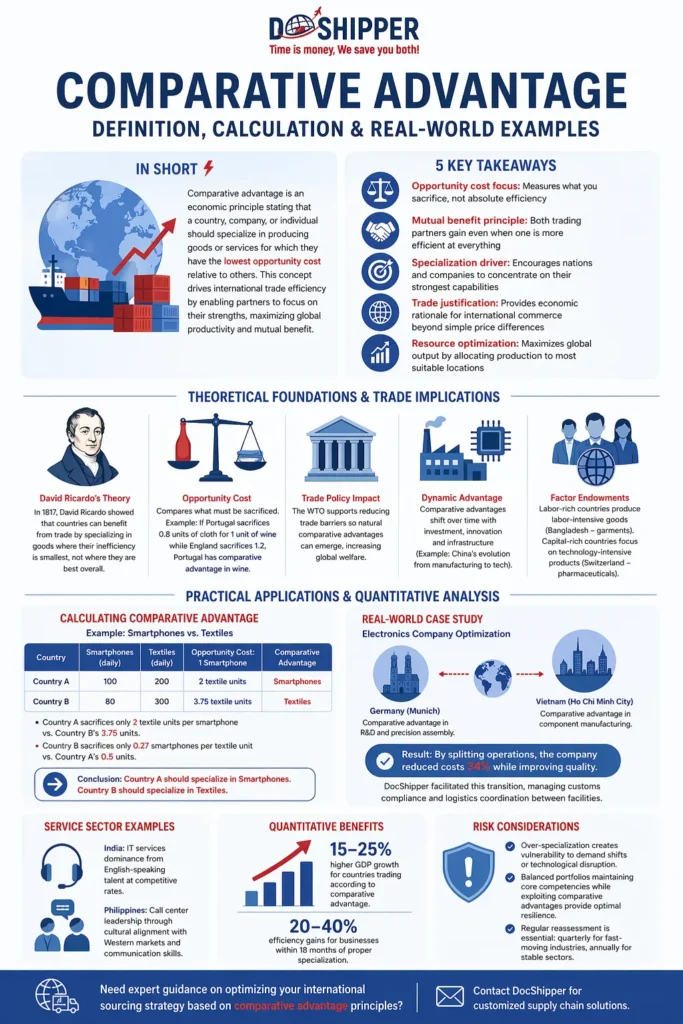
Comparative advantage is an economic principle stating that a country, company, or individual should specialize in producing goods or services for which they have the lowest opportunity cost relative to others. This concept drives international trade efficiency by enabling partners to focus on their strengths, maximizing global productivity and mutual benefit.Introduction
Many businesses struggle to determine which products to manufacture domestically versus source internationally. This confusion often leads to inefficient resource allocation and missed competitive opportunities. Understanding comparative advantage transforms this challenge into strategic clarity.
In global logistics and import/export operations, comparative advantage explains why Vietnam excels in textile manufacturing while Germany dominates precision machinery. This principle underpins every sourcing decision, trade agreement, and supply chain optimization strategy.
- Opportunity cost focus: Measures what you sacrifice, not absolute efficiency
- Mutual benefit principle: Both trading partners gain even when one is more efficient at everything
- Specialization driver: Encourages nations and companies to concentrate on their strongest capabilities
- Trade justification: Provides economic rationale for international commerce beyond simple price differences
- Resource optimization: Maximizes global output by allocating production to most suitable locations
Theoretical Foundations & Trade Implications
David Ricardo formalized comparative advantage theory in 1817, revolutionizing economic thought. Unlike absolute advantage (being best at producing something), comparative advantage examines relative efficiency. A country may be less efficient at producing everything yet still benefit from trade by specializing in goods where its inefficiency is smallest.
The opportunity cost calculation forms the core methodology. If Portugal can produce 1 unit of wine by sacrificing 0.8 units of cloth, while England sacrifices 1.2 units of cloth for 1 wine unit, Portugal has comparative advantage in wine production. England should focus on cloth, even if Portugal produces both faster.
Trade policy implications extend beyond theory. The World Trade Organization references comparative advantage when evaluating tariff structures. According to WTO principles, reducing artificial barriers allows natural comparative advantages to emerge, increasing global welfare.
Modern applications incorporate dynamic comparative advantage, recognizing that advantages shift over time. China’s evolution from low-cost manufacturing to technology leadership illustrates how investment in education and infrastructure creates new comparative advantages. At DocShipper, we monitor these shifts to advise clients on optimal sourcing locations as global production landscapes evolve.
Factor endowments determine comparative advantages naturally. Countries rich in labor specialize in labor-intensive goods, while capital-abundant nations focus on technology-intensive products. Bangladesh’s garment industry and Switzerland’s pharmaceutical sector exemplify this principle. Understanding your own factor endowments—whether skilled workforce, natural resources, or technological infrastructure—guides strategic positioning.
Practical Applications & Quantitative Analysis
Calculating comparative advantage requires systematic opportunity cost comparison. Consider two countries producing smartphones and textiles. Country A produces 100 smartphones or 200 textile units daily. Country B produces 80 smartphones or 300 textile units daily.
| Country | Smartphones (daily) | Textiles (daily) | Opportunity Cost: 1 Smartphone | Comparative Advantage |
|---|---|---|---|---|
| Country A | 100 | 200 | 2 textile units | Smartphones |
| Country B | 80 | 300 | 3.75 textile units | Textiles |
Country A sacrifices only 2 textile units per smartphone versus Country B’s 3.75 units, giving A comparative advantage in smartphones. Country B should specialize in textiles, where it sacrifices fewer smartphones per unit (0.27 vs. 0.5 for Country A).
Real-world case study: A European electronics company faced rising labor costs. Analysis revealed Germany held comparative advantage in R&D and precision assembly (opportunity cost: sacrificing lower-value production), while Vietnam excelled in component manufacturing (abundant skilled labor at lower wages). By splitting operations—design in Munich, assembly in Ho Chi Minh City—the company reduced costs 34% while improving quality. DocShipper facilitated this transition, managing customs compliance and logistics coordination between facilities.
Service sector applications demonstrate comparative advantage beyond manufacturing. India’s IT services dominance stems from English-speaking talent at competitive rates. The Philippines leads call center operations through cultural alignment with Western markets and communication skills. Companies leveraging these advantages through strategic outsourcing gain efficiency without sacrificing quality.
Quantitative benefits: Studies show countries trading according to comparative advantage achieve 15-25% higher GDP growth than those pursuing autarky. For individual businesses, proper specialization based on opportunity cost analysis typically yields 20-40% efficiency gains within 18 months of implementation.
Risk considerations: Over-specialization creates vulnerability to demand shifts or technological disruption. Balanced portfolios maintaining core competencies while exploiting comparative advantages provide optimal resilience. Regular reassessment—quarterly for fast-moving industries, annually for stable sectors—ensures strategies remain aligned with evolving market conditions.
Conclusion
Comparative advantage transforms abstract economic theory into actionable logistics strategy, guiding sourcing decisions, production locations, and trade partnerships. Mastering opportunity cost analysis enables businesses to maximize efficiency while navigating complex global supply chains.
Need expert guidance on optimizing your international sourcing strategy based on comparative advantage principles? Contact DocShipper for customized supply chain solutions.
📚 Quiz
Test Your Knowledge: Comparative Advantage
Q1 — What does comparative advantage primarily measure?
Q2 — Country A produces 100 smartphones or 200 textiles daily. Country B produces 80 smartphones or 300 textiles daily. Which country has the comparative advantage in textiles?
Q3 — A European electronics firm moves its R&D and precision assembly to Germany while relocating component manufacturing to Vietnam. Which principle best explains this strategic decision?
🎯 Your Result
📞 Free Quote in 24hFAQ | Comparative Advantage: Definition, Calculation & Real-World Examples
Absolute advantage means producing more efficiently in absolute terms. Comparative advantage focuses on opportunity cost—what you sacrifice to produce something. A country can lack absolute advantage in everything yet still benefit from trade through comparative advantage specialization.
Divide what you give up by what you gain. If producing 10 units of Product A means sacrificing 20 units of Product B, your opportunity cost is 2 units of B per A. Compare this ratio with trading partners to identify comparative advantages.
Yes, through investment in technology, education, or infrastructure. China shifted from labor-intensive manufacturing to advanced electronics through strategic development. Companies must regularly reassess comparative advantages as markets and capabilities evolve.
Absolutely. India's IT services, Philippines' customer support, and Ireland's financial services sectors all demonstrate service-based comparative advantages driven by skills, language capabilities, regulatory environments, and cost structures.
Transportation costs can negate comparative advantages if they exceed production savings. Perishable goods often require local production despite higher costs. Logistics optimization becomes crucial when comparative advantage margins are narrow.
It guides where to source materials, manufacture components, and assemble final products. Companies analyze opportunity costs across locations to build efficient multi-country supply chains that leverage each region's strengths.
Yes. Small firms can specialize in niche products where they have lowest opportunity costs, outsourcing other functions to partners with complementary advantages. This enables competing with larger competitors through strategic focus.
It assumes free trade, ignores transportation costs, doesn't account for economies of scale, and overlooks strategic industries requiring protection. Real-world applications must balance theoretical efficiency with practical constraints and national interests.
They distort natural comparative advantages by artificially raising costs of imported goods. While protecting domestic industries short-term, tariffs typically reduce overall economic efficiency by preventing optimal resource allocation.
Factor endowments (labor, capital, natural resources, technology) determine comparative advantages. Countries abundant in specific factors naturally develop advantages in industries using those factors intensively, forming the basis of trade patterns.
Conduct opportunity cost analysis comparing internal capabilities against competitors. Assess what you sacrifice least to produce each product or service. Focus on activities where your relative efficiency is highest, even if not absolute best.
Not entirely. Strategic considerations like intellectual property protection, quality control, and supply chain resilience may outweigh pure comparative advantage calculations. Balanced approaches consider both economic efficiency and operational risk management.
Need Help with
Logistics or Sourcing ?
First, we secure the right products from the right suppliers at the right price by managing the sourcing process from start to finish. Then, we simplify your shipping experience - from pickup to final delivery - ensuring any product, anywhere, is delivered at highly competitive prices.


Fill the Form
Prefer email? Send us your inquiry, and we’ll get back to you as soon as possible.
Contact us




