


In short ⚡
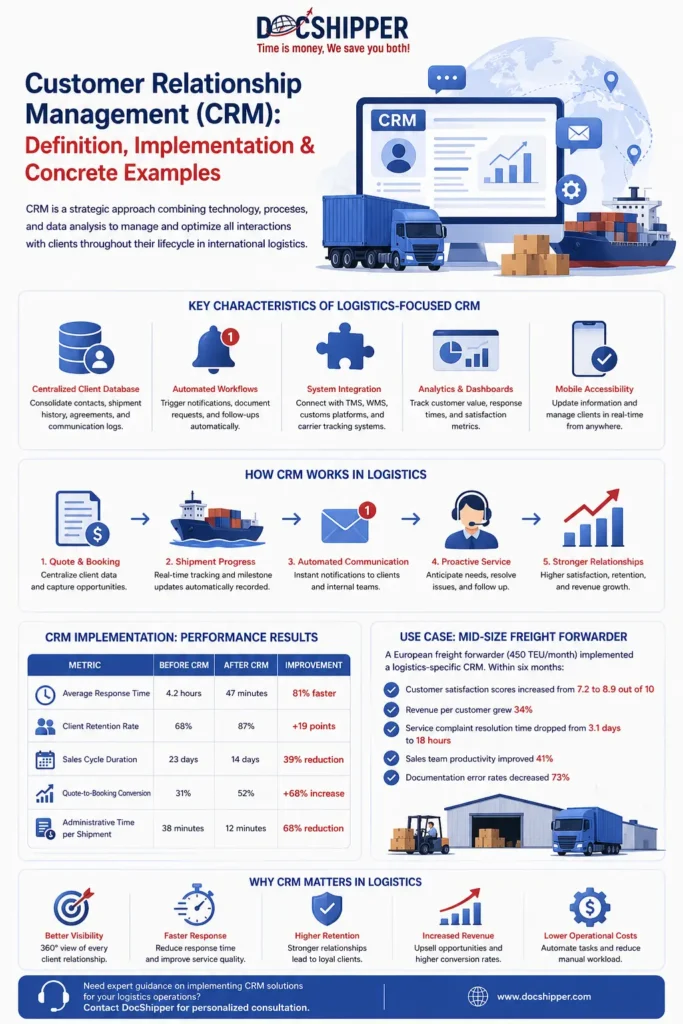
Customer Relationship Management (CRM) is a strategic approach combining technology, processes, and data analysis to manage and optimize all interactions with clients throughout their lifecycle. In international logistics, CRM systems centralize customer information, track shipments, automate communications, and enhance service quality while reducing operational costs.Introduction
Many freight forwarders and logistics providers struggle with fragmented customer data scattered across emails, spreadsheets, and disconnected platforms. This creates communication gaps, missed follow-ups, and inconsistent service quality that damages client relationships.
In international trade and logistics, where shipments involve multiple parties across different time zones, a robust CRM becomes essential infrastructure. It transforms reactive customer service into proactive relationship management, enabling companies to anticipate needs and resolve issues before they escalate.
Key characteristics of logistics-focused CRM systems include:
- Centralized client database consolidating contact details, shipment history, pricing agreements, and communication logs
- Automated workflow triggers for milestone notifications, documentation requests, and follow-up scheduling
- Integration capabilities with TMS, WMS, customs platforms, and carrier tracking systems
- Analytics dashboards measuring customer lifetime value, service response times, and satisfaction metrics
- Mobile accessibility allowing sales teams and operations staff to update information in real-time from any location
CRM Systems in Logistics: Technical Deep-Dive
Modern CRM platforms for logistics operations function as the central nervous system connecting sales, operations, finance, and customer service. Unlike generic CRM tools, logistics-specific solutions integrate directly with transportation management systems and customs documentation workflows.
The data architecture typically includes three layers: customer master data (company profiles, contacts, credit terms), transactional records (quotes, bookings, invoices), and interaction history (emails, calls, service tickets). This structure enables 360-degree visibility into each client relationship.
Automation capabilities reduce manual workload significantly. When a container departs the origin port, the CRM automatically sends departure notifications, updates internal stakeholders, and schedules follow-up tasks for arrival coordination. This eliminates the need for staff to manually track and communicate each shipment milestone.
The compliance dimension addresses GDPR and data protection regulations. Logistics CRMs must implement consent management, data retention policies, and audit trails. According to EU GDPR guidelines, customer data must be processed lawfully with explicit consent and protected through appropriate security measures.
Integration protocols determine system effectiveness. APIs connect CRM platforms with carrier portals, customs clearance software, and accounting systems. At DocShipper, we integrate our CRM with real-time tracking feeds to provide clients instant visibility without manual status updates.
The mobile-first approach has become critical as sales teams operate remotely. Cloud-based CRM solutions enable account managers to access client information, update opportunities, and respond to inquiries from smartphones or tablets, maintaining service continuity regardless of location.
Concrete Implementation & Performance Data
Implementation results vary based on company size and integration depth. The following data reflects industry benchmarks and documented case studies from freight forwarding operations.
| Metric | Before CRM | After CRM | Improvement |
|---|---|---|---|
| Average Response Time | 4.2 hours | 47 minutes | 81% faster |
| Client Retention Rate | 68% | 87% | +19 points |
| Sales Cycle Duration | 23 days | 14 days | 39% reduction |
| Quote-to-Booking Conversion | 31% | 52% | +68% increase |
| Administrative Time per Shipment | 38 minutes | 12 minutes | 68% reduction |
Use Case: Mid-Size Freight Forwarder
A European freight forwarder handling 450 TEU monthly implemented a logistics-specific CRM. Within six months, they documented these outcomes:
- Customer satisfaction scores increased from 7.2 to 8.9 out of 10
- Revenue per customer grew 34% through better upselling visibility
- Service complaint resolution time dropped from 3.1 days to 18 hours
- Sales team productivity improved 41% measured by opportunities managed per week
- Documentation error rates decreased 73% due to automated template systems
The company attributed success to three factors: comprehensive staff training, phased rollout starting with sales before expanding to operations, and executive commitment to data quality standards.
Conclusion
Customer Relationship Management systems have evolved from simple contact databases into strategic platforms that drive operational efficiency and revenue growth in international logistics. The data clearly demonstrates measurable improvements in response times, customer retention, and sales performance.
Need expert guidance on implementing CRM solutions for your logistics operations? Contact DocShipper for personalized consultation on optimizing your customer management processes.
📚 Quiz
Test Your Knowledge: Customer Relationship Management (CRM)
Q1 — What is the primary purpose of a CRM system in international logistics?
Q2 — A freight forwarder uses a CRM that automatically sends departure notifications when a container leaves the origin port. Which CRM capability does this illustrate?
Q3 — A logistics company is evaluating CRM platforms. They believe any standard CRM tool will work just as well as a logistics-specific one. Is this correct?
🎯 Your Result
📞 Free Quote in 24hFAQ | Customer Relationship Management (CRM): Definition, Implementation & Concrete Examples
Logistics CRM systems integrate directly with transportation management systems, customs platforms, and carrier tracking APIs. They include shipment-specific fields, milestone automation, and compliance documentation features that generic CRMs lack.
Implementation timelines range from 6-16 weeks depending on company size and integration complexity. This includes data migration, system configuration, staff training, and testing phases before full deployment.
Yes, modern logistics CRMs support multi-currency rate management with automatic conversion based on current exchange rates. They can store different pricing structures per customer, route, and service type.
Essential security features include role-based access controls, encrypted data transmission, regular backup protocols, audit trails, and compliance with GDPR or relevant data protection regulations in your operating regions.
Automated workflows trigger notifications when containers depart, clear customs, or encounter delays. Customers receive timely updates without manual intervention, reducing inquiry volume and improving satisfaction.
Industry studies show average ROI of 250-400% within 18 months through increased sales efficiency, reduced administrative costs, improved customer retention, and enhanced upselling capabilities.
Most modern CRM platforms offer API connections or pre-built integrations with major accounting systems like QuickBooks, SAP, and Xero, enabling seamless invoice generation and payment tracking.
Mobile access allows sales representatives to update client information, check shipment status, generate quotes, and respond to inquiries immediately during customer visits, eliminating delays from office-based workflows.
Effective adoption requires 12-20 hours of role-specific training covering data entry standards, workflow processes, reporting tools, and integration touchpoints. Ongoing support and refresher sessions maintain proficiency.
Analytics dashboards track metrics like shipment frequency, revenue per customer, service utilization patterns, and growth trends. This data highlights accounts with expansion potential and flags at-risk relationships requiring attention.
Advanced logistics CRMs store customer-specific documentation templates, compliance certificates, and regulatory requirements. They can automatically generate required paperwork based on shipment characteristics and destination regulations.
Primary challenges include data quality during migration, staff resistance to workflow changes, inadequate training investment, and unrealistic expectations about automation capabilities. Phased rollout and executive sponsorship mitigate these risks.
Need Help with
Logistics or Sourcing ?
First, we secure the right products from the right suppliers at the right price by managing the sourcing process from start to finish. Then, we simplify your shipping experience - from pickup to final delivery - ensuring any product, anywhere, is delivered at highly competitive prices.


Fill the Form
Prefer email? Send us your inquiry, and we’ll get back to you as soon as possible.
Contact us




