


In short ⚡
Demurrage and detention are penalty charges imposed by shipping lines when containers are not returned within agreed free time periods. Demurrage applies to containers at terminals, while detention covers containers outside port facilities. These fees can escalate rapidly, representing significant hidden costs in international logistics operations.
Introduction
One of the most common cost overruns in international trade stems from confusion between demurrage and detention charges. Importers frequently discover these fees only after receiving unexpected invoices, sometimes totaling thousands of dollars for delays of just a few days.
These charges exist because shipping lines operate on tight schedules with limited container inventories. When cargo sits idle or containers remain in circulation beyond planned timeframes, it disrupts operations and generates costs that carriers pass to shippers.
Understanding the distinction between these two charges is critical for:
- Cost control: Avoiding penalties that can exceed 10-15% of total freight costs
- Cash flow management: Predicting accurate landed costs before shipment arrival
- Operational planning: Coordinating customs clearance and inland transport efficiently
- Contract negotiation: Securing extended free time in shipping agreements
- Supply chain optimization: Reducing unnecessary storage and handling expenses
Understanding Mechanisms & Legal Framework
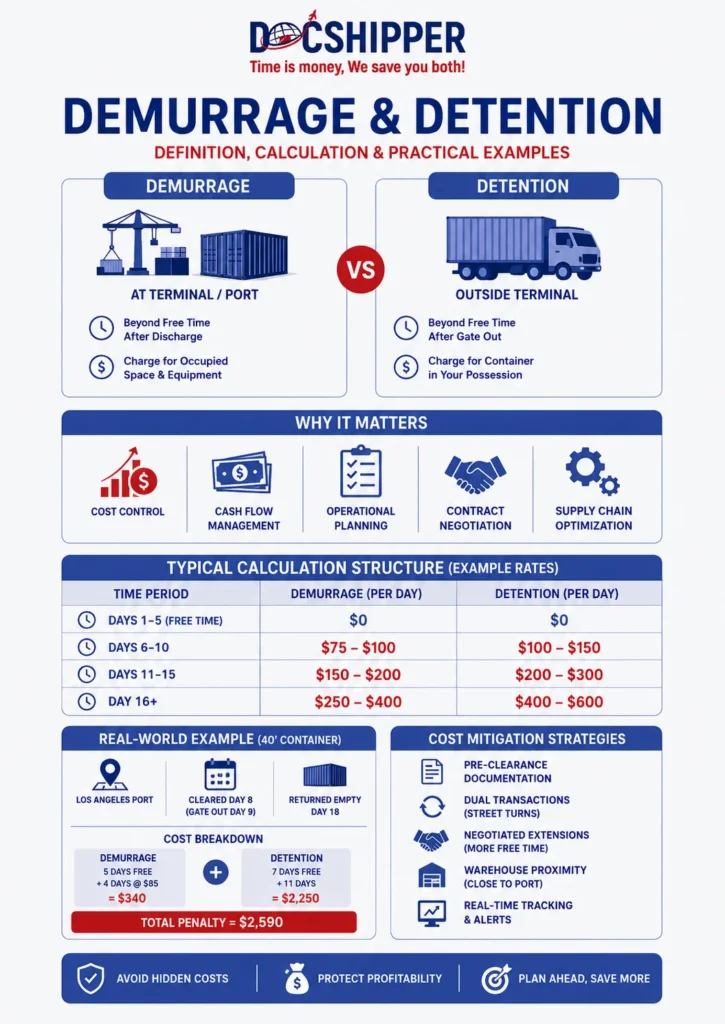
Demurrage specifically applies when a container remains at the port terminal or container yard beyond the allowed free time after vessel discharge. The clock starts once cargo becomes available for pickup, not when the ship docks. This charge compensates terminals for occupied space and equipment immobilization.
Detention begins when a container leaves the terminal but is not returned empty within the agreed period. This applies to the time containers spend at consignee facilities, warehouses, or in transit. Carriers impose this fee because each delayed container represents lost revenue from subsequent shipments.
The free time period typically ranges from 3 to 7 days for demurrage and 5 to 10 days for detention, though these vary significantly by carrier, trade lane, and contract terms. Once free time expires, charges accrue daily and often increase progressively in tiers.
Legal frameworks governing these charges fall under carrier tariffs and bill of lading terms. The Federal Maritime Commission in the United States and similar regulatory bodies worldwide establish guidelines, though enforcement varies. According to FMC regulations, carriers must provide clear notice of charge structures and reasonable opportunities to retrieve cargo.
At DocShipper, we systematically monitor free time windows and coordinate with customs brokers to minimize exposure to these charges. Our automated tracking systems alert clients 48 hours before demurrage or detention begins, enabling proactive container management.
Combined charges occur when both demurrage and detention accumulate simultaneously—a scenario that happens when containers remain at terminals beyond free time while the consignee also fails to return equipment promptly. This double-billing can create substantial unexpected costs, particularly during peak seasons or port congestion.
Calculation Methods & Real-World Scenarios
Demurrage and detention fees follow tiered structures that escalate over time. Understanding calculation methodologies helps importers budget accurately and identify optimization opportunities.
Standard Calculation Structure
| Time Period | Daily Demurrage Rate | Daily Detention Rate |
|---|---|---|
| Days 1-5 (Free Time) | $0 | $0 |
| Days 6-10 | $75-100/day | $100-150/day |
| Days 11-15 | $150-200/day | $200-300/day |
| Day 16+ | $250-400/day | $400-600/day |
Real-World Case Study
Scenario: A U.S. importer receives a 40-foot container at Los Angeles port. Customs examination delays clearance by 8 days. The container leaves the terminal on day 9 and is returned empty on day 18.
Calculation breakdown:
- Demurrage charges: 5 days free time + 4 days at $85/day = $340
- Detention charges: 7 days free time + 11 days (4 days at $125/day + 7 days at $250/day) = $2,250
- Total penalty: $2,590 for a single container
This represents approximately 30-40% additional cost on top of the original ocean freight rate. For importers handling multiple containers monthly, such charges can escalate to six-figure annual expenses.
Cost Mitigation Strategies
Effective management of demurrage and detention requires coordinated planning:
- Pre-clearance documentation: Submit customs paperwork before vessel arrival to expedite release
- Dual transactions: Use “street turns” where empty containers are redirected to new shippers without returning to terminals
- Negotiated extensions: Secure extended free time in annual shipping contracts, particularly for high-volume lanes
- Warehouse proximity: Position unloading facilities near ports to minimize detention exposure
- Real-time tracking: Implement digital systems monitoring container status and triggering alerts before charges begin
Conclusion
Demurrage and detention represent controllable costs that require proactive management rather than reactive payment. Strategic planning around free time windows directly impacts profitability in international trade operations.
Need expert assistance managing container logistics and avoiding unnecessary charges? Contact DocShipper for comprehensive support throughout your supply chain.
📚 Quiz
Test Your Knowledge: Demurrage & Detention
1. Where does demurrage apply in container logistics?
2. What is a common misconception about when demurrage charges begin?
3. An importer receives a container at the terminal on day 6 and returns it empty on day 16. Given standard 5-day demurrage free time and 7-day detention free time, which charges apply?
🎯 Your Result
📞 Free Quote in 24hFAQ | Demurrage & Detention: Definition, Calculation & Practical Examples
Demurrage applies while containers remain at the port terminal after discharge. Detention applies after containers leave the terminal but before they're returned empty. Think of demurrage as "storage rent" at the port and detention as "equipment rental" outside the port.
The party named on the bill of lading typically bears responsibility, usually the importer or consignee. However, freight forwarders or customs brokers may be liable if delays result from their negligence. Contractual agreements between parties can shift responsibility, but carriers will invoice whoever controls the shipment.
Yes, particularly when delays result from circumstances beyond shipper control—port congestion, carrier equipment shortages, or customs inspections. Documentation proving force majeure events strengthens waiver requests. High-volume shippers often negotiate reduced rates or extended free time in annual contracts.
Standard free time ranges from 3-7 days for demurrage and 5-10 days for detention, varying by carrier, port, and trade lane. Asian routes typically offer longer free time than transatlantic routes. Contract customers frequently negotiate 10-14 days combined free time.
This varies by carrier tariff and jurisdiction. Most U.S. carriers exclude Sundays and recognized holidays from demurrage calculations but include them for detention. European carriers often count all calendar days. Always verify specific carrier policies in your service contract.
Carriers can place holds on future shipments, refuse to release cargo, or initiate legal collection proceedings. Unpaid charges may be reported to credit agencies, affecting business creditworthiness. Disputes should be addressed through formal channels rather than non-payment.
No, rates typically increase with container size. A 40-foot container incurs charges approximately 50-75% higher than a 20-foot container. Specialized equipment like refrigerated containers (reefers) or tank containers command premium demurrage and detention rates due to limited availability.
Most carriers provide online portals showing container status and free time expiration. Third-party logistics platforms offer automated tracking with email alerts. At DocShipper, we monitor these timelines for clients and coordinate pickup scheduling to avoid charges.
Per diem is the daily rate charged for demurrage or detention. It's Latin for "per day" and represents the standard unit for calculating these fees. Per diem rates escalate in tiers—increasing after specific time thresholds to incentivize faster container turnaround.
Yes, through a practice called "street turns" or "container triangulation." Instead of returning empty containers to terminals, carriers redirect them to nearby exporters. This eliminates detention for importers and repositioning costs for carriers, creating mutual savings when coordinated properly.
Essential documentation includes the bill of lading, container release notifications, gate-in/gate-out receipts, customs examination notices, and communication logs with carriers or terminals. Photographic evidence of terminal congestion or equipment unavailability strengthens dispute cases.
Policies vary significantly. Some carriers grant automatic extensions during declared force majeure events, while others maintain standard charges regardless of circumstances. The FMC and European regulatory bodies have issued guidelines requiring reasonable accommodation for systemic delays, but enforcement remains inconsistent across carriers.
Need Help with
Logistics or Sourcing ?
First, we secure the right products from the right suppliers at the right price by managing the sourcing process from start to finish. Then, we simplify your shipping experience - from pickup to final delivery - ensuring any product, anywhere, is delivered at highly competitive prices.


Fill the Form
Prefer email? Send us your inquiry, and we’ll get back to you as soon as possible.
Contact us




