


In short ⚡
Environmentally Sensitive Engineering is a design and implementation approach that minimizes ecological impact throughout the lifecycle of infrastructure, logistics systems, and supply chain operations. This methodology integrates environmental protection principles into engineering decisions, ensuring sustainable development while maintaining operational efficiency in international trade and transportation networks.
Introduction
Modern logistics operations face increasing pressure to reduce environmental footprints. Many companies struggle to balance operational efficiency with ecological responsibility. Environmentally Sensitive Engineering addresses this challenge directly.
In international freight and supply chain management, this approach has become critical. Regulatory frameworks worldwide now mandate environmental considerations. Companies that ignore these requirements face penalties, delays, and reputational damage.
Key characteristics of Environmentally Sensitive Engineering include:
- Lifecycle assessment of all materials and processes from sourcing to disposal
- Resource optimization to minimize waste, energy consumption, and emissions
- Ecosystem protection through impact mitigation during construction and operation
- Regulatory compliance with international environmental standards (ISO 14001, IMO regulations)
- Circular economy principles prioritizing reuse, recycling, and regenerative practices
Core Principles & Implementation Framework
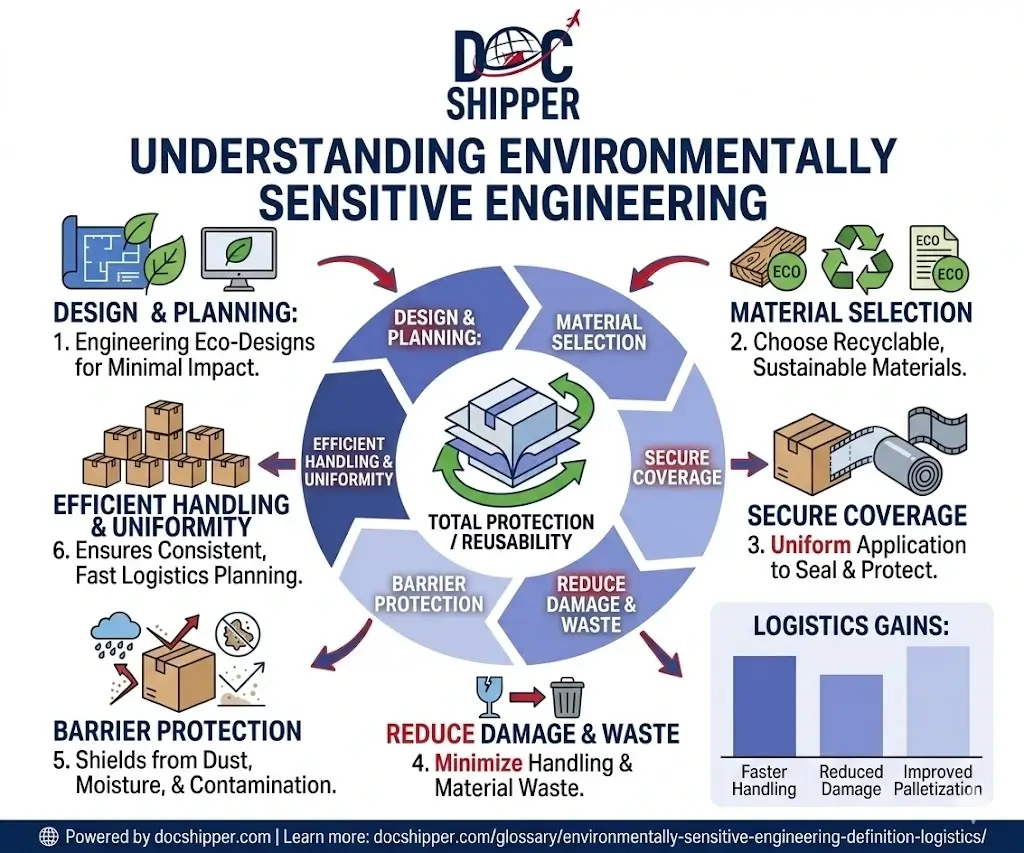
Environmentally Sensitive Engineering operates on five foundational principles. Understanding these mechanisms enables effective integration into logistics operations.
Impact assessment and prevention forms the first pillar. Engineers conduct thorough environmental impact studies before project initiation. These assessments identify potential harm to ecosystems, water sources, air quality, and biodiversity. Prevention strategies are then embedded into project design rather than added as afterthoughts.
Material selection and sourcing represents the second critical component. This involves choosing materials with lower carbon footprints, verified sustainable origins, and potential for end-of-life recycling. In warehouse construction, for example, this means selecting recycled steel, responsibly sourced timber, and low-VOC coatings.
Energy efficiency optimization drives the third principle. Modern logistics facilities incorporate renewable energy systems, LED lighting, smart HVAC controls, and automated systems that reduce power consumption. According to the International Energy Agency, energy-efficient warehouse design can reduce operational costs by 30-50% while significantly lowering emissions.
Waste minimization and circular processes constitute the fourth element. This includes designing for disassembly, establishing material recovery systems, and implementing closed-loop water treatment. Packaging optimization in freight operations exemplifies this principle through reduced material use and increased recyclability.
Continuous monitoring and adaptation completes the framework. Real-time environmental monitoring systems track emissions, resource consumption, and ecological indicators. This data enables rapid adjustments and continuous improvement.
At DocShipper, we systematically integrate these principles into supply chain design. Our consultants evaluate environmental factors during route planning, modal selection, and facility specification to ensure compliance and minimize ecological impact.
Concrete Applications & Industry Data
Real-world implementation demonstrates the tangible benefits of Environmentally Sensitive Engineering. Industry data reveals significant operational and environmental advantages.
Port Infrastructure Development
The Port of Rotterdam implemented environmentally sensitive design in its Maasvlakte 2 expansion. Engineers integrated natural dune formation, marine habitat creation, and shore-power systems for docked vessels. Results showed 20% reduction in CO2 emissions from berthed ships and successful establishment of protected bird nesting areas within operational zones.
Warehouse Construction Comparison
| Feature | Conventional Design | Environmentally Sensitive Design |
|---|---|---|
| Energy Consumption | 100 kWh/m²/year | 45 kWh/m²/year |
| Water Usage | Standard municipal supply | 60% rainwater harvesting |
| Construction Waste | 30% to landfill | 5% to landfill |
| Lifecycle Cost | Baseline | 18% lower over 25 years |
| Carbon Footprint | 850 tons CO2/year | 340 tons CO2/year |
Transportation Fleet Optimization
A European logistics provider applied environmentally sensitive principles to fleet management. The implementation included route optimization algorithms, driver eco-training, and aerodynamic vehicle modifications. Measured outcomes over 18 months:
- 14% fuel reduction across 500-vehicle fleet
- 22% decrease in NOx emissions in urban delivery zones
- Annual cost savings of €2.3 million
- Improved regulatory compliance in low-emission zones
- Enhanced corporate sustainability ratings
Packaging Innovation Case Study
An international shipper redesigned packaging using environmentally sensitive engineering. The project replaced expanded polystyrene with biodegradable mushroom-based materials and optimized box dimensions. Results included 40% reduction in packaging volume, 65% decrease in non-recyclable waste, and improved product protection during transit. The initiative reduced shipping costs by 12% through better container space utilization.
These examples demonstrate that environmental responsibility and operational efficiency are not mutually exclusive. Proper implementation creates competitive advantages while meeting sustainability requirements.
Conclusion
Environmentally Sensitive Engineering transforms logistics operations from environmental liabilities into sustainable assets. Companies that adopt these principles achieve regulatory compliance, cost reduction, and enhanced market positioning.
Need guidance implementing environmental best practices in your supply chain? Contact DocShipper for expert consultation on sustainable logistics solutions.
📚 Quiz
Test Your Knowledge: Environmentally Sensitive Engineering
What is the core definition of Environmentally Sensitive Engineering in logistics?
Which statement correctly describes the relationship between environmentally sensitive design and project timelines?
A small logistics company wants to adopt environmentally sensitive practices. What is the most accurate approach?
🎯 Your Results
📞 Free Quote in 24hFAQ | Environmentally Sensitive Engineering: Definition, Principles & Concrete Examples
Environmentally Sensitive Engineering integrates ecological considerations into every design phase, from material selection to end-of-life disposal. Conventional approaches typically address environmental concerns only when required by regulation, often as add-ons rather than fundamental design elements. The sensitive approach reduces lifecycle environmental impact by 40-60% while often decreasing long-term operational costs through efficiency gains and resource optimization.
Initial planning phases may extend by 15-20% due to comprehensive environmental assessments and stakeholder consultation. However, this investment prevents costly mid-project modifications, regulatory delays, and post-construction remediation. Projects incorporating environmental sensitivity from inception typically complete on schedule and avoid the 6-12 month delays common when environmental issues emerge during construction. Early integration streamlines permitting and reduces litigation risks.
Key frameworks include ISO 14001 (Environmental Management Systems), ISO 14040 (Life Cycle Assessment), and the IMO's MARPOL Convention for maritime operations. The European Union's Emissions Trading System and the International Maritime Organization's 2020 sulfur cap establish specific performance requirements. Additionally, LEED certification for buildings and the Global Reporting Initiative provide standardized metrics for measuring and reporting environmental performance in supply chain operations.
Yes, through scalable implementation. Small operators can begin with high-impact, low-cost measures: route optimization software (reducing fuel by 8-15%), driver training programs, LED lighting upgrades, and paperless documentation systems. These interventions typically achieve payback within 12-24 months. Gradual adoption of renewable energy, waste reduction programs, and efficient equipment follows as cash flow improves. Many regional incentive programs subsidize environmental upgrades for SMEs.
Four primary obstacles exist: initial capital requirements (typically 5-15% higher than conventional approaches), knowledge gaps among decision-makers, perceived complexity of environmental regulations, and short-term financial pressures. Overcoming these requires demonstrating total cost of ownership advantages, providing technical training, engaging environmental consultants early, and securing green financing options. Companies that address these barriers systematically report successful transitions within 18-36 months.
Site selection must evaluate proximity to sensitive ecosystems, flood risk zones, groundwater protection areas, and air quality management districts. Environmentally sensitive analysis considers transportation emission impacts based on location relative to suppliers and customers. Optimal sites balance environmental constraints with logistics efficiency—often resulting in locations that reduce total supply chain emissions by 20-30% compared to cost-only optimization. This approach also minimizes regulatory complications and community opposition.
Technology enables precise monitoring, optimization, and reporting. IoT sensors track real-time energy consumption, emissions, and resource usage. AI algorithms optimize routing to minimize fuel consumption and emissions. Building management systems automatically adjust HVAC and lighting based on occupancy and weather. Blockchain provides transparent supply chain traceability for sustainable sourcing verification. Digital twins allow testing environmental scenarios before physical implementation, reducing trial-and-error costs.
The approach applies four strategies: material substitution (replacing plastics with biodegradable alternatives), dimensional optimization (reducing void space by 30-50%), reusable container systems (eliminating single-use packaging for regular routes), and design for disassembly (enabling easy separation of materials for recycling). These methods reduce packaging waste by 40-70% while maintaining product protection. Some systems achieve complete closed-loop packaging cycles for specific trade lanes.
Environmental liability insurance costs typically decrease by 10-25% for projects demonstrating proactive environmental management. Comprehensive documentation of environmental measures provides legal protection against future claims. Many insurers offer premium reductions for ISO 14001 certification and proven environmental performance records. Conversely, projects without environmental due diligence face higher premiums, coverage exclusions for pollution events, and increased vulnerability to third-party environmental damage claims.
ISO 14001 standards recommend annual comprehensive audits with quarterly performance reviews. High-risk operations (chemical handling, port facilities, cold chain logistics) benefit from semi-annual detailed assessments. Real-time monitoring systems should track key indicators continuously, with automated alerts for threshold violations. Third-party verification adds credibility for sustainability reporting and regulatory compliance. This frequency identifies improvement opportunities while demonstrating due diligence to regulators and stakeholders.
Significantly. Diversified energy sources (solar, wind, grid) prevent single-point-of-failure vulnerabilities. Water recycling systems maintain operations during droughts. Climate-adapted infrastructure withstands extreme weather better than conventional designs. Resource efficiency creates cost buffers during price volatility. Environmental risk assessment identifies supply chain vulnerabilities to regulatory changes, natural disasters, and resource scarcity. Companies with environmentally sensitive operations report 30-40% faster recovery from disruptions compared to conventional facilities.
Multiple mechanisms support green logistics investments: government grants for renewable energy installations (covering 20-40% of costs), tax credits for energy-efficient equipment, accelerated depreciation for environmental technology, low-interest green bonds, and preferential customs treatment in some jurisdictions. The EU's Green Deal allocates €1 trillion for sustainable infrastructure. Many development banks offer concessional financing for projects meeting environmental criteria. Carbon credit programs provide ongoing revenue streams for emission reductions.
Need Help with
Logistics or Sourcing ?
First, we secure the right products from the right suppliers at the right price by managing the sourcing process from start to finish. Then, we simplify your shipping experience - from pickup to final delivery - ensuring any product, anywhere, is delivered at highly competitive prices.


Fill the Form
Prefer email? Send us your inquiry, and we’ll get back to you as soon as possible.
Contact us




