


In short ⚡
The Expiry Date is the last day on which a product, document, or contractual obligation remains valid or usable. In international logistics, it determines customs clearance eligibility, storage management, and regulatory compliance. Beyond perishable goods, expiry dates govern licenses, certificates of origin, insurance policies, and trade agreements, making them critical checkpoints in global supply chains.
Introduction
Imagine a shipment of pharmaceutical products stuck at customs because the health certificate expired two days before arrival. Or a container of organic coffee rejected at port due to expired organic certification. These scenarios cost importers thousands in demurrage fees, disposal costs, and lost contracts.
In international trade, expiry dates create temporal risk points that require precise coordination between production, transit, and clearance. Missing an expiry date can trigger inspection holds, product destruction, or legal penalties. Understanding how expiry dates operate across different contexts protects cargo value and ensures supply chain continuity.
Key expiry date categories in logistics include:
- Product shelf life: Food, cosmetics, pharmaceuticals, chemicals with consumption deadlines
- Regulatory documentation: Certificates of origin, phytosanitary certificates, health permits
- Commercial instruments: Letters of credit, insurance policies, import licenses
- Transport documents: Fumigation certificates, dangerous goods declarations
- Intellectual property: Patent protections, trademark registrations affecting parallel imports
Deep Dive & Technical Expertise
Expiry dates operate within multiple legal frameworks simultaneously. A shipment crossing three countries must satisfy the expiry requirements of origin regulations, transit rules, and destination standards. The EU General Food Law (Regulation 178/2002) mandates specific date marking formats, while FDA regulations require different labeling for the United States.
The calculation methodology varies by product category. For pharmaceuticals, the stability testing protocol determines expiry under ICH Q1A guidelines, accounting for storage conditions and degradation rates. Food products follow Codex Alimentarius standards, where “use by” dates indicate safety thresholds while “best before” dates suggest quality parameters.
Documentation expiry poses distinct challenges. A certificate of origin typically remains valid for 12 months from issuance, but preferential trade agreements may impose shorter windows. According to World Customs Organization guidelines, expired origin certificates void tariff preferences, exposing importers to full duty rates.
Insurance coverage follows policy term limits strictly. Marine cargo insurance expires precisely at the policy end date, leaving goods unprotected even if still in transit. The Institute Cargo Clauses specify that coverage terminates 60 days after vessel discharge or upon delivery, whichever occurs first, creating expiry pressure points during delayed clearance.
At DocShipper, we implement expiry date tracking systems that monitor all time-sensitive documents and products throughout the shipping process. Our customs experts verify documentation validity before vessel departure, preventing clearance rejections due to expired certificates. For perishable cargo, we calculate backwards from destination expiry requirements to optimize routing and storage conditions.
The legal liability framework shifts depending on Incoterms. Under DDP terms, the seller bears responsibility for ensuring all import documents remain valid through clearance. FOB terms transfer this risk at the port of loading. When expired documents cause delays, liability for demurrage and storage fees depends on contractual allocation of customs clearance responsibilities.
Concrete Examples & Data
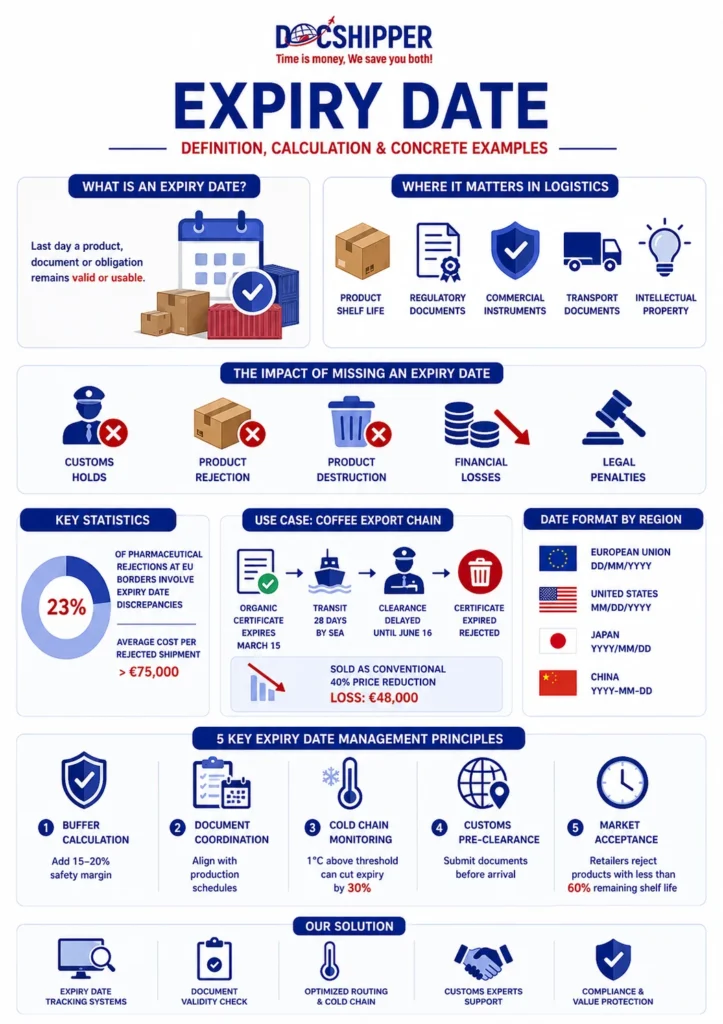
Real-world expiry management reveals the financial impact of temporal coordination. Industry data shows that 23% of pharmaceutical rejections at EU borders involve expiry date discrepancies, according to European Medicines Agency import refusal reports. The average cost per rejected pharmaceutical shipment exceeds €75,000 when factoring disposal, return shipping, and replacement production.
Use Case: Coffee Export Chain
A Brazilian coffee exporter ships 20 tons of organic beans to Germany. The organic certificate expires 90 days after issuance on March 15. Transit time is 28 days by sea, plus 5-7 days for customs clearance. To maintain validity, the shipment must clear customs by June 13. Port congestion delays clearance until June 16, three days past expiry. German customs rejects the organic certification, forcing the importer to sell the coffee as conventional at a 40% price reduction—a loss of €48,000 on this single shipment.
Comparative analysis of expiry date formats demonstrates regulatory complexity:
| Region | Date Format | Terminology | Regulatory Basis |
|---|---|---|---|
| European Union | DD/MM/YYYY | “Use by” / “Best before” | EU Regulation 1169/2011 |
| United States | MM/DD/YYYY | “Expiration date” / “Best if used by” | FDA Food Code |
| Japan | YYYY/MM/DD | 賞味期限 (shōmikigen) | Food Sanitation Act |
| China | YYYY-MM-DD | 保质期 (bǎozhìqī) | GB 7718-2011 |
Five critical expiry date management principles emerge from logistics data:
- Buffer calculation: Add 15-20% safety margin to minimum shelf life requirements for unforeseen delays
- Document coordination: Align certificate issuance dates with production schedules, not shipping dates
- Cold chain monitoring: Temperature excursions reduce effective shelf life—1°C above threshold can cut expiry by 30%
- Customs pre-clearance: Submit documentation before arrival to consume less shelf life during clearance
- Market acceptance windows: Retailers typically reject products with less than 60% remaining shelf life
A pharmaceutical case study illustrates financial optimization. A generic drug manufacturer ships temperature-sensitive vaccines with a six-month expiry window. By switching from standard FCL shipping (35 days) to air freight (5 days), the company gains 30 additional days of marketable shelf life. Despite air freight costing $12,000 more per shipment, the extended selling window generates $67,000 in additional revenue by accessing retail channels that require minimum 150-day shelf life at receipt.
Conclusion
Expiry date management transforms from administrative detail to strategic competitive advantage when executed with precision. Success requires integrating production timing, logistics speed, and regulatory knowledge into a unified temporal strategy that maximizes product value while ensuring compliance.
Need expert guidance on managing expiry dates across your international supply chain? Contact DocShipper for customized solutions that protect your cargo value and ensure on-time delivery.
📚 Quiz
Test Your Knowledge: Expiry Date
What does an expiry date primarily determine in international logistics?
A certificate of origin expires during customs clearance. What is the most likely consequence?
A pharmaceutical shipment has a 6-month expiry window. Most retailers require 60% remaining shelf life at receipt. How should you calculate minimum production-to-clearance time?
🎯 Your Result
📞 Free Quote in 24hFAQ | Expiry Date: Definition, Calculation & Concrete Examples
Customs authorities typically place the shipment on hold pending document renewal or reject entry entirely. For perishable goods, this often means total loss. The importer faces storage fees, demurrage charges, and potential disposal costs. In some jurisdictions, expired certificates void preferential tariff treatment, requiring payment of full duty rates. The financial impact depends on product value, storage duration, and local regulations governing expired imports.
Start with destination market requirements—most retailers demand 60-75% of total shelf life remaining at receipt. Work backwards: add transit time, customs clearance (typically 5-10 days), inland distribution (3-7 days), and a 15% buffer for delays. For a product with 12-month shelf life shipping to Europe via ocean (30 days), you need approximately 10.5 months remaining at production. This calculation must account for production-to-shipment lag and seasonal port congestion patterns.
Product expiry dates cannot be altered once labeled, as they reflect stability testing under specific conditions. However, regulatory documentation like certificates of origin or phytosanitary certificates can sometimes be renewed before expiration if goods remain under customs control. This requires coordination with issuing authorities and may incur reissue fees. For products, the only option is expedited shipping to beat expiration or negotiated acceptance by buyers at reduced prices for shortened shelf life.
"Use by" indicates a safety deadline—consuming products after this date poses health risks, common for meat, dairy, and ready-to-eat meals. "Best before" suggests quality degradation—products remain safe but may lose flavor, texture, or nutritional value, typical for dry goods and canned items. In logistics, "use by" dates create absolute barriers to import, while "best before" dates allow more flexibility depending on destination regulations and buyer acceptance criteria.
No. Date format inconsistency causes significant customs delays. The US uses MM/DD/YYYY, Europe DD/MM/YYYY, and Asia often YYYY/MM/DD. Beyond format, terminology differs—Japan distinguishes between consumption deadline and quality deadline with separate terms. Some countries require bilingual labeling. Smart exporters include multiple format representations and ensure compliance with destination-specific regulations like EU FIC or China's GB standards to avoid rejection at borders.
This varies by document type and issuing authority. Certificates of origin are typically valid for 12 months but should be issued within 30 days of shipment for trade agreement compliance. Phytosanitary certificates must be issued within 14 days of export for most countries. Health certificates for animal products often require issuance within 48 hours of departure. Timing coordination with production schedules and booking confirmations prevents last-minute document rushes that create expiry risks.
Modern systems use barcode scanning, RFID tags, and IoT sensors to monitor expiry dates automatically. Cold chain solutions integrate temperature monitoring with shelf-life algorithms that adjust expiry predictions based on actual storage conditions. Blockchain platforms create immutable records of production dates and certificate issuance. AI-powered logistics software calculates optimal routing based on expiry constraints, recommending air freight when ocean transit would exceed shelf-life buffers, balancing cost against product value preservation.
Liability depends on Incoterms and the cause of delay. Under DDP terms, the seller assumes risk until delivery, including expiry during customs processes they control. With DAP or CIF terms, risk transfers upon arrival, making the buyer responsible for timely clearance. However, if delays result from incorrect documentation provided by the seller, liability may revert. Insurance coverage typically excludes expiry losses unless specifically endorsed. Clear contractual language and customs broker selection critically impact financial exposure.
Buyer acceptance doesn't override regulatory requirements. If destination customs or health authorities mandate minimum shelf life percentages, shipments failing this standard face rejection regardless of commercial agreements. However, for products without regulatory minimums, negotiated short-date shipments at discounted prices are common. Document the buyer's explicit acceptance in writing and ensure it references specific expiry dates to prevent disputes. Some markets prohibit sale of near-expiry items, particularly pharmaceuticals and infant formula.
FTAs often impose stricter timelines than standard origin rules. USMCA requires certificates to be completed before or upon importation with strict retroactive limits. EU GSP schemes demand certification within specific windows relative to shipment dates. If origin certificates expire between shipment and clearance, preferential tariff treatment is lost, potentially adding 10-25% duty costs. Forward-thinking exporters coordinate certificate issuance with booking confirmations and share tracking data with customs brokers to ensure validity through final clearance.
The top five errors include: (1) calculating shelf life from production date rather than packaging date; (2) ignoring that customs clearance consumes shelf life even though goods haven't reached buyers; (3) failing to account for different date format interpretations causing rejection; (4) assuming all certificates issued together share the same validity period; and (5) neglecting to verify that fumigation or treatment certificates remain valid through the entire journey, not just until port arrival. Each mistake typically costs $5,000-$50,000 per incident in fees and lost product value.
Temperature deviations accelerate chemical degradation and biological activity, effectively shortening shelf life even though the printed expiry date remains unchanged. Pharmaceuticals following ICH stability guidelines may lose potency 2-3 times faster when stored 5°C above specification. Some buyers contractually require shelf-life adjustments based on temperature logger data. Cold chain failures can render products unsellable despite technically valid expiry dates because quality testing reveals degradation. Continuous temperature monitoring with automated alerts prevents these hidden shelf-life losses.
Need Help with
Logistics or Sourcing ?
First, we secure the right products from the right suppliers at the right price by managing the sourcing process from start to finish. Then, we simplify your shipping experience - from pickup to final delivery - ensuring any product, anywhere, is delivered at highly competitive prices.


Fill the Form
Prefer email? Send us your inquiry, and we’ll get back to you as soon as possible.
Contact us




