


In short ⚡
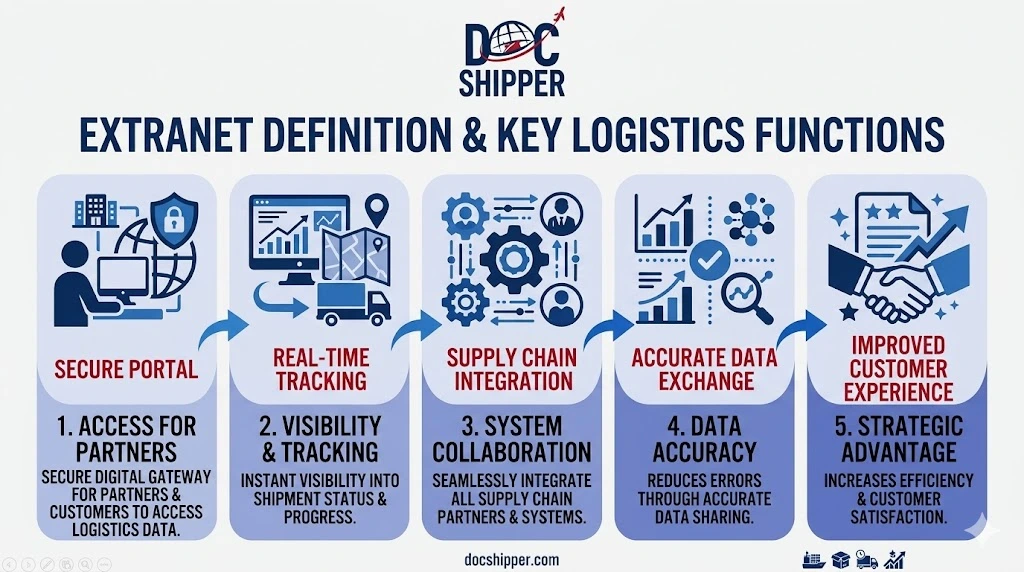
An extranet is a controlled private network that extends an organization's internal resources to select external partners, suppliers, or customers using internet protocols. Unlike intranets (internal-only) or the public internet, extranets provide secure, authenticated access to specific business data, enabling seamless collaboration while maintaining confidentiality and operational efficiency across the supply chain.
Introduction
In international logistics, miscommunication between shippers, freight forwarders, and customs brokers causes 67% of shipment delays according to supply chain management studies. Without real-time visibility, businesses struggle to coordinate documentation, track inventory, and respond to regulatory changes.
Extranets solve this challenge by creating secure digital bridges between organizations. Rather than relying on emails, phone calls, or scattered platforms, logistics providers and their clients access centralized systems where critical information flows instantly and transparently.
Key characteristics of logistics extranets include:
- Selective access control: Partners see only data relevant to their role and contracts
- Real-time synchronization: Inventory levels, shipment statuses, and documents update automatically
- Compliance frameworks: Built-in protocols align with customs regulations like AES, EORI, or HS code validation
- Audit trails: Every transaction, document upload, and status change is timestamped and traceable
- Mobile compatibility: Users manage shipments from any device during transit or at warehouses
Technical Framework & Security Architecture
Extranets operate through VPN tunnels, SSL/TLS encryption, and multi-factor authentication to ensure data integrity. Unlike open internet connections, extranet traffic is encrypted end-to-end, preventing unauthorized interception during transmission.
The authentication layer uses role-based access control (RBAC), where permissions are granularly defined. For example, a customs broker may view clearance documents but cannot modify freight rates, while a warehouse partner accesses inventory data without seeing financial invoices.
API integration forms the backbone of modern extranets. Systems connect with ERP platforms (SAP, Oracle), TMS software, and government databases like the EU’s Customs Decision System. This enables automated data exchange—when a container is released at a port, the extranet updates all stakeholders simultaneously.
From a compliance perspective, extranets enforce data residency rules required by GDPR or China’s Cybersecurity Law. Information remains within approved geographic servers, and audit logs prove regulatory adherence during inspections.
At DocShipper, our extranet platform integrates directly with customs systems across 50+ countries. Clients upload commercial invoices, packing lists, and certificates of origin once—our system automatically formats them to meet destination country requirements, reducing clearance time by an average of 40%.
Practical Applications & Performance Data
Logistics extranets transform theoretical efficiency into measurable outcomes. Consider a comparison between traditional email-based coordination and extranet-enabled workflows:
| Process | Email Method | Extranet Method | Time Saved |
|---|---|---|---|
| Bill of Lading Approval | 6-8 hours (waiting for responses) | 15 minutes (instant notifications) | 92% |
| Customs Documentation | 2-3 days (manual compilation) | 30 minutes (auto-population) | 95% |
| Shipment Tracking Updates | Daily manual reports | Real-time GPS integration | 100% |
| Invoice Reconciliation | 5-7 business days | 2 hours (automated matching) | 86% |
Use Case: A European electronics importer sources components from Southeast Asia. Before implementing an extranet, their logistics partner communicated shipment statuses via weekly email summaries. When a typhoon delayed vessel departure, the importer learned about the 72-hour delay only after the original ETA passed, causing production line shutdowns.
After deploying an extranet with real-time carrier API feeds, the system automatically alerted all parties when the vessel diverted. The importer rescheduled production, the freight forwarder arranged alternative warehousing, and customs pre-cleared documents during the delay. Result: Zero downtime and $18,000 in avoided rush fees.
Key performance indicators from extranet adoption studies show:
- Documentation errors: Reduced by 73% through template standardization
- Communication overhead: 58% fewer emails and calls per shipment
- Dispute resolution time: Cut from 3 weeks to 4 days with shared audit trails
- Client satisfaction scores: Increased by 41% due to proactive visibility
- Onboarding time for new partners: Decreased from 2 weeks to 48 hours
Conclusion
Extranets eliminate information silos in international logistics by providing secure, real-time collaboration between trading partners. As supply chains grow more complex, the ability to share data instantly while maintaining strict access controls becomes a competitive necessity rather than a luxury.
Need an extranet solution tailored to your shipping operations? Contact DocShipper to discover how our integrated platform connects your suppliers, freight forwarders, and customs brokers in one secure environment.
📚 Quiz
Test Your Knowledge: Extranet
What is the primary defining characteristic of an extranet compared to the public internet?
A logistics coordinator claims that extranets and VPNs serve identical functions. Which statement correctly addresses this misconception?
A typhoon delays a vessel departure by 72 hours. In an extranet-enabled supply chain, what is the expected operational outcome compared to traditional email-based communication?
🎯 Your Result
📞 Free Quote in 24hFAQ | Extranet: Definition, Functions & Practical Use Cases
A VPN creates a secure tunnel for any data transmission, while an extranet is a structured application layer built atop VPN protocols. Extranets include role-based dashboards, workflow automation, and business logic specific to logistics operations—features absent in basic VPN connections that merely encrypt traffic.
Modern cloud-based extranets operate on subscription models starting under $100/month for basic logistics functionality. Providers like DocShipper offer scalable plans where costs correlate with shipment volume rather than fixed infrastructure investments, making them accessible even for businesses handling 20-50 shipments annually.
Enterprise extranets support Unicode character sets and dynamic translation engines. When a Chinese supplier uploads a packing list, the system can auto-translate key fields into English, French, or Spanish for downstream partners while preserving original documents for compliance purposes. Machine learning models continuously improve translation accuracy for logistics terminology.
Robust extranets employ offline caching—users download critical documents and data to local devices before connectivity loss. Once reconnected, the system synchronizes changes bidirectionally. For time-sensitive operations like customs clearance, SMS alerts and alternative communication protocols activate automatically as failsafes.
Leading logistics extranets align with Customs-Trade Partnership Against Terrorism standards by implementing access logging, encryption at rest, annual penetration testing, and vendor security audits. Compliance modules generate reports demonstrating adherence to CBP's supply chain security criteria during C-TPAT validation reviews.
Through RESTful APIs or EDI protocols, extranets sync with ERP platforms like SAP, Oracle NetSuite, or Microsoft Dynamics. Shipment data automatically populates accounting modules, inventory levels update procurement systems, and customs clearance statuses trigger financial workflows—eliminating manual data entry and reconciliation errors.
Advanced extranets include built-in tariff classification databases cross-referenced with WCO standards. When suppliers declare products, the system validates HS codes against historical shipments and flags discrepancies. Some platforms use AI to suggest correct classifications based on product descriptions, reducing duty miscalculations by up to 68%.
Intuitive interface design reduces training to 2-4 hours for basic users. Most platforms include role-specific tutorials, contextual help tooltips, and simulated workflows. For power users managing complex operations like consolidated shipments or bonded warehousing, providers offer 1-2 day certification courses covering advanced features.
Systems display timestamps in users' local time zones while storing data in UTC format backend. Automated workflows account for business hours—if a Shanghai supplier uploads documents at 10 PM CST, the system queues review tasks for European partners during their morning hours rather than sending disruptive midnight notifications.
Some next-generation extranets integrate with blockchain networks like TradeLens or IBM Food Trust. Each milestone—factory pickup, port loading, customs clearance—creates an immutable ledger entry. This proves particularly valuable for pharmaceuticals, luxury goods, or conflict minerals requiring transparent chain-of-custody documentation.
Yes, through permission hierarchies. A shipper might grant primary forwarder full visibility while allowing backup forwarders read-only access to rates and routing options. The system maintains separate communication threads and prevents data leakage between competitors through strict data partitioning at database level.
Enterprise solutions mandate 99.9% uptime SLAs backed by redundant data centers across geographies. Automated backups occur every 4 hours, with point-in-time recovery capabilities. In catastrophic failures, hot-standby environments activate within 15 minutes, ensuring continuous access to shipment-critical information during emergencies or cyberattacks.
Need Help with
Logistics or Sourcing ?
First, we secure the right products from the right suppliers at the right price by managing the sourcing process from start to finish. Then, we simplify your shipping experience - from pickup to final delivery - ensuring any product, anywhere, is delivered at highly competitive prices.


Fill the Form
Prefer email? Send us your inquiry, and we’ll get back to you as soon as possible.
Contact us




