


In short ⚡
Flexibility in logistics refers to a supply chain's ability to adapt quickly to unforeseen changes—demand fluctuations, disruptions, regulatory shifts, or market volatility—while maintaining service levels and controlling costs. It encompasses operational agility, infrastructure scalability, and strategic responsiveness across procurement, warehousing, transportation, and distribution networks.Introduction
In today’s volatile global trade environment, rigid supply chains collapse under pressure. Port congestion, sudden tariff changes, pandemic-related factory shutdowns, or unexpected demand surges expose companies lacking logistical flexibility. The ability to pivot—reroute shipments, switch carriers, adjust inventory levels, or activate alternative suppliers—determines business continuity and competitive advantage.
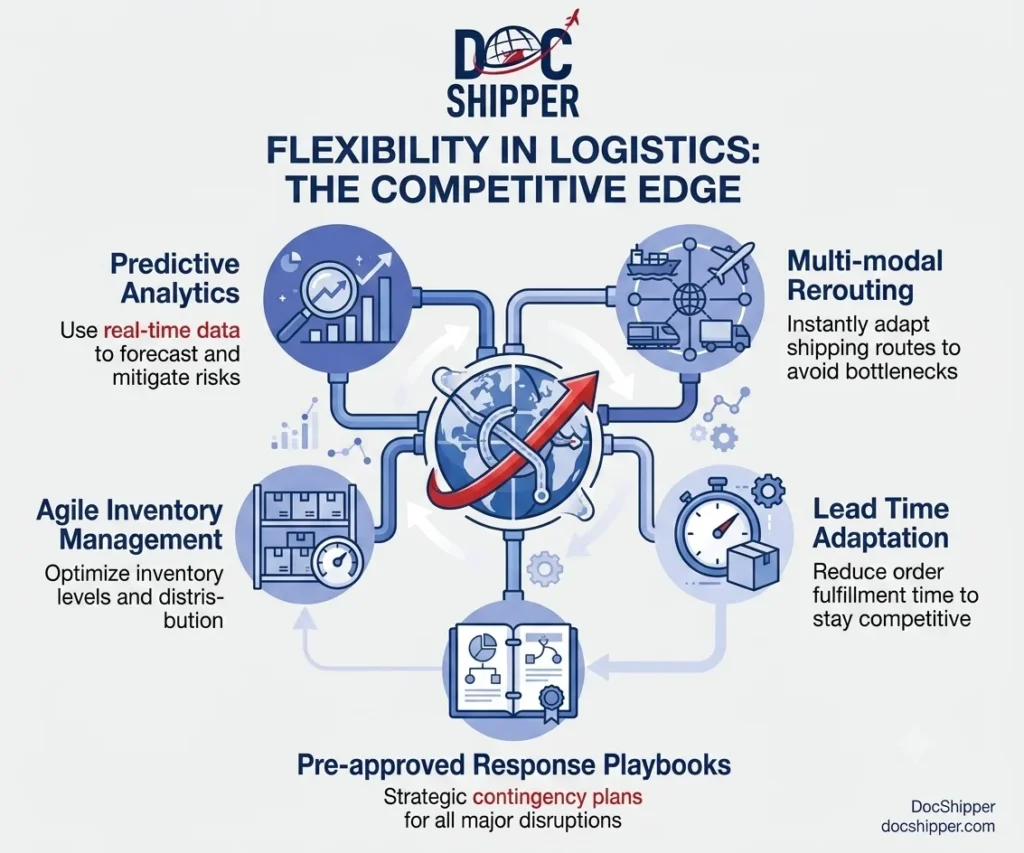
Flexibility transforms reactive firefighting into proactive resilience. Companies achieve it through diversified supplier networks, multi-modal transport options, agile warehousing solutions, and real-time data systems. The concept extends beyond emergency response: it drives everyday efficiency, customer satisfaction, and cost optimization.
Key characteristics include:
- Demand responsiveness: Scaling operations up or down based on market signals
- Route diversification: Maintaining alternative transport corridors and carrier partnerships
- Inventory adaptability: Dynamic stock positioning across multiple fulfillment centers
- Supplier redundancy: Dual or multi-sourcing strategies to mitigate single-point failures
- Technology integration: Real-time visibility platforms enabling rapid decision-making
Strategic Dimensions & Operational Framework
Logistical flexibility operates across three strategic layers: structural flexibility (infrastructure and partnerships), tactical flexibility (process adaptability), and operational flexibility (day-to-day execution agility). Structural investments include establishing relationships with multiple freight forwarders, maintaining warehouses in different regions, and negotiating flexible contract terms.
Tactical flexibility involves adaptive planning mechanisms. Rolling forecasts replace static annual budgets. S&OP (Sales and Operations Planning) cycles shorten from monthly to weekly. Scenario planning models simulate disruptions—strike risks, weather events, geopolitical tensions—allowing pre-emptive mitigation strategies. Companies deploy postponement strategies, delaying final product customization until demand patterns clarify.
Operational agility manifests in modal interchangeability. Air freight substitutes for delayed ocean shipments. Rail corridors provide alternatives to congested trucking routes. Cross-docking reduces warehouse dwell time, accelerating throughput. Advanced warehouse management systems (WMS) enable dynamic slotting, optimizing pick paths as inventory compositions shift.
Regulatory compliance adds complexity. The EU’s Authorized Economic Operator (AEO) certification facilitates customs clearance flexibility through trusted trader status. However, Brexit triggered new border requirements, forcing companies to establish dual inventory pools and customs brokerage capacity across UK-EU corridors.
At DocShipper, we design supply chain flexibility blueprints tailored to client risk profiles, balancing redundancy costs against disruption exposure. Our multi-carrier network and regional warehouse partnerships provide immediate pivot options when standard routes fail.
Real-World Applications & Performance Metrics
Consider a European electronics retailer facing a 40% surge in online orders during Black Friday. Flexible logistics enables:
| Capability | Rigid Approach | Flexible Approach |
|---|---|---|
| Warehousing | Single central DC, overwhelmed | Activates 3 overflow facilities within 48 hours |
| Transportation | Fixed carrier capacity, shipments delayed 7+ days | Spot market bookings, cross-border trucking supplements |
| Inventory | Stockouts on 30% of SKUs | Safety stock pre-positioned in regional hubs, 98% availability |
| Labor | Overtime limits hit, orders backlogged | Temporary staffing agencies on standby contracts |
Performance metrics for flexibility include supply chain velocity (order-to-delivery cycle time variability), capacity utilization elasticity (% change in throughput per unit of demand change), and cost-to-serve volatility (standard deviation of per-unit logistics costs across demand scenarios).
A pharmaceutical company shipping temperature-sensitive vaccines illustrates risk mitigation flexibility. Primary route: Shanghai → Rotterdam → Frankfurt distribution center. When Rotterdam experiences labor strikes, the flexible plan activates:
- Alternative routing: Divert to Hamburg port, truck to Frankfurt (+18 hours)
- Carrier swap: Switch from Ocean Carrier A to Air Freight Charter (cost +220%, time -5 days)
- Cold chain backup: Pre-qualified GDP-compliant warehouse in Hamburg stores product temporarily
- Regulatory clearance: Dual customs broker relationships ensure no import delays
- Cost recovery: Insurance claim filed under cargo policy’s delay coverage
Industry data shows companies with high flexibility scores achieve 15-25% better service levels during disruptions while incurring only 8-12% higher baseline logistics costs. The flexibility premium proves cost-effective when disruption frequency exceeds twice annually.
Conclusion
Flexibility is not a luxury but a fundamental requirement in modern international logistics. It transforms supply chains from fragile sequences into resilient networks capable of absorbing shocks and capitalizing on opportunities. The strategic investments—diversified partnerships, technology platforms, scenario planning—pay dividends through sustained service levels and competitive differentiation.
Need help building supply chain flexibility into your operations? Contact DocShipper for a customized resilience assessment and implementation roadmap.
📚 Quiz
Test Your Knowledge: Flexibility in Logistics
What is the primary definition of flexibility in logistics?
Which statement correctly distinguishes flexibility from agility in supply chain management?
A pharmaceutical company's primary Shanghai-Rotterdam-Frankfurt vaccine route faces Rotterdam port strikes. Which response demonstrates logistical flexibility?
🎯 Your Results
📞 Free Personalized QuoteFAQ | Flexibility in Logistics: Definition, Strategic Impact & Concrete Examples
Need Help with
Logistics or Sourcing ?
First, we secure the right products from the right suppliers at the right price by managing the sourcing process from start to finish. Then, we simplify your shipping experience - from pickup to final delivery - ensuring any product, anywhere, is delivered at highly competitive prices.


Fill the Form
Prefer email? Send us your inquiry, and we’ll get back to you as soon as possible.
Contact us




