


In short ⚡
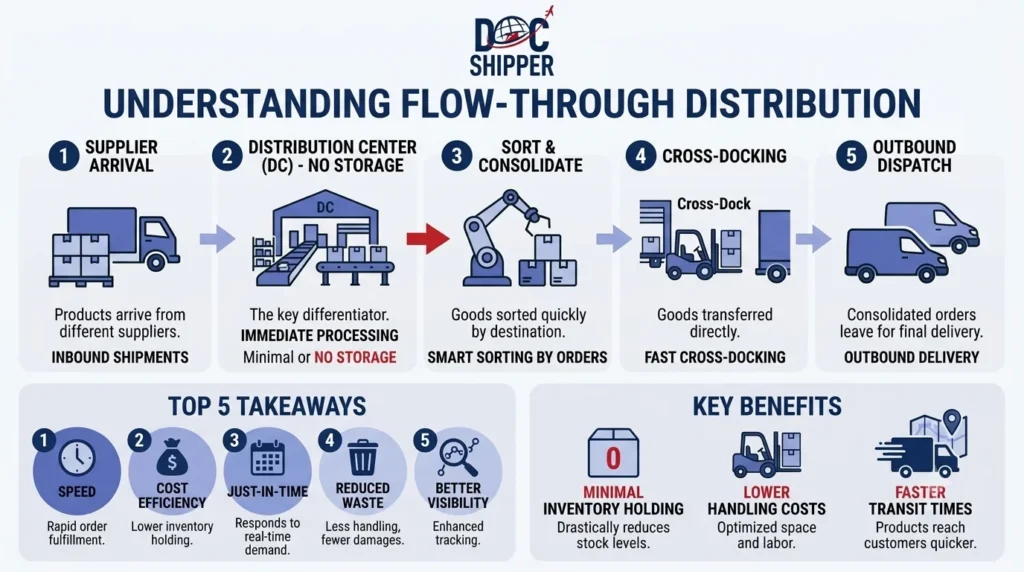
Flow-through distribution is a logistics strategy where imported goods bypass traditional warehouse storage and are immediately redistributed to final destinations. This cross-docking method minimizes inventory holding time, reducing warehousing costs while accelerating supply chain velocity for time-sensitive or high-turnover products in international trade operations.
Introduction
Most importers struggle with a critical dilemma: inventory costs versus delivery speed. Traditional warehousing requires capital for storage space, handling, and insurance, yet delays product availability. Flow-through distribution eliminates this trade-off by synchronizing inbound shipments with outbound distribution schedules.
This methodology proves particularly relevant in global commerce where margin compression and customer expectations demand operational efficiency. Unlike conventional distribution centers that hold inventory for weeks or months, flow-through facilities function as velocity hubs, typically processing goods within 24-48 hours of arrival.
Key characteristics of flow-through distribution include:
- Minimal dwell time: Products remain in the facility less than 72 hours
- Pre-planned allocation: Final destinations determined before customs clearance
- Synchronized transportation: Inbound and outbound logistics coordinated in real-time
- Advanced sortation systems: Automated routing to consolidate shipments efficiently
- Regulatory compliance maintained: Customs procedures completed without storage delays
Strategic Mechanisms & Supply Chain Impact
Flow-through distribution operates on information synchronization rather than physical inventory buffering. Before containers arrive at port, distribution instructions are transmitted to logistics partners, enabling immediate sortation upon customs clearance. This requires sophisticated WMS (Warehouse Management Systems) integration with customs brokers and carriers.
The cross-docking methodology forms the operational core. Imported pallets are unloaded, quality-checked, and reconfigured into outbound shipments without intermediate storage. Two primary approaches exist: pre-distribution cross-docking (where allocation occurs before arrival) and post-distribution cross-docking (where sorting happens after physical inspection).
From a customs compliance perspective, flow-through distribution requires meticulous documentation. Goods must clear customs before redistribution, meaning brokers coordinate release procedures while transportation teams simultaneously prepare outbound routing. At DocShipper, we verify all customs documentation in advance to prevent clearance delays that would disrupt the flow-through timeline.
Infrastructure requirements distinguish successful flow-through operations. Facilities need multiple dock doors for simultaneous loading/unloading, conveyor systems for rapid sortation, and staging areas organized by outbound routes. Temperature-controlled zones may be necessary for perishables, while security protocols ensure high-value goods remain traceable throughout the 24-hour processing window.
The financial impact extends beyond obvious warehousing savings. Reduced inventory holding decreases working capital requirements, improves cash flow cycles, and minimizes obsolescence risk for fashion or technology products. Insurance premiums decline when goods spend minimal time in static storage, and product freshness improves for consumables—critical factors in competitive markets where shelf life drives purchasing decisions.
Concrete Examples & Performance Data
Comparative analysis demonstrates quantifiable advantages of flow-through distribution versus traditional warehousing:
| Metric | Traditional Warehousing | Flow-Through Distribution |
|---|---|---|
| Average Dwell Time | 14-21 days | 24-48 hours |
| Handling Touches | 4-6 times (receive, put-away, pick, pack, ship) | 2-3 times (receive, sort, ship) |
| Storage Cost per Pallet | $8-15/day | $2-4/day |
| Damage/Loss Rate | 1.2-2.5% | 0.4-0.8% |
| Order Cycle Time | 5-7 days | 1-2 days |
Use Case: Electronics Retailer Seasonal Import
A European electronics chain imports 250,000 units of consumer devices from Asia during Q4. Traditional warehousing would cost €375,000 in storage fees over 30 days. By implementing flow-through distribution through Rotterdam, they achieve:
- Customs clearance synchronized with vessel arrival (Day 0)
- Automated sortation into 18 regional distribution routes (Day 1)
- Full-truck-load shipments departing within 36 hours (Day 1-2)
- Total facility cost: €62,000 (cross-dock fees + sortation)
- Net savings: €313,000 (83% reduction)
Fresh Produce Scenario: A North American grocer importing Ecuadorian bananas operates zero-inventory distribution. Refrigerated containers arrive at Miami, undergo USDA inspection at the port cross-dock facility, and are immediately loaded onto temperature-controlled trucks. Average port-to-store time: 18 hours versus 4-6 days with traditional cold storage, extending shelf life by 40%.
Automotive Parts Distribution: A Tier-1 supplier serving assembly plants across Mexico uses flow-through distribution at Laredo. Just-In-Time manufacturing demands 99.8% on-time delivery. Cross-docking enables parts imported from Germany to reach production lines within 48 hours of border crossing, maintaining assembly schedules without safety stock buffers.
Conclusion
Flow-through distribution represents a paradigm shift from inventory-centric to velocity-centric logistics, particularly valuable for importers managing high-volume, time-sensitive, or capital-intensive goods. The methodology demands operational precision but delivers measurable cost reductions and competitive advantages through accelerated market access.
Need assistance implementing flow-through distribution for your import operations? Contact DocShipper for customized logistics solutions that synchronize your inbound shipments with distribution requirements.
📚 Quiz
Test Your Knowledge: Flow-Through Distribution
What is the primary defining characteristic of flow-through distribution?
Which statement correctly describes the customs clearance process in flow-through operations?
A pharmaceutical importer receives temperature-sensitive vaccines requiring complex relabeling and compliance documentation taking 5-7 days. Is flow-through distribution appropriate for this scenario?
🎯 Your Results
📞 Free Personalized QuoteFAQ | Flow-Through Distribution: Definition, Process & Concrete Examples
High-turnover consumer goods, perishable items, seasonal products, and just-in-time manufacturing components gain maximum advantage. Products with predictable demand patterns, standardized packaging, and pre-sold inventory work best since destination allocation can occur before arrival, enabling seamless cross-docking operations.
Customs procedures remain identical, but coordination intensifies. Brokers must submit documentation earlier to ensure clearance coincides with vessel discharge. Electronic pre-clearance systems like CBP's ACE or EU's ICS2 facilitate this synchronization, allowing goods to exit ports immediately after physical release rather than waiting in bonded warehouses.
Advanced WMS with real-time inventory visibility, EDI integration connecting carriers/customs brokers/clients, automated sortation systems (conveyors, RFID scanners), TMS for route optimization, and cloud-based dashboards enabling stakeholders to track shipment status from origin to final delivery point are essential components.
Absolutely. Third-party logistics providers (3PLs) offer shared cross-dock facilities where multiple importers pool resources. Minimum volume requirements typically start at 10-15 pallets per week. Costs scale with throughput rather than storage duration, making it accessible for mid-sized operations importing regularly scheduled shipments.
Primary vulnerabilities include transportation delays disrupting tight schedules, quality issues discovered during cross-docking requiring rework space, and demand volatility causing last-minute destination changes. Mitigation strategies involve buffer time in scheduling, pre-shipment inspections at origin, and maintaining small safety stock at regional hubs for contingencies.
Workforce needs shift from traditional warehouse roles (forklift operators, pickers) toward sortation specialists and logistics coordinators. Peak activity concentrates around vessel arrivals, requiring flexible staffing models. Automation reduces manual handling but demands technical personnel for system maintenance. Overall labor hours per unit processed typically decrease 30-40%.
Standard import documents (commercial invoice, packing list, bill of lading) plus detailed distribution manifests specifying final destination routing, often at SKU level. Advance Shipping Notices (ASNs) transmitted electronically enable receiving facilities to prepare dock schedules. For regulated goods, compliance certificates must clear before cross-docking commences.
Consolidated shipments and reduced handling typically lower emissions 15-25% compared to traditional distribution. Eliminating warehouse HVAC/lighting for extended periods contributes significantly. However, tighter scheduling may require premium transportation modes (air freight, expedited trucking) that increase emissions, requiring careful route planning to maintain sustainability gains.
Limited services like labeling, kitting, or retail-ready packaging can integrate if they complete within the 24-48 hour window. Complex customization requiring extended processing times contradicts flow-through principles. Best practice involves completing value-added work at origin or dedicating separate zones within the facility for specialized handling outside primary cross-dock operations.
Critical safeguards include agreements with backup cross-dock facilities in adjacent ports, relationships with expedited carriers for emergency routing, maintained visibility into supplier production schedules to anticipate delays, and strategic safety stock at 2-3 regional nodes. Communication protocols ensuring all stakeholders receive real-time alerts prevent cascading failures across the distribution network.
Cargo insurance premiums often decrease due to reduced theft/damage exposure during minimal facility time. However, coverage must extend continuously from origin through final delivery without gaps during cross-docking. Policies should specify liability during sortation activities and address scenarios where goods require temporary holding due to transportation delays or quality holds.
Key indicators include average dwell time (target <48 hours), on-time departure rate (>95%), sortation accuracy (>99.5%), dock-to-stock cycle time, cost per unit handled, and perfect order percentage. Leading importers also track inventory turns (target >50x annually) and working capital days, measuring how flow-through distribution accelerates cash conversion cycles.
Need Help with
Logistics or Sourcing ?
First, we secure the right products from the right suppliers at the right price by managing the sourcing process from start to finish. Then, we simplify your shipping experience - from pickup to final delivery - ensuring any product, anywhere, is delivered at highly competitive prices.


Fill the Form
Prefer email? Send us your inquiry, and we’ll get back to you as soon as possible.
Contact us




