


In short ⚡
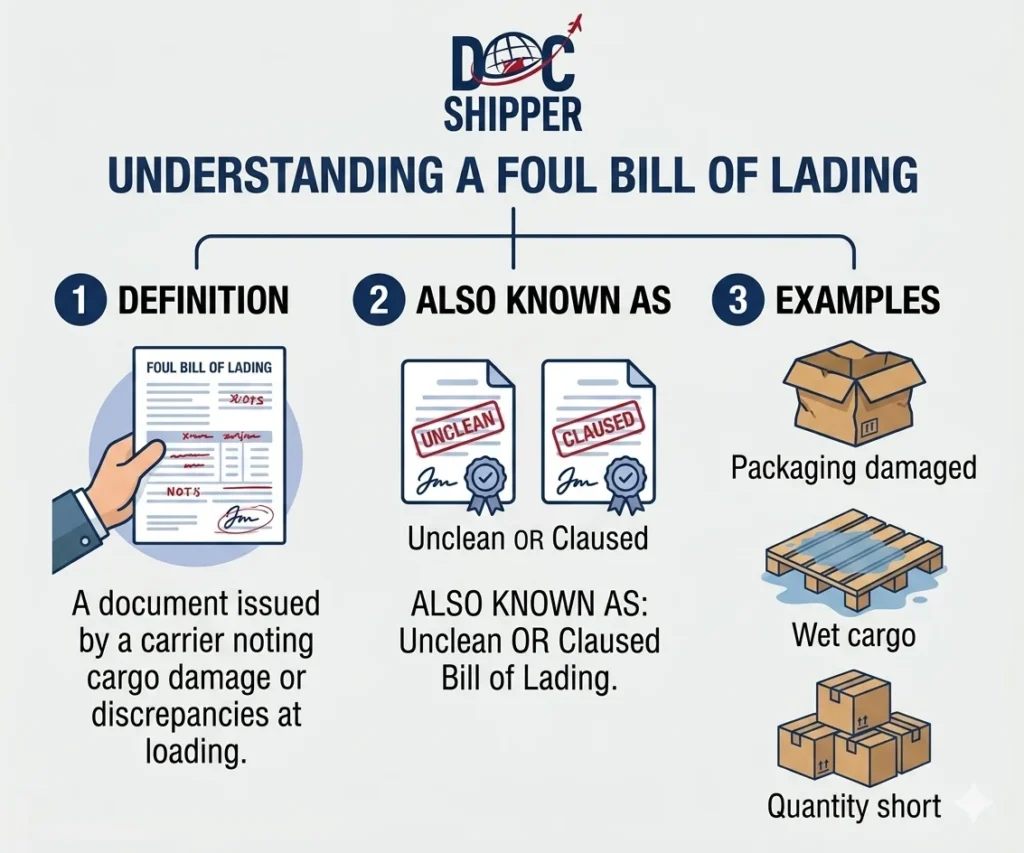
A Foul Bill of Lading (also called "Claused" or "Dirty" Bill of Lading) is a shipping document issued by the carrier indicating that the goods received for transport show visible damage, defective packaging, or discrepancies in quantity. Unlike a clean Bill of Lading, this document contains notations or clauses that highlight issues, making it a critical red flag in international trade and potentially complicating payment under Letters of Credit.
Introduction
In international shipping, documentation accuracy determines financial flows. When a carrier notes damage or irregularities on a Bill of Lading, it transforms into a Foul Bill of Lading—a document that can derail payments, insurance claims, and commercial relationships.
This instrument serves as both evidence and warning. For buyers, it signals potential quality issues. For sellers, it jeopardizes payment security under documentary credit arrangements. Understanding when and why Bills of Lading become “foul” is essential for risk management in logistics.
Key characteristics of a Foul Bill of Lading include:
- Carrier annotations: Written remarks describing visible defects or quantity discrepancies
- Payment complications: Banks typically reject foul Bills under Letter of Credit terms
- Liability documentation: Establishes evidence for insurance and legal claims
- Inspection requirement: Results from pre-shipment cargo examination by the carrier
- Negotiability impact: Severely limits document transferability in trade finance
Legal & Commercial Implications
The issuance of a Foul Bill of Lading triggers immediate commercial consequences. Under the Uniform Customs and Practice for Documentary Credits (UCP 600), Article 27 explicitly states that banks will refuse documents bearing clauses indicating defective condition of goods or packaging.
From a legal standpoint, the document serves as prima facie evidence in disputes. The carrier’s notations shift the burden of proof regarding cargo condition at the time of receipt. This becomes crucial when determining liability between shippers, carriers, and consignees during claims procedures.
The insurance ramifications are equally significant. Marine cargo insurance policies typically exclude claims for damage noted on a Foul Bill of Lading, as the defect existed before the insurance coverage period began. This leaves exporters vulnerable unless they secure specialized pre-shipment insurance.
Commercial trust suffers when foul documentation enters the transaction chain. Buyers interpret these clauses as warnings about supplier quality control. Repeated issuance of Foul Bills can damage long-term business relationships and supplier reputation in competitive markets.
At DocShipper, we conduct pre-shipment quality inspections to identify potential issues before carrier reception, preventing the issuance of Foul Bills and protecting our clients’ payment security.
The negotiation dynamics shift dramatically. While a Clean Bill of Lading allows for smooth document transfer through banking channels, a Foul Bill requires direct negotiation between buyer and seller. This eliminates the protective buffer that documentary credits provide, exposing both parties to increased commercial risk.
Practical Cases & Trade Data
Understanding Foul Bills of Lading through real-world scenarios clarifies their practical impact on international transactions.
| Scenario | Issue Noted | Financial Impact | Resolution |
|---|---|---|---|
| Electronics from China to EU | Water-stained packaging on 15% of cartons | Bank rejected $180,000 LC payment | Direct negotiation, 12% price reduction |
| Textile shipment Bangladesh-USA | Quantity discrepancy: 950 units vs 1,000 declared | Partial payment only, 5% revenue loss | Claim against supplier for missing goods |
| Agricultural products Turkey-Gulf | Torn sacks, product spillage visible | Complete LC rejection, delayed payment 45 days | Renegotiated terms, quality certificate required |
| Machinery Germany-Brazil | Rust marks on protective crating | Insurance claim denied, $22,000 loss | Seller absorbed costs to maintain relationship |
Statistical context: According to trade finance data, approximately 8-12% of Bills of Lading issued globally contain some form of notation or clause. Of these, roughly 60% result in payment delays exceeding 30 days, while 25% require price renegotiation between parties.
Use Case: Container Load from Vietnam
A European furniture importer ordered 280 dining sets (FOB Ho Chi Minh). Upon carrier inspection, 18 cartons showed corner damage. The carrier issued a Foul Bill noting “cartons 45-62 exhibit impact damage, corners crushed.” The buyer’s bank immediately rejected the documents under their LC terms requiring a “Clean Bill of Lading without adverse clauses.”
The financial chain reaction was immediate: the seller couldn’t access the $95,000 payment, the buyer refused delivery without price adjustment, and both parties incurred storage fees. Resolution took 28 days through direct negotiation, ultimately settling on a 7% discount plus seller-funded inspection at destination.
DocShipper’s approach prevents such scenarios through comprehensive pre-loading inspections, identifying packaging vulnerabilities before carrier reception and enabling corrective action while goods remain under shipper control.
Five critical prevention strategies:
- Quality packaging standards: Implement carrier-approved packing specifications for all shipments
- Pre-shipment inspections: Third-party verification before goods reach carrier custody
- Accurate documentation: Ensure declared quantities match actual units loaded
- Carrier communication: Address any concerns during loading process before Bill issuance
- Insurance alignment: Secure coverage that responds to pre-existing damage if Foul Bill issues
Conclusion
A Foul Bill of Lading represents a critical disruption point in international trade, transforming routine transactions into complex negotiations while exposing parties to financial and commercial risks that clean documentation avoids.
Need expert guidance on shipping documentation and quality control? Contact DocShipper for comprehensive logistics support that protects your payment security.
📚 Quiz
Test Your Knowledge: Foul Bill of Lading
What defines a Foul Bill of Lading?
Under UCP 600 documentary credit rules, how do banks typically handle a Foul Bill of Lading?
A European importer receives notification that the carrier issued a Foul Bill noting "18 cartons exhibit impact damage" for their furniture shipment. What is the most appropriate immediate action?
🎯 Your Result
📞 Free Quote in 24hFAQ | Foul Bill of Lading: Definition, Implications & Practical Examples
A Clean Bill of Lading contains no notations or clauses indicating damage, defects, or discrepancies—it confirms goods were received in apparent good order. A Foul Bill includes carrier remarks about visible damage, packaging defects, or quantity issues, immediately signaling problems that affect payment, insurance, and commercial trust in the transaction.
Under UCP 600 Article 27, banks will reject Bills of Lading bearing clauses or notations indicating defective condition unless the Letter of Credit explicitly authorizes acceptance of such documents. This rejection is automatic and protects the buyer from receiving damaged goods while maintaining documentary credit integrity. Sellers must obtain buyer consent before banks will process foul documentation.
Liability depends on when and how damage occurred. If damage existed before carrier receipt, the shipper/exporter typically bears responsibility. If damage occurred during carrier custody, the carrier may be liable under their contract of carriage. The Foul Bill's notations become critical evidence in determining which party must absorb losses or negotiate settlements.
Marine cargo insurance policies typically exclude coverage for damage noted on a Foul Bill of Lading, as the defect existed before the insurance coverage period commenced. Insurers require a Clean Bill to validate that goods were in good condition when risk transferred. Pre-existing damage documented on a Foul Bill falls outside standard policy coverage, leaving the claimant without insurance recourse.
Carriers cannot simply convert a Foul Bill to a Clean Bill after issuance. If the notations were made in error, the carrier may issue a Letter of Indemnity or correction, but this requires investigation and proof that the original notation was incorrect. Attempting to obtain a Clean Bill through pressure or inducement when legitimate damage exists constitutes fraud and exposes parties to legal liability.
Common notations include "packages damaged," "cartons water-stained," "quantity not verified," "torn sacks," "rusty containers," "packaging insufficient for voyage," or "said to contain" (indicating carrier cannot verify contents). These phrases alert all parties that the cargo condition or quantity differs from what ideal shipping circumstances would require, triggering downstream commercial consequences.
Preventive measures include implementing robust packaging standards that meet or exceed carrier requirements, conducting pre-shipment quality inspections before goods reach the port, ensuring accurate quantity declarations match actual units loaded, maintaining clear communication with carriers during loading operations, and using experienced freight forwarders who understand carrier acceptance criteria and can address issues before Bill issuance.
While a Foul Bill doesn't directly increase freight rates or extend transit times, it creates indirect delays through payment disputes, document renegotiation, and potential cargo holds at destination. Buyers may refuse delivery until price adjustments are negotiated, resulting in storage fees and demurrage charges that significantly increase the total transaction cost beyond the original freight expense.
Buyers should immediately notify their bank to prevent payment under documentary credit, contact the seller to understand the extent and nature of damage noted, request photographic evidence of the condition that triggered the notation, evaluate whether the goods remain commercially acceptable for their intended purpose, and negotiate appropriate remedies such as price reduction, replacement, or shipment rejection before accepting delivery.
Sectors handling fragile goods (electronics, glassware), bulk commodities (grains, minerals), perishable products (food, flowers), and heavy machinery show higher Foul Bill issuance rates. Industries with complex packaging requirements or moisture-sensitive products also experience elevated risk. Agricultural exports face particular challenges due to packaging variability and susceptibility to environmental damage during inland transport before carrier receipt.
Under FOB terms, the seller's responsibility ends when goods pass the ship's rail, making pre-loading condition critical—a Foul Bill issued at loading becomes the seller's problem. Under CIF or CFR, the seller controls both goods and shipping arrangements longer, providing more opportunity to address issues before carrier receipt. FCA terms transfer risk at the carrier's premises, making packaging and condition verification essential at that earlier handover point.
Yes, electronic Bills of Lading (eBLs) can absolutely contain notations and clauses that classify them as Foul Bills. The digital format doesn't change the substantive content—if the carrier notes damage, defects, or discrepancies in the electronic document, it carries the same legal and commercial consequences as a paper Foul Bill. Digital platforms simply transmit the same information through encrypted, authenticated channels rather than physical document exchange.
Need Help with
Logistics or Sourcing ?
First, we secure the right products from the right suppliers at the right price by managing the sourcing process from start to finish. Then, we simplify your shipping experience - from pickup to final delivery - ensuring any product, anywhere, is delivered at highly competitive prices.


Fill the Form
Prefer email? Send us your inquiry, and we’ll get back to you as soon as possible.
Contact us




