


In short ⚡
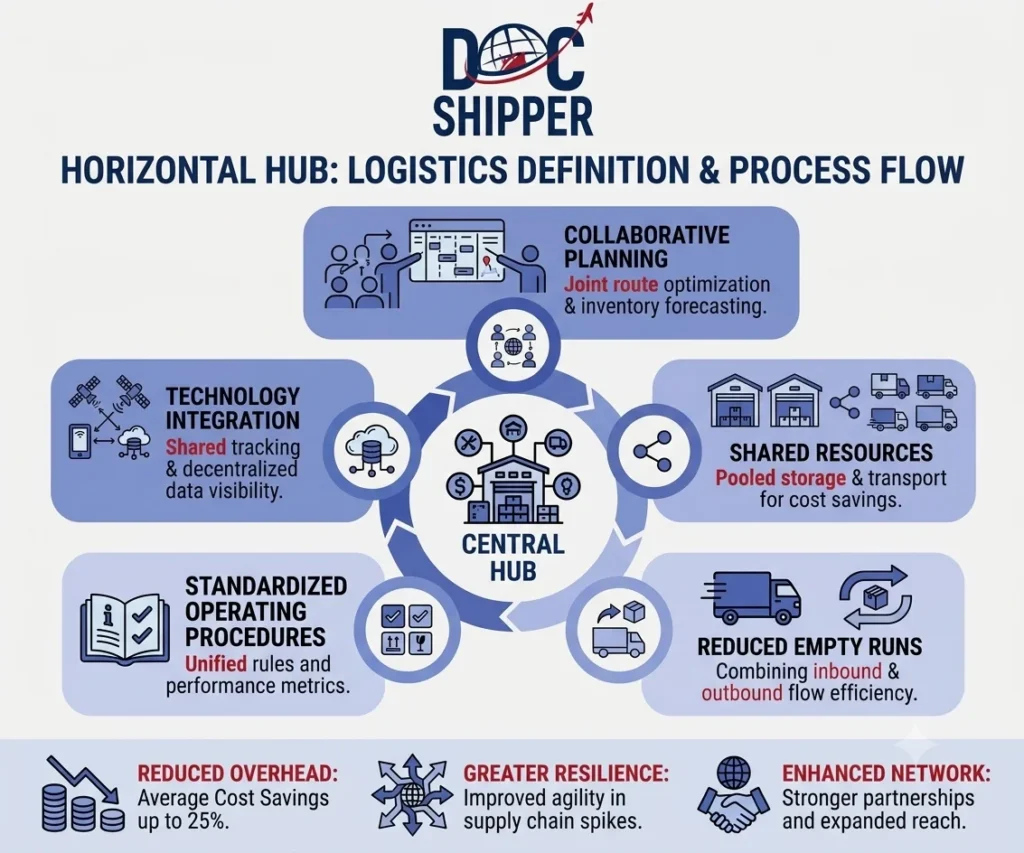
A Horizontal Hub is a logistics consolidation center that processes shipments across multiple industries and product categories, rather than specializing in one vertical sector. This multi-industry approach enables economies of scale, optimized space utilization, and flexible capacity allocation. Horizontal hubs serve as strategic nodes in supply chains, handling diverse cargo types from electronics to textiles within the same facility.
Introduction
Many importers struggle with the decision between specialized logistics facilities and diversified distribution centers. The confusion often stems from misunderstanding how horizontal integration impacts operational efficiency and cost structures in international trade.
In modern supply chain management, horizontal hubs represent a fundamental shift from traditional vertical warehousing. These facilities process cargo from automotive parts to consumer electronics simultaneously, creating cross-industry synergies that reduce per-unit handling costs.
The horizontal hub model offers several distinctive advantages:
- Diversified risk exposure across multiple market sectors and seasonal demand fluctuations
- Shared infrastructure costs through multi-client facility utilization and equipment pooling
- Flexible capacity allocation enabling dynamic space reallocation based on demand patterns
- Enhanced bargaining power with carriers through consolidated shipment volumes
- Knowledge transfer opportunities applying best practices across different industry verticals
Strategic Mechanisms & Operational Framework
The horizontal hub operates on the principle of cross-industry consolidation, where diverse product flows converge at a single strategic location. Unlike vertical hubs specialized in automotive or pharmaceutical logistics, horizontal facilities maintain the infrastructure flexibility to handle everything from temperature-sensitive goods to heavy machinery.
This operational model requires sophisticated warehouse management systems (WMS) capable of segregating inventory by client, product type, and handling requirements. The technology infrastructure must support multiple SKU classifications, varying storage conditions, and diverse picking methodologies within the same physical space.
From a regulatory perspective, horizontal hubs must comply with multi-sector certification requirements. A facility handling both food products and chemicals needs FDA approval, hazmat certifications, and potentially pharmaceutical licensing. This regulatory complexity represents both a barrier to entry and a competitive advantage once established.
The labor force composition in horizontal hubs differs significantly from specialized facilities. Workers require cross-training in multiple handling techniques, from delicate electronics packaging to heavy equipment maneuvering. This versatility enables dynamic workforce allocation based on daily inbound volumes across different product categories.
According to the European Union’s Eurostat database, horizontal logistics facilities demonstrate 23% higher space utilization rates compared to single-industry warehouses. This efficiency stems from counter-cyclical demand patterns across industries, allowing year-round capacity optimization.
At DocShipper, we leverage horizontal hub networks to provide clients with cost-effective consolidation options across Asia-Europe trade lanes. Our facilities in Shanghai and Rotterdam process shipments ranging from textile accessories to industrial components, enabling smaller importers to benefit from economies of scale typically reserved for large corporations.
Comparative Analysis & Performance Data
Understanding the quantitative advantages of horizontal hubs requires examining actual operational data. The following comparison illustrates cost structures and efficiency metrics between horizontal and vertical logistics facilities.
| Metric | Horizontal Hub | Vertical Hub | Difference |
|---|---|---|---|
| Space Utilization Rate | 78-85% | 62-71% | +16% average |
| Cost per Handled Unit | €2.80-€3.50 | €3.90-€4.60 | -28% reduction |
| Seasonal Demand Variation | ±18% | ±47% | 62% smoother |
| Labor Productivity (units/hour) | 42-48 | 38-44 | +9% efficiency |
| Equipment Investment ROI | 24-30 months | 36-48 months | 40% faster |
Real-world case study: A European importer distributing both consumer electronics and home textiles implemented a horizontal hub strategy in Hamburg. Previously operating two separate warehouses (one specialized facility for each product category), consolidation into a 25,000 m² horizontal hub yielded measurable results.
Over a 12-month operational period, the company documented €340,000 in annual savings. The cost reduction breakdown included €180,000 from consolidated facility lease expenses, €95,000 from shared material handling equipment, and €65,000 from optimized labor scheduling across product lines.
The horizontal approach enabled counter-cyclical inventory management. Electronics demand peaked during Q4 holiday season, while textile imports surged in spring fashion cycles. This temporal distribution allowed the facility to maintain consistent 80%+ utilization year-round, compared to the previous model where each specialized warehouse fluctuated between 45% and 95% capacity.
Industry data from third-party logistics providers reveals that horizontal hubs process an average of 4.7 distinct product categories simultaneously. The most successful operations maintain strategic diversity—avoiding over-concentration in correlated industries while ensuring complementary handling requirements.
Key operational success factors for horizontal hub implementation include:
- Technology integration: Unified WMS platforms with module-based product category management
- Zoning strategies: Physical segregation of incompatible goods (chemicals separated from food products)
- Cross-trained workforce: Minimum 40% of staff certified in multiple handling specializations
- Scalable infrastructure: Modular racking systems adaptable to changing product mix requirements
- Risk mitigation protocols: Diversified client portfolio preventing over-reliance on single industry exposure
Conclusion
The horizontal hub model represents a strategic evolution in logistics infrastructure, enabling cost efficiency through diversified consolidation while maintaining operational flexibility across multiple industries. For importers seeking to optimize supply chain economics, this multi-sector approach delivers measurable advantages in utilization rates and per-unit costs.
Need assistance implementing a horizontal hub strategy for your import operations? Contact DocShipper for a customized logistics analysis and facility network optimization plan.
📚 Quiz
Test Your Knowledge: Horizontal Hub
A Horizontal Hub is best defined as:
What is a common misconception about Horizontal Hubs and Cross-Dock facilities?
An e-commerce business selling electronics, apparel, and home goods is deciding between three specialized warehouses or one horizontal hub. Which strategy typically delivers better cost efficiency?
🎯 Your Result
📞 Free Quote in 24hFAQ | Horizontal Hub: Definition, Strategy & Concrete Examples
A horizontal hub provides storage and value-added services across multiple industries, while cross-dock facilities focus on rapid transfer without inventory holding. Horizontal hubs maintain longer dwell times (5-30 days average) and offer services like kitting, labeling, and quality inspections. Cross-docks typically process shipments within 24-48 hours with minimal handling beyond sortation and transfer.
Horizontal hubs implement physical zoning strategies with climate-controlled compartments, segregated hazmat areas, and dedicated food-grade sections. Advanced facilities use modular containment systems allowing rapid reconfiguration. Warehouse management systems enforce strict segregation rules, preventing cross-contamination through barcode verification at every movement stage. Temperature zones typically range from -25°C frozen storage to ambient and climate-controlled areas at 15-25°C.
Economic viability typically begins at 150-200 TEU annually across combined product categories. Smaller importers can access horizontal hub benefits through consolidated services where multiple clients share space and handling resources. The cost-per-unit advantage becomes significant when monthly throughput exceeds 15-20 containers, enabling negotiated rates on shared infrastructure and equipment.
Yes, advanced horizontal hubs maintain multi-certification status including FDA registration, GDP (Good Distribution Practice), and ISO 9001 compliance. These facilities dedicate specific zones with validated temperature monitoring, restricted access protocols, and serialization capabilities. However, highly specialized requirements like biological sample storage or radioactive materials typically remain in vertical facilities due to extreme compliance complexity.
Horizontal hubs can accelerate clearance through consolidated entry procedures when located in bonded zones or free trade areas. Multiple product categories under single importer entities benefit from streamlined documentation processing. However, mixed shipments containing goods with varying duty rates or regulatory requirements may experience slight delays compared to homogeneous vertical shipments. Strategic HS code grouping mitigates this challenge.
Core systems include cloud-based WMS with multi-client architecture, real-time inventory visibility platforms, automated sortation integration, and IoT sensors for condition monitoring. API connectivity to carrier systems, customs platforms, and client ERPs enables seamless data flow. Advanced operations deploy robotics for repetitive tasks and AI-driven demand forecasting to optimize space allocation across product categories.
Horizontal hubs may face 8-15% higher insurance premiums due to multi-product risk exposure and increased complexity. However, total insurance costs often decrease when calculated per handled unit due to volume economies. Comprehensive coverage for horizontal operations includes cargo liability, product contamination, regulatory compliance failures, and business interruption across multiple product categories. Strategic risk segregation through proper zoning can reduce premium multipliers.
Proximity to major ports (within 50 km) and intermodal rail terminals maximizes inbound efficiency. European horizontal hubs concentrate in Rotterdam, Hamburg, and Antwerp due to ocean gateway access. Asian operations cluster around Shanghai, Shenzhen, and Singapore. Inland hubs require exceptional road/rail connectivity and proximity to consumption markets. Free trade zones provide additional duty deferral advantages for horizontal consolidation strategies.
Flexible space allocation allows shifting capacity between industries based on seasonal patterns. Temporary mezzanine structures, external overflow agreements with partner facilities, and dynamic racking configurations provide surge capacity. Advanced horizontal hubs maintain 10-15% buffer capacity and utilize workforce augmentation services during predictable peaks. Cross-training enables labor redeployment from slower product categories to high-demand areas during seasonal fluctuations.
Common challenges include inadequate WMS segmentation leading to inventory mixing, insufficient workforce cross-training causing operational bottlenecks, and poor industry diversification resulting in correlated demand cycles. Regulatory non-compliance from inadequate zoning for incompatible products represents the most costly failure mode. Successful implementations require 6-9 month transition periods with parallel operations to identify and resolve integration issues before full consolidation.
E-commerce businesses gain significant advantages through horizontal hubs when selling diverse product portfolios. Unified fulfillment centers processing electronics, apparel, and home goods reduce per-order costs by 20-35% compared to category-specific warehouses. Horizontal integration enables shared returns processing, consolidated outbound shipping, and flexible inventory positioning. However, ultra-fast delivery requirements may necessitate regional micro-fulfillment centers for final-mile optimization alongside central horizontal hubs.
Consolidation typically reduces emissions by 15-25% through optimized transportation loads, shared facility energy consumption, and reduced redundant infrastructure. A single 30,000 m² horizontal hub consumes approximately 40% less energy per handled unit than three equivalent 10,000 m² specialized facilities due to shared HVAC, lighting, and material handling systems. However, benefits depend on maintaining high utilization rates and avoiding excessive cross-country repositioning between dispersed horizontal nodes.
Need Help with
Logistics or Sourcing ?
First, we secure the right products from the right suppliers at the right price by managing the sourcing process from start to finish. Then, we simplify your shipping experience - from pickup to final delivery - ensuring any product, anywhere, is delivered at highly competitive prices.


Fill the Form
Prefer email? Send us your inquiry, and we’ll get back to you as soon as possible.
Contact us




