


In short ⚡
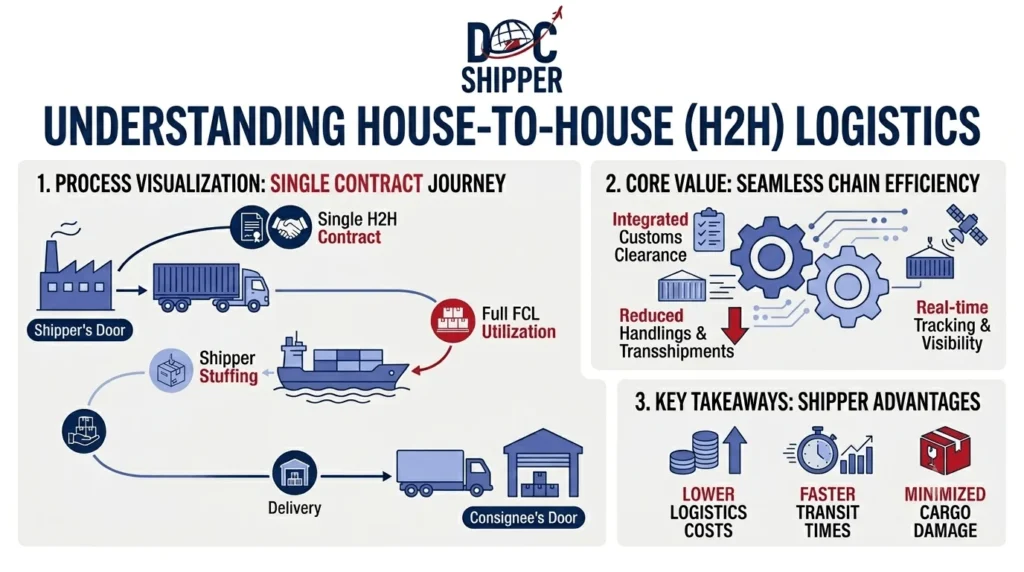
House to House (H) is a comprehensive logistics service where the freight forwarder manages the entire transportation chain from the shipper's premises (origin house) to the final consignee's location (destination house), including pickup, customs clearance, international transit, and final delivery. This door-to-door solution ensures seamless coordination of all logistics operations under a single service provider.
Introduction
Many importers and exporters struggle with fragmented logistics operations requiring coordination between multiple service providers. House to House shipping eliminates this complexity by providing end-to-end accountability through a single logistics partner.
This comprehensive service model represents the most complete logistics solution in international trade. Unlike port-to-port or terminal-to-terminal services, House to House covers every step of the supply chain journey.
Key characteristics of House to House services include:
- Complete pickup services from the manufacturer’s or supplier’s facility
- Export customs clearance and documentation handling at origin
- International transportation via sea, air, or multimodal routes
- Import clearance and duties payment at destination
- Final delivery to the consignee’s warehouse or business location
This service model is particularly valuable for businesses lacking internal logistics expertise or seeking to optimize their total landed cost calculations through consolidated provider management.
In-Depth Analysis & Logistics Expertise
House to House logistics operates on a unified liability framework where the freight forwarder assumes responsibility for the entire shipment journey. This contrasts sharply with segmented services where accountability transfers between carriers, customs brokers, and trucking companies.
The operational mechanics involve sophisticated coordination across multiple service layers. The freight forwarder orchestrates inland transportation at origin, manages export compliance requirements, selects appropriate carriers for the main carriage, and coordinates destination clearance and delivery.
From a legal perspective, House to House services typically operate under the freight forwarder’s Master Bill of Lading (MBL), with the forwarder issuing a House Bill of Lading (HBL) to the shipper. This dual-document structure provides the forwarder with contractual control over the entire shipment while offering the shipper simplified documentation. According to ICC Incoterms® 2020, these services align most closely with DDP (Delivered Duty Paid) terms when all customs and duties are included.
The insurance implications deserve particular attention. Comprehensive House to House services require continuous cargo insurance coverage spanning all transportation modes and handling points. At DocShipper, we verify that insurance policies contain no coverage gaps between transportation segments, eliminating potential claim disputes.
Technology integration has transformed House to House operations. Modern providers leverage track-and-trace systems offering real-time visibility across the entire journey. These platforms integrate customs status updates, carrier milestones, and delivery confirmations into unified dashboards accessible to all stakeholders.
The cost structure for House to House services bundles multiple fee categories into consolidated pricing models. This typically includes origin charges (pickup, export clearance, terminal handling), main freight (ocean or air), destination charges (import clearance, duties, delivery), and administrative fees. Transparent providers itemize these components to enable accurate cost comparison.
Concrete Examples & Data-Driven Scenarios
Consider a European furniture manufacturer shipping a 40-foot container of products from Lyon, France to a retailer’s distribution center in Los Angeles, USA. Under a House to House arrangement, the freight forwarder coordinates:
| Service Component | Timeframe | Typical Cost Range |
|---|---|---|
| Pickup from Lyon facility | Day 1 | €250-400 |
| Export clearance & documentation | Days 2-3 | €150-300 |
| Ocean freight Le Havre to Long Beach | Days 4-32 | €1,800-3,200 |
| US import clearance & ISF filing | Days 33-35 | $400-650 |
| Final delivery to Los Angeles DC | Day 36 | $350-550 |
In this scenario, the total transit time spans approximately 36 days with a consolidated cost ranging from €3,000 to €4,800, depending on market conditions and service urgency. The shipper receives a single invoice and maintains one point of contact throughout.
Comparative analysis reveals significant efficiency gains. A study of 500 international shipments by the International Federation of Freight Forwarders Associations (FIATA) found that House to House services reduced average claim incidents by 42% compared to multi-provider arrangements, primarily due to unified accountability and reduced handoff errors.
Another practical scenario involves e-commerce fulfillment. An electronics brand shipping 2,500 units from Shenzhen, China to a UK fulfillment center benefits from House to House services that include:
- Factory inspection and packaging verification before shipment departure
- Consolidated air freight reducing per-unit costs through volume economies
- Express customs clearance utilizing Authorized Economic Operator (AEO) status
- Direct warehouse delivery with unloading and inventory handover
- Documentation archiving for HMRC compliance requirements
Time-sensitive shipments demonstrate House to House value proposition most clearly. Automotive spare parts requiring 72-hour delivery windows rely on integrated logistics where origin pickup synchronizes with confirmed air capacity and pre-cleared customs documentation, enabling seamless transitions between service segments.
Cost modeling shows that House to House services typically command a 15-25% premium over basic port-to-port rates, but this differential often disappears when accounting for hidden costs in fragmented service models including demurrage, detention, coordination delays, and claim resolution expenses.
Conclusion
House to House logistics represents the most comprehensive service model in international trade, offering unified accountability, streamlined operations, and reduced complexity for shippers. The premium paid for integrated services delivers measurable value through reduced transit times, lower claim rates, and simplified cost structures.
Need expert guidance on House to House logistics solutions? Contact DocShipper for personalized consultation on optimizing your international supply chain.
📚 Quiz
Test Your Knowledge: House to House (H2H)
What is the primary defining characteristic of House to House logistics services?
A shipper claims that House to House services are identical to basic port-to-port shipping plus separate trucking. Is this interpretation correct?
An electronics company needs to ship temperature-controlled pharmaceutical components from a Shanghai factory to a Toronto distribution center with real-time tracking and delivery within 10 days. Which service best matches these requirements?
🎯 Your Result
📞 Free Quote in 24hFAQ | House to House (H): Definition, Calculation & Concrete Examples
House to House and Door to Door are essentially synonymous terms in logistics, both referring to comprehensive pickup-to-delivery services. Some providers use "House to House" to emphasize the commercial facility-to-facility nature, distinguishing from residential deliveries. The service scope, responsibilities, and operational mechanics remain identical regardless of terminology used.
Customs duties payment depends on the agreed Incoterms between buyer and seller. In complete House to House DDP arrangements, the freight forwarder advances duties on behalf of the shipper, who reimburses these costs. Under DDU or DAP terms, the consignee pays import duties directly. The freight forwarder coordinates clearance but payment responsibility follows contractual agreements.
House to House shipments require comprehensive cargo insurance covering all transportation segments from origin pickup through final delivery. The policy should explicitly include inland transit, ocean or air carriage, and destination delivery without coverage gaps. Freight forwarders typically offer integrated insurance as part of their service package, though shippers may arrange independent coverage meeting minimum liability requirements.
Yes, advanced House to House arrangements support multi-stop consolidation at origin and distribution at destination. This requires detailed routing planning and may involve additional charges for each supplementary pickup or drop-off point. Freight forwarders configure customized solutions for complex distribution networks, though cost efficiency typically favors single-point collections and deliveries.
Shippers receive a House Bill of Lading (HBL) issued by the freight forwarder, commercial invoice, packing list, certificate of origin if required, and customs clearance documentation for both export and import. The freight forwarder also provides proof of delivery upon final consignment. Digital platforms increasingly offer electronic access to all shipment documentation through centralized portals.
Transit times vary significantly based on transportation mode and route. Ocean House to House from Asia to Europe typically requires 35-45 days including pickup and delivery, while air services complete in 7-12 days. Express air can achieve 3-5 day delivery for urgent shipments. Origin and destination clearance processes, inland distances, and carrier schedules all influence total transit duration.
Under House to House arrangements, the freight forwarder maintains liability throughout the journey, simplifying claim processes. Damage must be documented immediately upon delivery through delivery receipt notations and photographic evidence. The freight forwarder coordinates investigation and claim resolution with carriers and insurers. This unified accountability structure typically accelerates claim settlement compared to multi-provider shipments.
Restrictions depend on the transportation modes and infrastructure capabilities. Standard containerized cargo accommodates up to 28-30 tons in 40-foot containers. Oversized or overweight cargo requires specialized House to House services involving heavy-lift equipment, route surveys, and permits. Air freight House to House typically limits individual pieces to aircraft cargo door dimensions, generally 3 meters maximum in any dimension.
House to House services typically cost 15-25% more than basic port-to-port rates due to included pickup, delivery, and clearance services. However, total landed cost analysis often reveals comparable or lower expenses when accounting for separate inland transport arrangements, customs broker fees, storage charges, and coordination overhead inherent in fragmented service models. Volume shippers frequently negotiate competitive House to House rates approaching port-to-port pricing.
Yes, specialized House to House providers offer end-to-end cold chain solutions maintaining controlled temperatures from origin to destination. These services require refrigerated trucks for pickup and delivery, reefer containers or thermal air cargo units for main carriage, and continuous temperature monitoring. Pharmaceutical, food, and chemical industries extensively utilize temperature-controlled House to House logistics for product integrity assurance.
Modern House to House services offer real-time tracking through integrated digital platforms displaying pickup confirmation, customs clearance status, carrier departure and arrival updates, and delivery completion. GPS tracking on trucks provides granular location data during inland segments. Leading freight forwarders provide mobile apps and automated notifications keeping stakeholders informed throughout the shipment lifecycle without requiring manual status inquiries.
Ocean House to House shipments benefit from 2-3 week advance booking to secure container space and optimize routing, though expedited arrangements can accommodate shorter notice. Air freight House to House typically requires 3-5 days notice for standard service, though express options handle same-day or next-day bookings. Peak seasons and specific trade lanes may require extended booking windows to ensure capacity availability and competitive pricing.
Need Help with
Logistics or Sourcing ?
First, we secure the right products from the right suppliers at the right price by managing the sourcing process from start to finish. Then, we simplify your shipping experience - from pickup to final delivery - ensuring any product, anywhere, is delivered at highly competitive prices.


Fill the Form
Prefer email? Send us your inquiry, and we’ll get back to you as soon as possible.
Contact us




:%20Definition,%20Calculation%20&%20Concrete%20Examples)