


In short ⚡
Independent Trading Exchange (ITE) refers to a private, non-governmental marketplace where commodities, securities, or goods are traded outside traditional public exchanges. ITEs operate autonomously, establishing their own rules, membership criteria, and trading mechanisms, primarily serving niche markets or specific industry sectors requiring specialized transaction frameworks.
Introduction
Many international traders struggle to differentiate between public stock exchanges and independent trading platforms. This confusion often leads to compliance issues or missed opportunities in specialized markets.
Independent Trading Exchanges play a crucial role in global commerce by providing alternative marketplaces for goods that don’t fit conventional exchange models. From agricultural commodities to industrial materials, these platforms facilitate billions in annual transactions.
Understanding ITEs is essential because they:
- Enable direct transactions between qualified buyers and sellers without intermediary commissions
- Offer specialized contract structures tailored to specific industries or commodities
- Provide price discovery mechanisms for niche or regional products
- Operate with greater flexibility than traditional regulated exchanges
- Support international trade through customized settlement and delivery terms
Operational Mechanisms & Regulatory Framework
Independent Trading Exchanges function through self-regulatory frameworks that balance market freedom with transaction security. Unlike government-regulated exchanges such as the New York Stock Exchange or London Metal Exchange, ITEs establish proprietary governance structures that members must accept upon entry.
The membership qualification process typically involves financial vetting, industry credentials verification, and acceptance of the exchange’s dispute resolution mechanisms. This closed-market approach reduces counterparty risk while maintaining transaction confidentiality.
Price formation in ITEs occurs through various mechanisms including continuous auction systems, periodic matching sessions, or negotiated bilateral agreements. The chosen method depends on market liquidity and commodity characteristics.
Regarding legal oversight, ITEs must still comply with Commodity Futures Trading Commission (CFTC) regulations in the United States or equivalent authorities in other jurisdictions, particularly concerning anti-money laundering (AML) and anti-fraud provisions.
Settlement procedures vary significantly from public exchanges. ITEs often allow customized delivery terms, deferred payment structures, or quality adjustments based on inspection results—flexibility impossible in standardized exchange contracts.
At DocShipper, we regularly assist clients navigating transactions on specialized commodity ITEs, ensuring documentation compliance and coordinating physical delivery logistics to match exchange settlement requirements.
Practical Examples & Market Data
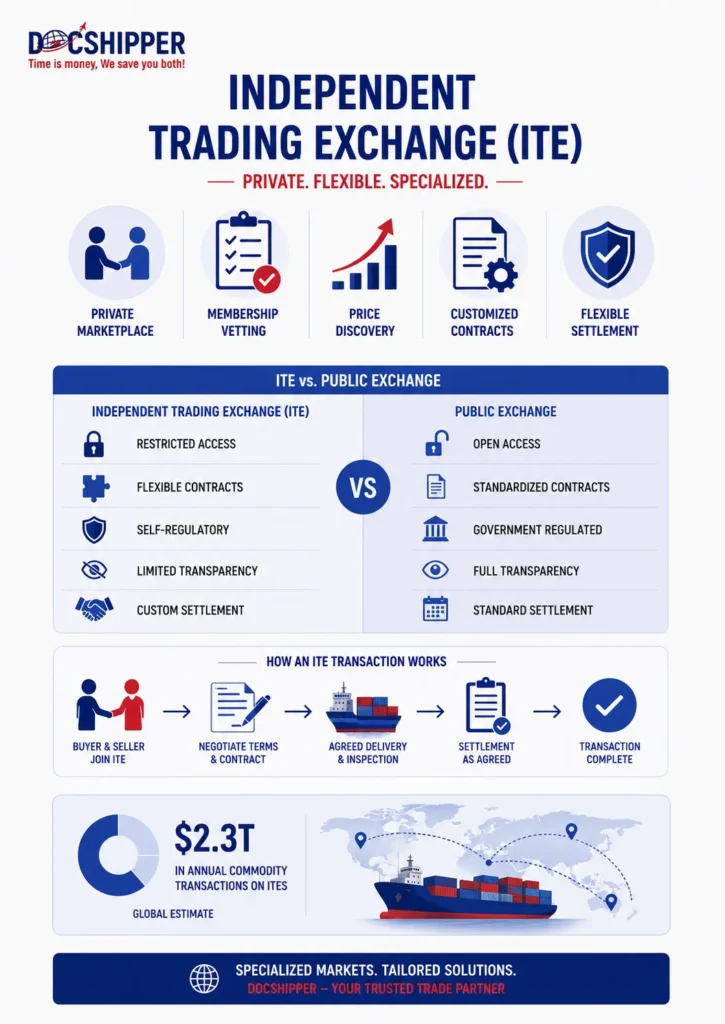
The practical application of Independent Trading Exchanges becomes clearer through real-world scenarios and comparative analysis. These platforms handle approximately $2.3 trillion in annual commodity transactions globally.
Comparative Framework: ITE vs. Public Exchange
| Characteristic | Independent Trading Exchange | Public Exchange |
|---|---|---|
| Membership Access | Restricted; requires vetting and industry credentials | Open to licensed brokers and qualified investors |
| Contract Standardization | Flexible; customizable terms and quality specifications | Highly standardized; uniform contract specifications |
| Regulatory Oversight | Self-regulatory with minimal government intervention | Strict government supervision (SEC, CFTC, FCA) |
| Price Transparency | Limited; often confidential transaction data | Full transparency; real-time public pricing |
| Settlement Options | Customizable delivery, payment, and inspection terms | Standardized settlement procedures |
Use Case: Agricultural Commodity Transaction
A European food manufacturer needs 5,000 metric tons of specialty organic wheat with specific protein content. Public exchanges don’t offer contracts matching these precise specifications.
The manufacturer joins an agricultural ITE specializing in organic grains. Through the platform, they locate a certified Canadian supplier offering the exact specifications required. The ITE facilitates:
- Customized quality parameters: 14.5% minimum protein content with organic certification verification
- Phased delivery schedule: 1,000 MT monthly over five months to match production needs
- Quality-adjusted pricing: Base price of $385/MT with +$15/MT premium for each 0.5% protein above 14.5%
- Inspection protocol: Independent surveyor verification at origin with arbitration clause
- Payment structure: 30% advance, 70% against Bill of Lading presentation
This transaction structure, impossible on standardized exchanges, reduces the manufacturer’s sourcing risk while providing the supplier with predictable offtake at premium pricing.
DocShipper coordinated the logistics for this shipment, managing container bookings, phytosanitary documentation, and coordinating with the ITE’s designated inspection agency to ensure seamless delivery matching the exchange contract terms.
Conclusion
Independent Trading Exchanges provide essential marketplace infrastructure for specialized commodities and industries requiring customized transaction frameworks beyond standardized public exchanges. Their flexibility, combined with self-regulatory governance, enables complex international trade that would otherwise face significant friction.
Need assistance navigating transactions on specialized trading platforms or coordinating international logistics? Contact DocShipper for expert guidance tailored to your specific trading requirements.
📚 Quiz
Test Your Knowledge: Independent Trading Exchange (ITE)
An Independent Trading Exchange (ITE) primarily serves which type of market?
Which statement accurately describes contract flexibility on ITEs compared to public exchanges?
A food manufacturer needs 5,000 MT of organic wheat with specific protein content not available on public exchanges. Which platform would best serve this requirement?
🎯 Your Result
📞 Free Quote in 24hFAQ | Independent Trading Exchange (ITE): Definition, Role & Practical Examples
Unlike broker networks where intermediaries facilitate individual transactions, ITEs provide centralized marketplace infrastructure with standardized membership rules, dispute resolution mechanisms, and trading protocols. Members trade directly with each other within the exchange framework, whereas broker networks involve third-party facilitation for each transaction. ITEs also typically offer price discovery mechanisms and market data services not available through fragmented broker relationships.
Yes, contracts executed through ITEs are legally binding agreements subject to the exchange's terms and conditions accepted during membership. Most ITEs incorporate arbitration clauses and specify governing law jurisdictions. While less regulated than public exchanges, ITEs must still comply with fundamental contract law, anti-fraud statutes, and sector-specific regulations. Members typically sign comprehensive agreements establishing legal enforceability before trading privileges are granted.
ITEs employ various risk mitigation strategies including financial qualification requirements for membership, margin deposit systems, performance bonds, escrow arrangements, and credit limit monitoring. Some exchanges operate clearinghouse functions or partner with third-party financial institutions to guarantee settlement. Unlike public exchanges with centralized clearing, ITEs often use bilateral credit arrangements with exchange-mandated minimum standards and dispute resolution procedures to protect transaction integrity.
Access depends on the specific ITE's membership policies and applicable international sanctions or trade restrictions. Most ITEs accept international members but require compliance with local regulations in the member's jurisdiction. Cross-border traders should verify that their participation doesn't violate export controls, sanctions lists, or licensing requirements. Some exchanges restrict membership to specific geographic regions or impose additional documentation requirements for international participants to ensure regulatory compliance.
ITEs commonly facilitate trading in specialty agricultural products, regional industrial materials, secondary metals, energy products not listed on major exchanges, recycled materials, organic or certified commodities, and niche chemical products. These platforms excel in markets requiring quality variations, regional pricing, or customized contract terms that standardized exchanges cannot accommodate. Essentially any commodity with heterogeneous characteristics or limited liquidity may benefit from ITE trading structures.
Price formation mechanisms vary by ITE but commonly include continuous double-auction systems, periodic matching sessions where orders accumulate then execute simultaneously, reference pricing based on published indices with negotiated differentials, or bilateral negotiations within exchange-monitored frameworks. Unlike public exchanges with transparent order books, many ITEs feature semi-transparent or confidential pricing, revealing only executed transaction ranges to maintain competitive confidentiality while providing market guidance.
Fee structures differ significantly across ITEs but typically include annual membership dues ($5,000-$50,000 depending on exchange prestige), transaction fees (0.1%-0.5% of contract value), listing fees for sellers offering products, data subscription charges for market information access, and dispute resolution fees if arbitration services are utilized. Some exchanges operate on flat-fee models while others use tiered structures based on transaction volume. Always review complete fee schedules before joining.
Most ITEs don't directly provide financing but many partner with trade finance institutions offering members preferential access to working capital, letter of credit facilities, or inventory financing. Some exchanges operate vendor financing programs where established sellers extend payment terms to qualified buyers. The exchange itself typically facilitates these arrangements through documentation standards and credit verification rather than assuming financial risk directly.
Delivery terms in ITE contracts are typically more flexible than standardized exchanges, allowing parties to negotiate Incoterms, delivery locations, timeframes, and inspection procedures. The exchange usually provides template contracts with standard clauses but permits customization. Physical logistics coordination remains the parties' responsibility, though some ITEs maintain approved logistics provider networks. Documentation requirements mirror international trade standards including bills of lading, certificates of origin, and quality certificates as specified in individual contracts.
ITEs typically mandate binding arbitration as the primary dispute resolution mechanism, with specific arbitration rules and venues outlined in membership agreements. Members waive rights to pursue litigation in many cases, instead submitting disputes to exchange-designated arbitrators or international arbitration bodies like the International Chamber of Commerce. The exchange may also offer mediation services for minor disputes. Arbitration decisions are generally final and enforceable in signatory countries under the New York Convention on international arbitration.
While ITEs traditionally served large corporations, many now accommodate smaller enterprises through tiered membership categories, reduced minimum transaction sizes, or associate memberships with limited trading privileges. Financial qualification requirements still apply but may be scaled to business size. Small businesses should evaluate whether transaction volumes justify membership costs and whether they possess the operational capacity to fulfill exchange contract obligations, including financing, logistics coordination, and quality compliance.
Quality assurance mechanisms include approved inspector networks, mandatory certification requirements, sample testing protocols, photographic documentation standards, and quality arbitration procedures. Many ITEs maintain databases of certified suppliers with track records, implement rating systems based on past performance, and require warranties or guarantees for specific quality parameters. Independent surveyor verification at origin and destination is common for high-value commodities, with costs typically shared between parties or specified in contract terms.
Need Help with
Logistics or Sourcing ?
First, we secure the right products from the right suppliers at the right price by managing the sourcing process from start to finish. Then, we simplify your shipping experience - from pickup to final delivery - ensuring any product, anywhere, is delivered at highly competitive prices.


Fill the Form
Prefer email? Send us your inquiry, and we’ll get back to you as soon as possible.
Contact us




