


In short ⚡
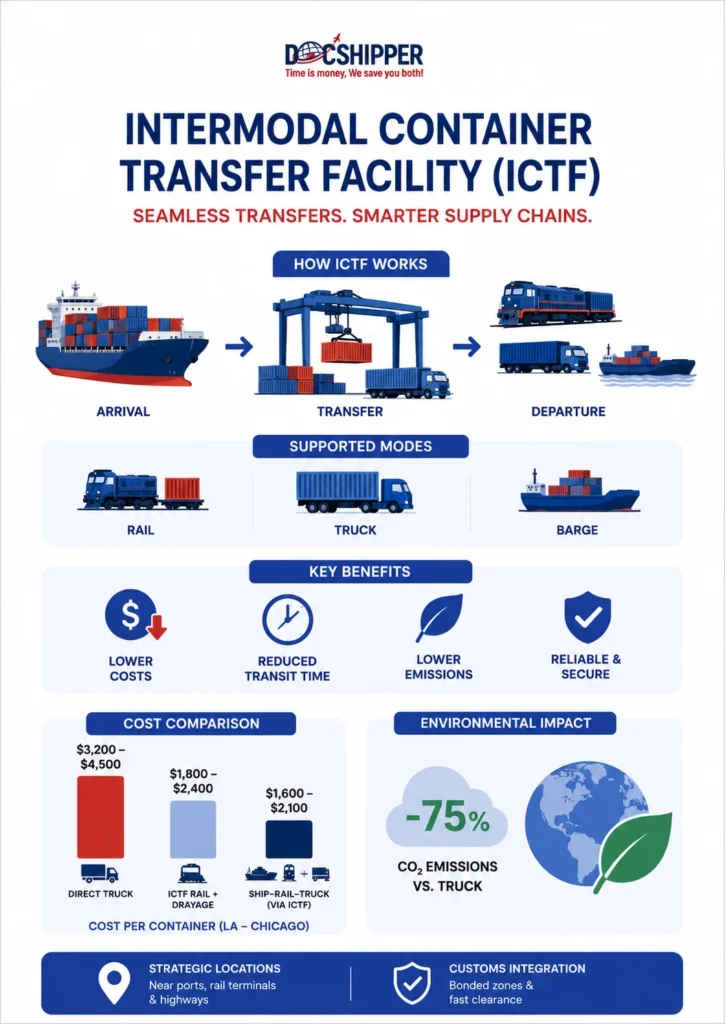
An Intermodal Container Transfer Facility (ICTF) is a specialized logistics hub designed to transfer shipping containers between different transportation modes—typically rail, truck, and sometimes barge—without opening or unloading the cargo. These facilities optimize supply chain efficiency by enabling seamless modal shifts, reducing transit times, and lowering transportation costs in international trade.
Introduction
In global import-export operations, one critical bottleneck often emerges: the handoff between transportation modes. Containers arriving by ship need rail or truck connections. Delays at these junctions translate to inventory costs, missed delivery windows, and disrupted supply chains.
Intermodal Container Transfer Facilities solve this challenge. They serve as pivot points where containers move efficiently between ships, trains, and trucks without cargo handling. This infrastructure is essential for modern logistics networks, particularly in high-volume trade corridors connecting ports to inland distribution centers.
Key characteristics of ICTFs include:
- Modal flexibility: Supports rail-to-truck, ship-to-rail, and multi-mode transfers
- Standardization: Handles ISO containers (20ft, 40ft, 45ft high-cube units)
- Automation capability: Advanced facilities use automated cranes and tracking systems
- Strategic location: Positioned near ports, rail terminals, or highway intersections
- Customs integration: Often includes bonded zones for international cargo clearance
Operations & Technical Expertise
ICTFs operate through coordinated processes involving specialized equipment and regulatory compliance. Understanding these mechanisms is crucial for importers, freight forwarders, and logistics planners.
Equipment infrastructure includes rubber-tired gantry cranes (RTGs), rail-mounted gantry cranes (RMGs), reach stackers, and chassis yards. RTGs can lift containers directly from rail cars to truck chassis or storage stacks. Modern facilities process between 30 to 50 container lifts per hour per crane, with peak facilities reaching 70+ lifts during optimized operations.
Operational workflow follows a structured sequence: containers arrive via one mode, are identified through RFID or optical character recognition, positioned in designated zones, and loaded onto outbound transport. The entire transfer typically completes within 24 to 48 hours for standard shipments, though express services can achieve same-day turnaround.
Regulatory compliance requires facilities to maintain customs bonds when handling international cargo. According to U.S. Customs and Border Protection, bonded ICTFs must implement approved security protocols, maintain detailed cargo manifests, and provide real-time visibility to customs authorities. European facilities follow similar requirements under the Union Customs Code.
Technology integration transforms modern ICTFs into data-driven operations. Terminal operating systems (TOS) coordinate container movements, predict equipment needs, and optimize yard layouts. GPS tracking on containers and vehicles provides real-time location data. At DocShipper, we coordinate with ICTFs that utilize cloud-based TOS platforms, ensuring our clients receive immediate shipment status updates and predictive arrival windows.
Environmental considerations increasingly influence ICTF design. Rail transfer produces approximately 75% less CO2 per ton-mile than truck transport. Facilities near ports reduce urban truck traffic, lowering emissions and congestion. California’s Clean Truck Program mandates zero-emission vehicles for port-adjacent ICTFs by 2035, setting standards other regions are adopting.
Concrete Examples & Data
Real-world ICTF operations demonstrate how these facilities impact supply chain performance. The following data illustrates comparative advantages and operational benchmarks.
| Transportation Mode | Cost per Container (LA-Chicago) | Transit Time | CO2 Emissions (kg) |
|---|---|---|---|
| Direct Truck | $3,200 – $4,500 | 36-48 hours | 850 |
| ICTF Rail + Drayage | $1,800 – $2,400 | 72-96 hours | 210 |
| Ship-Rail-Truck (via ICTF) | $1,600 – $2,100 | 10-14 days (door-to-door) | 165 |
Case Study: Port of Long Beach ICTF
The Long Beach Container Terminal handles over 1.5 million TEUs annually with direct rail connectivity. A European importer shipping automotive parts from Shanghai uses this facility to transfer containers from ship to rail, then to a Chicago distribution center. By utilizing the ICTF, the importer reduces inland transportation costs by 38% compared to direct trucking, while cutting delivery time variability from ±2 days to ±6 hours through predictive rail scheduling.
Key operational metrics across major ICTFs reveal performance standards:
- Throughput capacity: Leading facilities process 800,000 to 2 million TEUs per year
- Dwell time: Average container residence of 24-72 hours, with express lanes under 12 hours
- Modal split: Typical facilities handle 60% rail, 35% truck, 5% barge transfers
- Operational uptime: Top-tier ICTFs maintain 98%+ availability with 24/7 operations
- Cost differential: Rail-intermodal saves $800-$1,500 per container on long-haul routes versus pure trucking
At DocShipper, we leverage strategic ICTF partnerships to optimize routing for clients. For example, a textile importer moving goods from Vietnam to the U.S. Midwest benefits from our pre-arranged rail slots at the Port of Oakland ICTF, reducing total landed costs by 22% while maintaining predictable lead times that support just-in-time inventory models.
Conclusion
Intermodal Container Transfer Facilities represent critical infrastructure in modern supply chains, enabling cost-effective, sustainable cargo movement across transportation networks. Their strategic importance continues growing as shippers prioritize efficiency and environmental responsibility.
Need guidance on integrating ICTF solutions into your logistics strategy? Contact DocShipper for customized intermodal planning and execution support.
📚 Quiz
Test Your Knowledge: Intermodal Container Transfer Facility
What is the primary function of an Intermodal Container Transfer Facility?
What is the typical environmental benefit of using rail transfer via ICTF compared to direct trucking?
A textile importer is shipping containers from Asia to the U.S. Midwest (2,000+ miles inland). Which scenario best applies ICTF advantages?
🎯 Your Result
📞 Free Personalized QuoteFAQ | Intermodal Container Transfer Facility: Definition, Operations & Concrete Examples
ICTFs handle standardized containerized cargo including manufactured goods, automotive parts, electronics, textiles, and non-perishable consumer products. Temperature-controlled containers (reefers) are supported at facilities with electrical hookups. Oversized, break-bulk, or hazardous materials requiring special handling typically bypass ICTFs for direct terminal processing.
Cost savings result from consolidating long-haul rail transport (60-70% cheaper than trucking per mile), reducing driver labor costs, and optimizing equipment utilization. Rail transfers eliminate highway tolls and fuel surcharges. Facilities near ports minimize expensive short-haul drayage, while bonded warehousing within ICTFs defers customs duties until final delivery.
Standard transfers complete within 24 to 48 hours from container arrival to departure on the next mode. Express services achieve same-day turnaround. Total door-to-door transit (including rail leg) typically adds 2-4 days versus direct trucking but delivers significant cost savings on routes exceeding 500 miles.
Modern ICTFs implement multi-layer security including perimeter fencing, 24/7 surveillance, access control systems, and container seal verification. Facilities handling international cargo maintain C-TPAT (U.S.) or AEO (EU) certifications. DocShipper recommends insurance coverage for high-value goods regardless of security protocols, as carrier liability limits apply.
Yes, equipped facilities provide electrical connections (genset or direct plug-in) for refrigerated containers. Reefer monitoring systems track temperature throughout the transfer. Not all ICTFs offer this service, so advance verification is essential for temperature-sensitive cargo like pharmaceuticals or perishable foods.
Bonded facilities allow containers to remain under customs seal during modal transfers without formal entry. Importers defer duty payments until cargo reaches the final destination. This enables inland port processing, reducing port congestion. Electronic manifest systems notify customs of container movements in real-time, with automated risk assessment determining inspection requirements.
Rail transport via ICTFs reduces CO2 emissions by approximately 75% per ton-mile compared to trucking. A single rail car carries the load of 3-4 trucks while consuming less fuel per unit. Urban areas benefit from reduced truck traffic, lowering local air pollution and road wear. This advantage becomes significant on routes exceeding 750 miles.
Most large container ports have nearby ICTF infrastructure, but capacity and services vary. Los Angeles, Long Beach, Savannah, and Houston feature extensive on-dock rail facilities. Smaller ports may require trucking containers to inland ICTFs. Freight forwarders like DocShipper evaluate facility availability and routing efficiency during shipment planning.
Liability depends on where damage occurs and which party was controlling the container. ICTFs inspect containers during intake and document pre-existing damage. Operators carry liability insurance, but claims require proof the damage occurred within the facility. Shippers should photograph containers before handoff and maintain cargo insurance covering all transport legs.
Rail slots at high-volume facilities require 5-10 days advance booking during peak seasons. Standard transfers need 48-72 hours notice. Last-minute bookings face premium pricing and limited availability. DocShipper coordinates ICTF scheduling as part of comprehensive shipment planning, securing priority access through established carrier relationships.
Most ICTFs offer short-term storage (free dwell typically 3-5 days), after which per-diem charges apply ($50-$150 per day depending on facility). Extended storage requires moving containers to separate warehouse facilities. For deliberate storage, dedicated container yards or distribution centers provide more cost-effective solutions than ICTF holding fees.
Automation leads current innovations: autonomous yard tractors, AI-powered crane optimization, and IoT sensors for predictive maintenance. Blockchain integration creates transparent custody chains. Digital twins simulate facility operations for capacity planning. 5G connectivity enables real-time equipment coordination. These technologies reduce turnaround times by 20-30% while cutting operational costs and improving safety records.
Need Help with
Logistics or Sourcing ?
First, we secure the right products from the right suppliers at the right price by managing the sourcing process from start to finish. Then, we simplify your shipping experience - from pickup to final delivery - ensuring any product, anywhere, is delivered at highly competitive prices.


Fill the Form
Prefer email? Send us your inquiry, and we’ll get back to you as soon as possible.
Contact us




