


In short ⚡
An Irregular Route Carrier is a freight transportation provider operating without fixed schedules or predetermined routes, offering on-demand services based on shipper needs. Unlike common carriers with published timetables, irregular carriers provide flexible, customized transport solutions for specialized cargo or ad-hoc shipments requiring non-standard routing.
Introduction
Many businesses struggle to transport oversized equipment, time-sensitive shipments, or specialized cargo that doesn’t fit scheduled carrier services. This challenge becomes particularly acute when standard shipping routes cannot accommodate unique freight requirements or urgent delivery windows.
Irregular route carriers fill this critical gap in the international logistics chain. These specialized operators provide demand-responsive transportation that adapts to shipper specifications rather than forcing cargo into predetermined schedules.
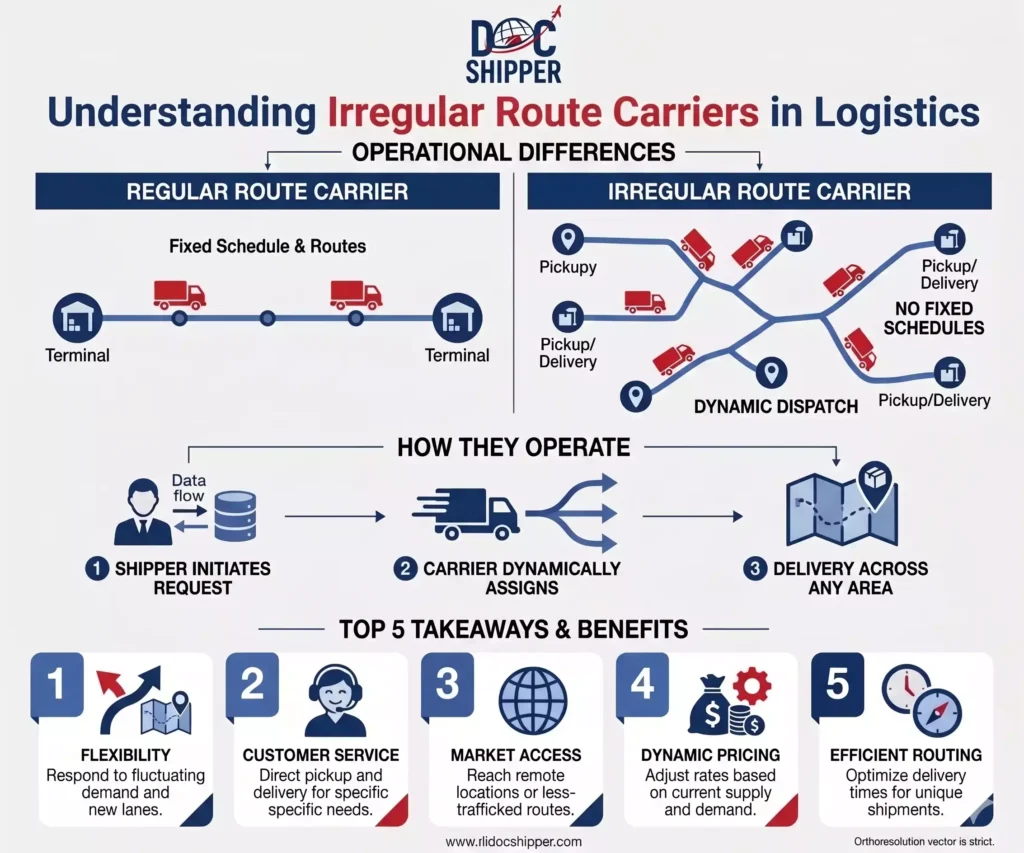
Key characteristics include:
- No fixed schedules: Services operate based on customer booking rather than published timetables
- Flexible routing: Carriers determine optimal paths based on cargo specifications and delivery requirements
- Specialized equipment: Often equipped to handle oversized, hazardous, or high-value freight
- Contract-based operations: Each shipment typically involves individual negotiation and agreement
- Variable pricing: Rates fluctuate based on distance, cargo type, urgency, and market conditions
Understanding Irregular Route Carriers: Mechanisms & Legal Framework
Irregular route carriers operate under distinct regulatory frameworks compared to common carriers. In the United States, the Federal Motor Carrier Safety Administration (FMCSA) classifies these operators as contract carriers, requiring specific operating authority and insurance coverage.
The fundamental distinction lies in the contractual obligation. While common carriers must serve all customers who request their services at published rates, irregular carriers maintain the right to accept or refuse shipments. This flexibility enables them to specialize in niche markets where standard services prove inadequate.
From a legal perspective, irregular carriers function under private contracts rather than public tariffs. Each shipment involves negotiated terms covering liability limits, delivery timeframes, handling procedures, and compensation structures. This contractual freedom allows both parties to define responsibilities clearly for complex or unusual freight movements.
The operational model requires sophisticated route optimization capabilities. Irregular carriers must continuously analyze factors including fuel costs, border crossing regulations, seasonal restrictions, and infrastructure limitations. At DocShipper, we collaborate with verified irregular carriers to ensure compliance with international transit regulations while maintaining competitive pricing for specialized shipments.
Insurance requirements differ substantially from scheduled carriers. Irregular operators typically maintain higher liability coverage due to the specialized nature of cargo they handle. Coverage must address unique risks associated with oversized loads, hazardous materials, or high-value commodities requiring enhanced security measures.
Practical Applications & Industry Data
Understanding when to utilize irregular route carriers versus scheduled services significantly impacts logistics efficiency and cost management. The following comparative analysis demonstrates typical scenarios where irregular carriers provide optimal solutions:
| Shipment Type | Scheduled Carrier | Irregular Route Carrier | Cost Difference |
|---|---|---|---|
| Standard Palletized (1,000 kg) | $2,400 (baseline) | $3,100 – $3,600 | +29-50% |
| Oversized Equipment (15,000 kg) | Not available | $18,500 – $24,000 | Exclusive option |
| Urgent Delivery (48h window) | $3,200 + delays risk | $4,800 – $5,500 | +50-72% |
| Hazardous Materials (Class 3) | Limited availability | $5,200 – $7,100 | Specialized service |
| Remote Destination Delivery | $3,800 + transshipment | $4,200 – $5,000 | +11-32% |
Use Case: Manufacturing Equipment Transport
A European machinery manufacturer needed to ship a custom-built industrial press weighing 22,000 kg with dimensions exceeding standard container specifications (5.2m height) from Stuttgart, Germany to a production facility in Chengdu, China.
Scheduled ocean freight services couldn’t accommodate the oversized dimensions without costly disassembly. The manufacturer engaged an irregular route carrier specializing in project cargo. The carrier provided door-to-door service using specialized flatbed trucks, obtained necessary oversize permits across multiple jurisdictions, and coordinated multimodal transport including rail segments through Kazakhstan.
Final costs totaled €47,800 versus estimated €65,000+ for disassembly, scheduled shipping, and reassembly. Transit time: 28 days compared to projected 45-60 days via standard routes. This demonstrates how irregular carriers deliver both cost savings and time efficiency for specialized cargo.
Key operational advantages observed in irregular carrier utilization:
- Cargo integrity: Reduced handling minimizes damage risk for sensitive equipment
- Customs facilitation: Single-carrier responsibility streamlines documentation and clearance processes
- Insurance simplification: Unified coverage under one carrier reduces claims complexity
- Route flexibility: Real-time adaptation to weather, infrastructure issues, or regulatory changes
- Security enhancement: Continuous monitoring and reduced transshipment points for high-value cargo
Conclusion
Irregular route carriers provide essential flexibility for shipments requiring specialized handling, non-standard routing, or urgent delivery outside scheduled service networks. Understanding when these services deliver optimal value versus standard carriers enables strategic logistics decision-making that balances cost, speed, and cargo-specific requirements.
Need guidance on selecting the right carrier type for your specialized shipment? Contact DocShipper’s logistics experts for personalized recommendations and competitive quotes from verified irregular route carriers worldwide.
📚 Quiz
Test Your Knowledge: Irregular Route Carriers
What fundamentally defines an irregular route carrier's operational model?
Unlike common carriers, irregular route carriers have the legal right to:
A manufacturer needs to ship a 22,000 kg industrial press with 5.2m height from Germany to China within 30 days. Which carrier type provides the optimal solution?
🎯 Your Result
📞 Free Quote in 24hFAQ | Irregular Route Carrier: Definition, Calculation & Practical Examples
Irregular route carriers operate without fixed schedules or predetermined routes, accepting shipments on a contract basis. Common carriers maintain published schedules and routes, serving all customers at standardized rates. Irregular carriers can refuse shipments, while common carriers typically cannot. This distinction allows irregular carriers to specialize in complex, oversized, or time-sensitive freight requiring customized handling and routing solutions.
Select irregular route carriers when shipping oversized equipment exceeding standard container dimensions, transporting hazardous materials requiring specialized handling, meeting urgent delivery deadlines outside scheduled service windows, reaching remote destinations without established freight routes, or moving high-value cargo requiring enhanced security and minimal transshipment. These scenarios justify the typically higher costs through reduced risk and operational efficiency.
Rates depend on multiple factors: cargo weight and dimensions, total distance, route complexity, fuel costs, special equipment requirements, insurance coverage levels, handling procedures, delivery urgency, and current market capacity. Unlike scheduled carriers with published tariffs, irregular carriers quote each shipment individually based on these variables. Expect negotiations and detailed cost breakdowns including permits, escorts for oversized loads, and customs brokerage services.
Irregular carriers typically maintain higher liability limits than common carriers due to specialized cargo handling. Standard coverage ranges from $100,000 to $2,000,000 per shipment depending on cargo value and risk profile. Additional coverage options include all-risk policies for high-value goods, specialized hazmat insurance, and contingent cargo insurance. Always verify carrier insurance certificates and consider supplemental shipper's interest coverage for full protection.
Reputable irregular carriers often deliver superior reliability for specialized international freight compared to scheduled services. Their dedicated handling reduces transshipment points where delays commonly occur. However, reliability varies significantly between operators. Verify carrier credentials including operating authority, safety ratings, financial stability, and customer references. Working with freight forwarders who maintain vetted carrier networks provides additional quality assurance.
Most irregular route carriers coordinate customs clearance as part of their door-to-door service, especially for complex shipments. They typically work with licensed customs brokers in destination countries to prepare required documentation, calculate duties and taxes, and manage clearance procedures. This integrated approach simplifies international shipping compared to coordinating multiple service providers. Ensure your contract clearly defines customs-related responsibilities and who bears costs for documentation, inspections, and potential delays.
Booking requirements vary by cargo complexity and carrier availability. Standard specialized shipments typically need 7-14 days advance notice for route planning, permit acquisition, and equipment allocation. Oversized or hazardous cargo may require 3-4 weeks for regulatory approvals across multiple jurisdictions. However, some irregular carriers maintain expedited services with 48-72 hour mobilization for urgent shipments at premium rates. Early engagement ensures optimal routing and competitive pricing.
Many irregular carriers specialize in multimodal solutions combining truck, rail, ocean, and air segments under single contracts. This capability proves essential for oversized cargo requiring different transport modes across various terrain and regulatory environments. The carrier coordinates equipment transfers, documentation, and regulatory compliance at each modal transition point. This unified management reduces complexity and potential delays compared to engaging separate carriers for each transport segment.
Legal protections depend on jurisdiction and contract terms. In the United States, irregular carriers must maintain FMCSA operating authority and minimum insurance levels. International shipments fall under conventions like CMR (Europe) or Warsaw Convention (air). Your contract should specify liability limits, force majeure provisions, dispute resolution mechanisms, and applicable law. Consider including cargo insurance clauses, delivery guarantees with penalties, and detailed handling instructions to protect against damage or delay claims.
Professional irregular carriers employ sophisticated logistics planning systems analyzing fuel efficiency, border crossing wait times, road restrictions, weather patterns, and infrastructure conditions. They consider weight limits on bridges, tunnel clearances, seasonal road closures, and permit requirements for each jurisdiction. Advanced carriers use GPS tracking and real-time traffic data to adjust routes dynamically. This expertise transforms complex routing challenges into efficient transport solutions unavailable through standard scheduled services.
File claims according to your contract terms, typically within specified timeframes (often 9 months for domestic, 1 year for international). Document damage immediately with photographs and inspection reports. The carrier's liability depends on contract terms and applicable transportation law. Standard carrier liability may be limited to weight-based calculations ($0.50-$1.00 per pound), making supplemental cargo insurance crucial for high-value shipments. Dispute resolution options include arbitration, mediation, or litigation as specified in your contract.
Coverage varies significantly between carriers. Some specialize in specific corridors or regions, while others maintain global networks through partner relationships. Remote or politically unstable regions may have limited irregular carrier availability or require specialized operators with security expertise. When sourcing carriers for challenging destinations, verify their operational experience, local partnerships, security protocols, and insurance coverage specific to that region. Freight forwarders with established irregular carrier networks can identify suitable options for virtually any global destination.
Need Help with
Logistics or Sourcing ?
First, we secure the right products from the right suppliers at the right price by managing the sourcing process from start to finish. Then, we simplify your shipping experience - from pickup to final delivery - ensuring any product, anywhere, is delivered at highly competitive prices.


Fill the Form
Prefer email? Send us your inquiry, and we’ll get back to you as soon as possible.
Contact us




