


In short ⚡
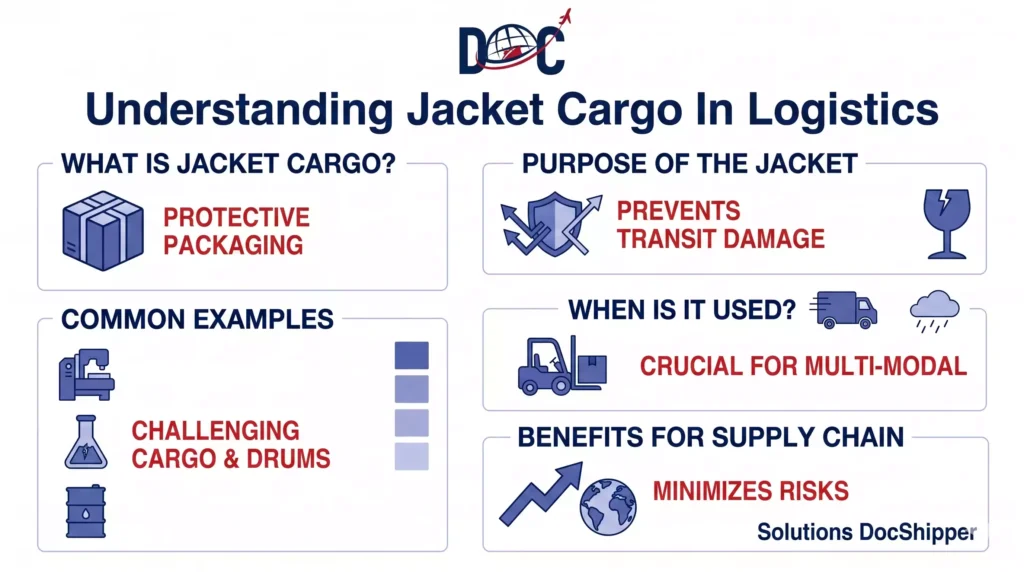
A jacket in logistics refers to a protective outer covering used to shield cargo, containers, or equipment from environmental damage during transportation and storage. Commonly applied to insulated containers, freight pallets, or specialized machinery, jackets prevent temperature fluctuations, moisture ingress, and physical impact, ensuring cargo integrity throughout the supply chain.
Introduction
Many shippers underestimate the critical role protective coverings play in preventing cargo damage and financial losses during international transport. Temperature-sensitive pharmaceuticals, corrosive chemicals, and precision electronics require specialized protection against environmental extremes.
In the logistics industry, the jacket serves as the first defense line against external hazards. Whether transporting refrigerated goods across equatorial routes or protecting machinery in maritime environments, proper jacketing directly impacts delivery success rates.
Key characteristics of logistics jackets include:
- Thermal insulation – Maintains stable internal temperatures for perishables and chemicals
- Moisture barriers – Prevents condensation and water ingress during ocean freight
- Impact resistance – Cushions cargo against handling shocks and vibrations
- UV protection – Shields light-sensitive materials during outdoor storage
- Regulatory compliance – Meets IMDG, ADR, and FDA standards for specific cargo types
Technical Analysis & Industry Standards
The application of jackets varies significantly based on cargo classification and transportation mode. Thermal jackets dominate pharmaceutical logistics, where WHO guidelines mandate temperature maintenance between 2°C and 8°C for vaccines. These typically employ closed-cell foam insulation with reflective barriers achieving R-values exceeding 25.
Container jackets represent another critical category, particularly for ISO tank containers transporting bulk liquids. The International Maritime Organization (IMO) requires specific insulation thicknesses for hazardous materials – typically 50-100mm polyurethane foam depending on the substance’s flash point. According to IMO regulations, heated or cooled cargo must maintain temperature stability within ±3°C throughout transit.
The protective function extends beyond temperature control. Marine environments expose cargo to salt spray corrosion, requiring jackets with vapor barriers rated to ASTM E96 standards. Military and aerospace shipments demand jackets with electrostatic discharge (ESD) properties, grounding static electricity to prevent equipment damage.
Material composition directly determines performance characteristics. Common materials include:
- Cross-linked polyethylene (XLPE) for chemical resistance
- Metallized films for radiant heat reflection
- Closed-cell neoprene for maritime applications
- Fire-retardant fabrics meeting NFPA 701 standards
At DocShipper, we systematically assess cargo specifications to recommend appropriate jacketing solutions, ensuring compliance with destination country regulations while optimizing protection costs. Our technical team coordinates with manufacturers to verify insulation performance before shipment departure.
Installation protocols require specialized training. Improper sealing creates thermal bridges that negate insulation benefits. Industry best practices mandate overlap seams of minimum 50mm with pressure-sensitive adhesives rated for the operational temperature range.
Practical Applications & Case Studies
Real-world logistics scenarios demonstrate the critical impact of proper jacketing on cargo integrity and delivery success. Consider these quantified examples across different industries:
Pharmaceutical Cold Chain Transport
A European pharmaceutical manufacturer shipped 12,000 vaccine doses from Belgium to Nigeria during summer months. Without adequate jacketing, internal container temperatures would have exceeded 25°C within 6 hours based on ambient conditions. The solution involved:
- Triple-layer thermal jacket (outer reflective, mid-foam, inner vapor barrier)
- Phase-change material (PCM) integration maintaining 4°C for 72 continuous hours
- Real-time temperature monitoring via IoT sensors
Result: Zero temperature excursions recorded, with the shipment maintaining 3.2-4.8°C throughout the 14-day transit, preventing an estimated €2.4M in product losses.
Electronics Manufacturing Equipment
| Protection Type | Without Jacket | With Jacket | Cost Difference |
|---|---|---|---|
| Moisture damage rate | 18% units affected | 1.2% units affected | +$850 per shipment |
| Corrosion incidents | 7 claims/year | 0 claims/year | Saves $43K annually |
| Average claim value | $6,200 | $0 | ROI: 51x investment |
Automotive Parts Distribution
A Japanese automotive supplier shipping precision engine components to Mexico faced 23% rejection rates due to rust formation during humid coastal transit. Implementation of desiccant-integrated jackets with humidity indicators reduced rejection rates to 2.1% within three months.
The jacketing system included:
- Silica gel pockets absorbing 300g moisture per cubic meter
- Color-change indicators signaling saturation thresholds
- Anti-static properties preventing dust attraction
- Reusable design reducing packaging costs by 40%
DocShipper coordinates customized jacketing solutions for complex cargo requirements, liaising with packaging engineers to develop specifications that balance protection needs against shipping weight constraints. Our quality control teams verify installation integrity before container sealing.
Conclusion
Proper jacketing represents a strategic investment in cargo protection, delivering measurable returns through reduced damage rates and insurance claims. Understanding material properties, regulatory requirements, and application techniques ensures optimal supply chain performance.
Need expert guidance on protective packaging for your shipments? Contact DocShipper for customized logistics solutions tailored to your cargo specifications.
📚 Quiz
Test Your Knowledge: Jacket (Logistics)
What is the primary function of a jacket in logistics?
Which statement about thermal jacket performance is correct?
A pharmaceutical company needs to ship temperature-sensitive vaccines from Europe to Africa during summer. Which jacket application would be most appropriate?
🎯 Your Result
📞 Free Quote in 24hFAQ | Jacket (Logistics): Definition, Types & Practical Applications
High-performance thermal jackets maintain temperatures within ±2°C of target for 48-96 hours depending on insulation thickness and ambient conditions. Pharmaceutical-grade systems with phase-change materials can extend this to 120 hours. The actual duration depends on external temperature differentials, with performance declining when ambient temperatures exceed 40°C or drop below -20°C.
Most industrial jackets withstand 20-50 uses when properly maintained. Reusable designs feature durable outer fabrics (typically 600D polyester) with replaceable insulation cores. Inspection protocols should check for tears, compromised seals, and insulation compression before reuse. Single-use jackets dominate pharmaceutical applications due to contamination concerns and regulatory requirements for validated temperature maintenance.
Calculate required thermal resistance (R-value) using the formula: R = (T_internal - T_ambient) / Heat_flux_target. For example, maintaining 5°C cargo in 35°C conditions with maximum 10W/m² heat transfer requires R ≈ 3.0 m²·K/W, typically achieved with 40-50mm polyurethane foam. Specialized calculators account for container size, transit duration, and cargo thermal mass.
IMDG Code Chapter 7.3 specifies insulation requirements for dangerous goods, while 49 CFR 173 covers US domestic transport. Flammable liquids require jackets meeting UN fire resistance standards, and corrosives need chemical-resistant materials verified by compatibility testing. EU's ADR regulation mandates specific insulation for temperature-controlled dangerous goods, with documentation proving thermal performance.
Impact-resistant jackets incorporate closed-cell foam with density ratings of 60-100 kg/m³, absorbing shock energy during drops and collisions. Military-spec designs withstand 1.2m drop tests per MIL-STD-810G standards. However, jackets primarily address environmental protection – structural damage prevention requires additional packaging like crates or custom skidding for heavy machinery.
Moisture vapor transmission rates (MVTR) vary significantly: polyethylene films achieve 0.5-2.0 g/m²/day, metallized laminates reach 0.05 g/m²/day, and aluminum foils provide near-zero transmission. Marine applications require materials with MVTR below 0.1 g/m²/day to prevent condensation. Performance degrades with temperature increases – expect 15-20% higher transmission at 40°C versus 20°C ambient conditions.
Basic thermal jackets for pallets cost $45-120 depending on size and insulation thickness. Pharmaceutical-grade containers with validated performance range from $800-2,500 per unit. Custom jackets for oversized machinery can exceed $5,000 but prevent damage claims averaging $15,000-50,000. Bulk purchasing and reusable designs reduce per-shipment costs by 40-60% over single-use alternatives.
Typical jackets add 3-8% to cargo weight and 50-150mm to each dimension. Carriers calculate freight charges on dimensional weight (length × width × height / 5000 for air, / 6000 for ocean), meaning jackets can push shipments into higher pricing tiers. Balance protection benefits against potential dimensional weight surcharges – sometimes upgrading to a larger container size with jacketing costs less than damage risk exposure.
Conduct thermal validation by placing temperature loggers inside jacketed containers, exposing them to target ambient conditions for planned transit duration, and verifying internal temperatures remain within specifications. Third-party testing labs provide ATP (Agreement on the International Carriage of Perishable Foodstuffs) certification for food-grade applications. Document validation results for insurance purposes and regulatory compliance.
Manufacturers produce custom-fitted jackets for machinery, vehicles, and oversized equipment using 3D scanning and CAD design. Turnaround times range from 2-6 weeks depending on complexity. Custom solutions cost 2-4x standard jackets but eliminate gaps that compromise protection. Velcro closures, drawstrings, and modular panels allow field adjustment for dimensional variations during installation.
Many jackets contain recyclable materials (polyethylene, aluminum) eligible for standard recycling streams. Contaminated pharmaceutical jackets require incineration per medical waste protocols. Industrial jackets with polyurethane foam can be mechanically separated into material streams, though economically viable only for large-volume operations. Reusable designs drastically reduce disposal needs – prioritize durable construction over single-use convenience when environmentally sustainable.
Air freight faces rapid temperature fluctuations during loading/unloading at altitude, requiring jackets emphasizing thermal response speed. Ocean freight prioritizes long-duration insulation (14-45 days) and saltwater corrosion resistance. Air shipments benefit from lightweight materials minimizing dimensional weight charges, while ocean allows heavier insulation for superior performance. Humidity control matters more for ocean transport due to extended exposure to maritime conditions.
Need Help with
Logistics or Sourcing ?
First, we secure the right products from the right suppliers at the right price by managing the sourcing process from start to finish. Then, we simplify your shipping experience - from pickup to final delivery - ensuring any product, anywhere, is delivered at highly competitive prices.


Fill the Form
Prefer email? Send us your inquiry, and we’ll get back to you as soon as possible.
Contact us




:%20Definition,%20Types%20&%20Practical%20Applications)