


In short ⚡
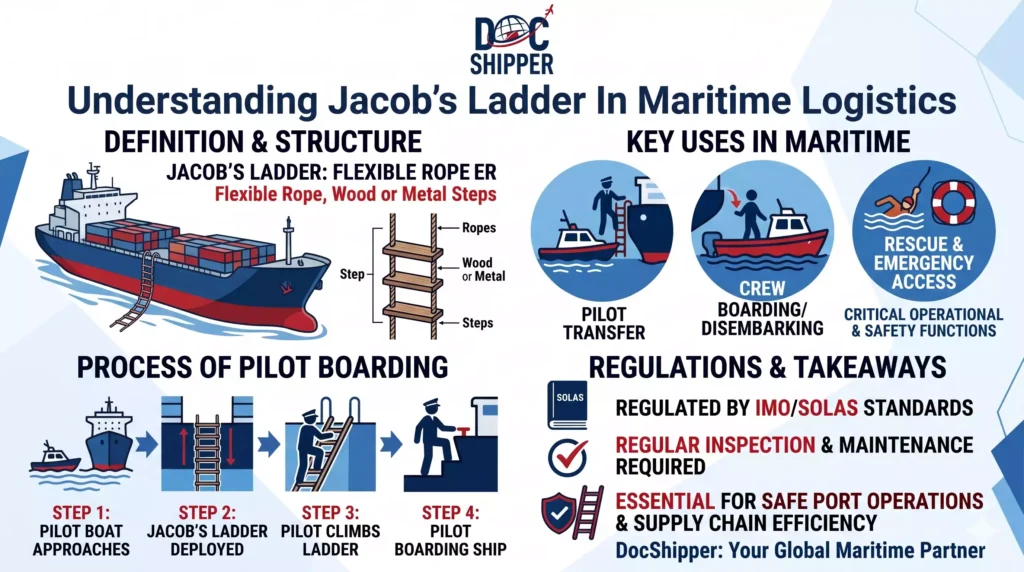
Jacob's Ladder is a flexible rope or chain ladder with wooden or metal rungs used for boarding and disembarking vessels in port operations and maritime logistics. This essential safety equipment enables crew, pilots, and port personnel to safely access ships when fixed gangways are unavailable or impractical.
Introduction
In port operations and ship-to-shore transfers, accessing vessels safely presents unique challenges. Weather conditions, tidal variations, and vessel configurations often make traditional fixed gangways impossible to deploy. This is where specialized boarding equipment becomes critical.
Jacob’s Ladder serves as a primary boarding solution in maritime logistics, particularly during pilot transfers, emergency situations, and port operations where conventional access methods prove impractical. Understanding its proper use is essential for compliance with international maritime safety standards.
Key characteristics of Jacob’s Ladders include:
- Flexible construction allowing adaptation to vessel movement and varying heights
- Standardized rung spacing typically between 300-380mm as per SOLAS requirements
- Weather-resistant materials designed for harsh marine environments
- Quick deployment capability for rapid boarding in time-sensitive operations
- Compliance certification mandatory under IMO and flag state regulations
Technical Specifications & Maritime Regulations
The construction and deployment of Jacob’s Ladders are governed by strict international maritime safety regulations, primarily outlined in the International Maritime Organization’s (IMO) Safety of Life at Sea (SOLAS) Convention. These standards ensure consistent safety across global shipping operations.
Material specifications require side ropes manufactured from manila rope or equivalent synthetic material with minimum circumference of 65mm. The rungs must be constructed from hardwood or non-slip material, measuring at least 480mm long, 115mm wide, and 25mm thick. The lowest rung must sit at least 1.5 meters above water level during deployment.
Regulatory compliance extends to inspection protocols mandated by classification societies. Ladders must undergo thorough examination before each use and comprehensive annual inspections documented in the vessel’s safety equipment log. Any signs of deterioration, including rope fraying, rung damage, or securing mechanism failure, requires immediate replacement.
The deployment procedure follows strict protocols to prevent accidents. Crew members must secure the ladder’s upper end to approved strong points on the vessel, ensuring the ladder hangs without obstruction and maintains proper vertical alignment. Side ropes must extend through the lowest rung with enough length for secure handholds.
Load-bearing capacity standards require ladders to support at least 150kg per rung simultaneously. This specification accounts for personnel weight plus safety equipment during boarding operations. Testing procedures verify structural integrity under dynamic loading conditions that simulate wave motion and vessel roll.
At DocShipper, we coordinate with vessel operators to ensure all boarding equipment meets international standards, facilitating smooth cargo operations and personnel transfers across global shipping routes. Our logistics specialists verify compliance documentation as part of comprehensive freight management services.
For detailed regulatory requirements, consult the IMO Safety Regulations database maintained by the International Maritime Organization.
Practical Applications & Operational Scenarios
Jacob’s Ladders serve multiple critical functions throughout maritime logistics operations. Understanding their practical applications helps logistics professionals anticipate operational requirements and ensure proper safety protocols.
The most common application involves pilot transfers in port approaches. Maritime pilots board vessels to guide them through congested harbor waters, utilizing Jacob’s Ladders when pilot boats cannot position alongside for conventional transfer. Statistics from the International Maritime Pilots’ Association indicate over 50,000 pilot transfers occur daily worldwide, with approximately 30% requiring ladder boarding.
| Operational Scenario | Typical Conditions | Safety Considerations |
|---|---|---|
| Pilot Boarding | Open water, vessel in motion, sea states up to 3 | Requires lifebuoy, heaving line, proper lighting |
| Emergency Evacuation | Vessel alongside or at anchor, potential distress | Rapid deployment capability essential, backup required |
| Port Inspection | Sheltered waters, vessel stationary | Standard safety equipment, daylight operations preferred |
| Crew Transfer (Remote) | Offshore locations, limited port infrastructure | Weather-dependent, requires experienced personnel |
Emergency scenarios represent another critical application. During mechanical failures, medical emergencies, or security incidents, Jacob’s Ladders provide rapid egress when conventional gangways cannot be deployed. Port state control authorities recorded approximately 12,000 emergency transfers globally in 2023 where flexible ladder systems proved essential.
In offshore operations, particularly involving supply vessels servicing oil platforms or wind farms, Jacob’s Ladders facilitate personnel transfers when weather conditions prevent helicopter operations or when platforms lack accommodation ladders. The offshore energy sector reports reliance on these systems for roughly 40% of personnel transfers during adverse weather periods.
Case Study: A container vessel arriving at Rotterdam encountered mechanical failure of its primary accommodation ladder during approach. Port authorities and the vessel’s agent coordinated deployment of a certified Jacob’s Ladder for pilot boarding, enabling safe navigation into berth without delaying cargo operations. The incident demonstrated how proper safety equipment maintains operational continuity despite equipment failures.
Customs and immigration officials frequently use Jacob’s Ladders during vessel clearance procedures at anchorages where boarding before berth assignment is required. This practice expedites documentation processing and reduces port turnaround time, directly impacting logistics efficiency and cost management.
Conclusion
Jacob’s Ladder remains an indispensable safety component in maritime logistics, enabling secure vessel access across diverse operational scenarios. Understanding proper specifications, regulatory compliance, and practical applications ensures safe operations and regulatory adherence in international shipping.
Need expert guidance on maritime logistics compliance or operational coordination? Contact DocShipper today for comprehensive freight forwarding solutions tailored to your shipping requirements.
📚 Quiz
Test Your Knowledge: Jacob's Ladder
What is the primary function of a Jacob's Ladder in maritime logistics?
According to SOLAS regulations, what is the minimum required rung spacing for a Jacob's Ladder?
In which operational scenario is a Jacob's Ladder most commonly deployed?
🎯 Your Result
📞 Free Quote in 24hFAQ | Jacob's Ladder: Definition, Application & Practical Examples in Logistics
While often used interchangeably, a pilot ladder specifically refers to equipment meeting SOLAS Chapter V requirements for pilot transfers, featuring spreader steps and specific construction standards. Jacob's Ladder is a broader term encompassing various flexible ladder designs, though in maritime contexts they typically refer to the same equipment meeting pilot ladder specifications.
Maritime regulations require visual inspection before each use, thorough monthly inspections documented in ship logs, and comprehensive annual surveys by qualified personnel. Replacement depends on condition rather than fixed timeline, but most operators replace ladders every 2-3 years or immediately upon detecting deterioration, fraying, or structural damage affecting safety.
Yes, modern regulations permit synthetic rope materials provided they meet equivalent strength and durability specifications. Polypropylene and polyester ropes are commonly approved alternatives offering improved weather resistance and longevity. However, materials must be specifically certified for marine use and comply with flag state and classification society requirements.
Safety protocols typically prohibit ladder use when significant wave height exceeds 2.5 meters, wind speeds surpass 25 knots, or visibility drops below safe operational levels. Local port authorities and pilot associations establish specific weather criteria based on regional conditions. Vessel masters hold ultimate authority to refuse ladder deployment when conditions pose unacceptable risk.
The vessel owner and master bear primary legal responsibility for ensuring proper maintenance, inspection, and operational readiness of all safety equipment including Jacob's Ladders. This responsibility extends to training crew in proper deployment procedures and maintaining documentation proving compliance with applicable maritime safety conventions and flag state requirements.
Alternatives include accommodation ladders (mechanical gangways), combination ladders (incorporating both steps and rope sections), and specialized transfer systems like davit-launched personnel baskets. However, Jacob's Ladders remain mandatory backup equipment on most commercial vessels due to their reliability, simplicity, and ability to function when mechanical systems fail.
Maritime personnel must complete safety training covering proper climbing techniques, personal protective equipment use, and emergency procedures. Pilots specifically undergo specialized training through national pilot associations. STCW (Standards of Training, Certification and Watchkeeping) conventions mandate basic safety training for all seafarers including ladder operations as part of personal safety and social responsibility modules.
Significant tidal ranges require careful planning to ensure the ladder maintains proper positioning throughout boarding operations. In ports with extreme tides exceeding 5 meters, continuous adjustment may be necessary during extended operations. Operators must calculate water level changes and ensure sufficient ladder length to maintain the required minimum freeboard throughout the tidal cycle.
Liability typically falls under maritime law principles including vessel owner negligence, improper equipment maintenance, or failure to meet safety standards. Insurance coverage through Protection and Indemnity (P&I) clubs generally covers injury claims. Jurisdictional issues depend on flag state, location of incident, and nationality of injured parties, often requiring specialized maritime legal expertise to resolve.
No, Jacob's Ladders are exclusively designed for personnel transfer and explicitly prohibited for cargo handling under maritime safety regulations. Their construction specifications focus on human weight loads, not cargo masses. Attempting to use them for cargo risks structural failure, personal injury, and regulatory violations resulting in port state control detentions and potential criminal liability.
During port state control inspections, surveyors examine physical condition, verify certification markings, review maintenance records, and may conduct deployment tests. They check for proper storage, accessibility, and crew familiarity with deployment procedures. Non-compliance can result in vessel detention until deficiencies are rectified, causing significant operational delays and financial penalties.
Recent developments include integrated lighting systems for night operations, quick-release mechanisms improving deployment speed, enhanced materials offering superior grip in wet conditions, and monitoring systems detecting structural stress or damage. Some manufacturers incorporate RFID tracking for inspection scheduling and compliance documentation, though traditional designs remain predominant due to proven reliability and regulatory acceptance.
Need Help with
Logistics or Sourcing ?
First, we secure the right products from the right suppliers at the right price by managing the sourcing process from start to finish. Then, we simplify your shipping experience - from pickup to final delivery - ensuring any product, anywhere, is delivered at highly competitive prices.


Fill the Form
Prefer email? Send us your inquiry, and we’ll get back to you as soon as possible.
Contact us




