


In short ⚡
The K Factor is a dimensional coefficient used in sheet metal bending calculations to determine the precise location of the neutral axis. It represents the ratio between the distance from the inner bend surface to the neutral axis and the material thickness, crucial for accurate flat pattern development and material consumption forecasting in manufacturing and logistics operations.
Introduction
Manufacturers and logistics professionals frequently encounter discrepancies between designed dimensions and actual fabricated parts. This gap often stems from miscalculating material behavior during bending operations.
The K Factor addresses this challenge by providing a standardized method to predict how sheet metal behaves when formed. Understanding this coefficient is essential for accurate cost estimation, material ordering, and quality control in international supply chains.
- Material-specific constant: Varies based on metal type, thickness, and bending radius
- Neutral axis determination: Identifies the theoretical layer that maintains original length during bending
- Flat pattern accuracy: Enables precise calculation of pre-bend dimensions
- Cost optimization: Reduces material waste and rework in fabrication processes
- Quality assurance: Ensures dimensional compliance across production batches
Technical Fundamentals & Engineering Applications
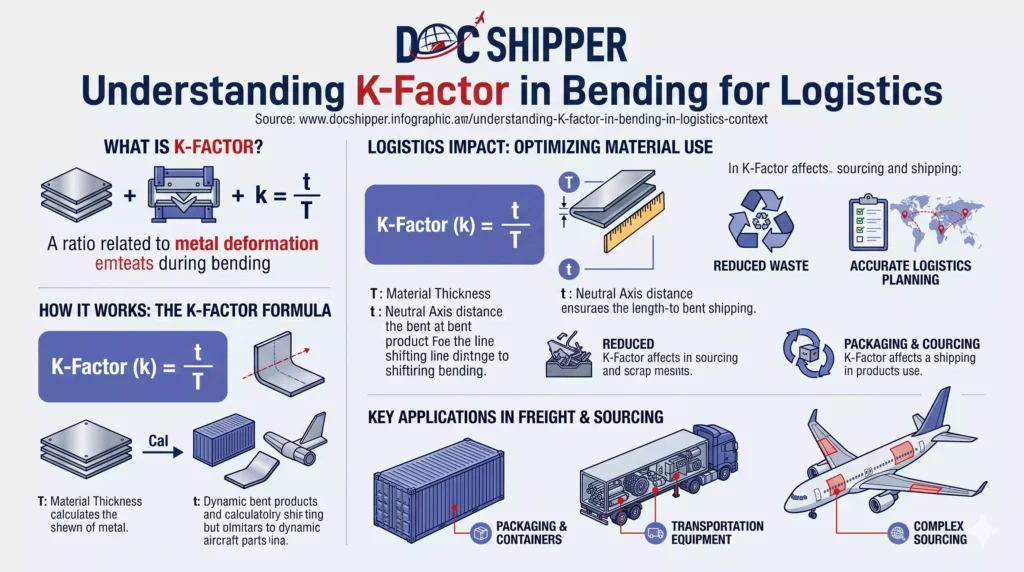
The K Factor represents the position of the neutral axis within bent sheet metal. During bending, the outer surface stretches while the inner surface compresses, creating a theoretical layer—the neutral axis—that neither elongates nor contracts.
The standard formula expresses K Factor as: K = t/T, where t represents the distance from the inner bend surface to the neutral axis, and T equals the material thickness. Typical values range from 0.30 to 0.50 for most metals, with softer materials generally exhibiting higher values.
The bend allowance calculation directly depends on the K Factor: BA = (π/180) × (R + K × T) × A, where BA is bend allowance, R is inside radius, T is material thickness, and A is bend angle in degrees. This equation determines the additional material length consumed during the bending process.
Manufacturing specifications require different K Factor values based on material properties and forming conditions. Cold-rolled steel typically uses 0.33-0.38, aluminum alloys range from 0.38-0.42, and stainless steel falls between 0.35-0.40. Temperature, bending speed, and tooling geometry also influence the effective K Factor.
At DocShipper, we coordinate with fabrication partners globally to ensure K Factor specifications match the destination market’s manufacturing standards, preventing costly dimensional rejections during customs inspections and quality audits. According to ASME standards, proper K Factor application reduces manufacturing tolerances by 40-60%.
The Y Factor alternative (Y = K × π/2) is sometimes preferred in European manufacturing contexts, representing the same physical principle through different mathematical expression. Understanding both systems facilitates international collaboration and specification interpretation.
Practical Calculations & Industry Data
Real-world application of K Factor calculations demonstrates measurable impacts on material procurement and logistics costs. Consider a container shipment of 5,000 aluminum brackets requiring 90-degree bends.
| Parameter | Without K Factor | With K Factor (0.40) | Impact |
|---|---|---|---|
| Flat pattern length | 150 mm | 153.14 mm | +2.1% material |
| Material per part | 0.225 kg | 0.230 kg | +0.005 kg |
| Total shipment weight | 1,125 kg | 1,150 kg | +25 kg difference |
| Dimensional accuracy | ±2.5 mm tolerance | ±0.3 mm tolerance | 88% improvement |
| Rejection rate | 12-15% | 2-3% | 80% reduction |
Use Case: Electronics Enclosure Manufacturing
A logistics coordinator managing component imports for a telecommunications project faced repeated rejections due to bracket dimensional inconsistencies. The manufacturer was calculating flat patterns using assumed bend deductions without K Factor verification.
After implementing K Factor-based calculations (K=0.38 for 1.5mm cold-rolled steel with 3mm inside radius), the following improvements occurred:
- First-pass acceptance: Increased from 73% to 96%
- Material waste: Decreased by 18.5% per production run
- Lead time: Reduced by 11 days through elimination of remake cycles
- Shipping consolidation: Enabled 15% more units per container due to tighter dimensional control
- Customs clearance: Accelerated through consistent specification compliance
Industry benchmarks from the Society of Manufacturing Engineers indicate that K Factor implementation reduces total production costs by 8-14% across medium-volume operations (5,000-50,000 units annually).
For international procurement, DocShipper validates K Factor specifications during pre-production inspections, ensuring manufacturing partners apply appropriate coefficients for the specific materials and tooling available. This verification step prevents the most common cause of dimensional non-conformance in metal fabrication imports.
Conclusion
The K Factor transforms theoretical designs into manufacturable realities by accurately predicting material behavior during forming operations. Proper application eliminates costly dimensional discrepancies that disrupt international supply chains.
Need assistance coordinating fabrication specifications across your global supply chain? Contact DocShipper for expert guidance on manufacturing compliance and quality assurance.
📚 Quiz
Test Your Knowledge: K Factor in Sheet Metal Bending
What does the K Factor primarily represent in sheet metal bending?
A manufacturer calculates flat patterns using assumed bend deductions without verifying K Factor. What is the most likely consequence?
You're sourcing 10,000 stainless steel brackets from an overseas manufacturer. The supplier proposes using a generic K Factor of 0.30 for all materials. What should you do?
🎯 Your Result
📞 Free Quote in 24hFAQ | K Factor: Definition, Calculation & Practical Examples
The K Factor depends on material type, thickness, grain direction, and bending conditions. Most manufacturers reference material datasheets or conduct empirical bend tests. Standard values: mild steel (0.33-0.38), aluminum (0.38-0.42), stainless steel (0.35-0.40). For critical applications, physical testing with the actual material batch and tooling provides the most accurate coefficient.
Both describe neutral axis position but use different mathematical expressions. K Factor (0-0.5 range) represents the ratio directly, while Y Factor (0-π/2 range) applies a π/2 multiplier. Y Factor = K Factor × π/2. European standards often prefer Y Factor, while North American specifications typically use K Factor. They represent identical physical phenomena.
Yes. K Factor changes based on temper condition, rolling direction, actual thickness variance, and even ambient temperature during forming. Heat-treated aluminum exhibits different K values than annealed aluminum. Manufacturing best practice involves periodic verification testing rather than assuming catalog values remain constant across production batches.
K Factor directly determines bend allowance, the critical dimension added to flat lengths. A 0.05 error in K Factor (e.g., using 0.35 instead of 0.40) creates approximately 0.15mm dimensional error per bend in 2mm material. For parts with multiple bends, errors compound, potentially exceeding tolerance limits and causing rejection.
Thin materials (under 0.5mm) typically require K Factors between 0.40-0.50 due to their higher ductility and proportionally larger neutral axis shift. However, tooling becomes the dominant factor. Small inside radii (tight bends) push K values lower, while larger radii increase them. Empirical testing is strongly recommended for thin-gauge precision applications.
K Factor addresses neutral axis position; springback requires separate compensation. Springback depends on material yield strength, bend angle, and tooling. Apply K Factor for accurate flat pattern development, then add springback compensation (typically 2-8 degrees overbend) based on material-specific testing. Modern CAD systems incorporate both factors in forming simulations.
Yes significantly. Smaller inside radii (relative to material thickness) shift the neutral axis inward, reducing K Factor. A 1:1 ratio (radius equals thickness) might use K=0.33, while 4:1 ratio could reach K=0.42 for the same material. Sharp bends create non-uniform stress distributions that move the neutral axis closer to the inner surface.
Generally yes, if all bends use similar radii and bend the same direction relative to grain orientation. However, mixed bend angles, varying radii, or grain direction changes require individual K Factor consideration per bend. Complex parts benefit from CAD software that applies specific coefficients to each feature based on its unique geometry.
K Factor itself is a coefficient, not a dimension requiring tolerance. Instead, specify the resulting dimensional tolerances for finished parts (e.g., ±0.2mm for critical dimensions). Communicate the K Factor as a calculation requirement along with expected dimensional outcomes. Quality manufacturers will validate their processes achieve specified tolerances using the provided K Factor.
Accurate K Factor application reduces raw material requirements by 3-8% compared to conservative flat pattern estimates. For high-volume production, this directly impacts material procurement costs. When requesting quotes, providing verified K Factor specifications enables suppliers to offer tighter pricing based on actual material consumption rather than buffered estimates that protect against dimensional uncertainty.
Yes. The bend deduction method subtracts a fixed value from the sum of leg lengths. The outside setback method calculates from exterior dimensions. However, K Factor remains the most versatile and material-specific approach. It adapts to different thicknesses, radii, and materials through a single coefficient adjustment, making it preferred for engineering documentation and international manufacturing coordination.
Customs inspectors verify finished dimensions against declared specifications, not calculation methods. However, consistent application of proper K Factor ensures parts match technical drawings submitted for tariff classification and origin certification. Dimensional discrepancies between samples and production shipments can trigger compliance audits. DocShipper coordinates pre-shipment inspections to verify manufacturing accuracy before international transport.
Need Help with
Logistics or Sourcing ?
First, we secure the right products from the right suppliers at the right price by managing the sourcing process from start to finish. Then, we simplify your shipping experience - from pickup to final delivery - ensuring any product, anywhere, is delivered at highly competitive prices.


Fill the Form
Prefer email? Send us your inquiry, and we’ll get back to you as soon as possible.
Contact us




