


In short ⚡
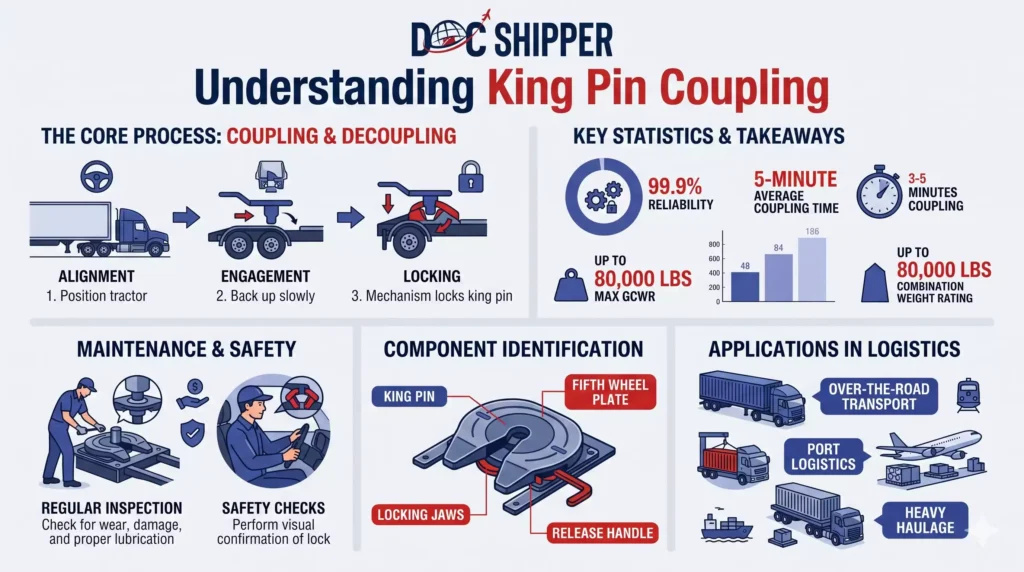
The King Pin is a critical coupling component that connects the fifth wheel of a tractor unit to the semi-trailer. This steel pin, typically 2 or 3.5 inches in diameter, locks into the fifth wheel mechanism to create a pivot point for articulated vehicles, enabling safe turning and weight distribution across commercial transport operations.
Introduction
Many logistics professionals underestimate the king pin’s critical role in freight safety. A damaged or improperly maintained king pin can lead to catastrophic trailer detachment during transport, causing severe accidents and cargo loss. This small component bears the entire vertical load of a loaded semi-trailer while allowing horizontal articulation.
In international shipping and intermodal transport, understanding king pin specifications becomes essential for equipment compatibility. Different regional standards and wear patterns directly impact operational efficiency and compliance with transportation regulations.
- Load-bearing capacity: Supports vertical loads ranging from 12,000 to 25,000 kg depending on trailer configuration
- Standardized dimensions: Governed by SAE J133 (North America) and ISO 1726 (International) specifications
- Material composition: Manufactured from high-strength alloy steel with minimum tensile strength of 120,000 PSI
- Inspection requirements: Mandatory visual checks before coupling and periodic dimensional verification
- Replacement indicators: Wear exceeding 0.25 inches (6.35 mm) necessitates immediate replacement
Technical Specifications & Safety Standards
The king pin operates under extreme mechanical stress during transport operations. Its design incorporates specific dimensional tolerances that ensure proper engagement with fifth wheel locking jaws. North American standards specify a 2-inch diameter king pin with precise length requirements measured from the trailer bolster plate.
According to FMCSA regulations, the king pin must not show wear exceeding 1/4 inch at any point around its circumference. This critical wear limit directly impacts the security of the coupling mechanism. Excessive wear reduces the contact surface between the pin and locking mechanism, potentially allowing inadvertent release during maneuvers.
The heat treatment process applied during manufacturing creates a hardened outer surface while maintaining a ductile core. This combination prevents brittle fracture under shock loads while resisting surface wear from repeated coupling cycles. Quality king pins undergo induction hardening to achieve Rockwell hardness between 35-45 HRC.
International operations require careful attention to compatibility between European and North American systems. While ISO standards specify similar load requirements, mounting configurations and inspection protocols vary significantly. European semi-trailers often feature king pins mounted to bolster plates with different bolt patterns than their North American counterparts.
At DocShipper, we systematically verify king pin condition during equipment inspections for intermodal shipments. Our pre-departure checks include caliper measurements and visual inspection for cracks, excessive rust, or deformation that could compromise coupling integrity during international transport operations.
The safety inspection protocol mandates checking for vertical play after coupling. Excessive movement indicates either king pin wear or fifth wheel jaw deterioration. Both conditions require immediate correction before releasing vehicles for highway operation, as specified in commercial vehicle safety regulations across major shipping jurisdictions.
Practical Applications & Industry Data
Real-world king pin failures account for a measurable percentage of road transport incidents. Understanding wear patterns and replacement economics helps logistics operators maintain safe fleets while optimizing maintenance budgets.
| King Pin Condition | Measurement Range | Action Required | Safety Impact |
|---|---|---|---|
| New/Excellent | 1.995″ – 2.000″ | None – Continue operation | Optimal coupling security |
| Acceptable Wear | 1.875″ – 1.994″ | Monitor closely – Schedule replacement | Safe but approaching limit |
| Excessive Wear | 1.750″ – 1.874″ | Immediate replacement required | Potential decoupling risk |
| Critical/Failed | Below 1.750″ | Vehicle out of service | Imminent failure hazard |
Industry data from fleet operations reveals that king pins typically require replacement after 150,000 to 250,000 miles of service, depending on operational conditions. Intermodal trailers experience faster wear due to frequent coupling/uncoupling cycles compared to dedicated long-haul units.
Use Case – International Container Transport: A logistics company operating drayage services between port terminals and inland distribution centers discovered premature king pin wear on trailers handling 15-20 container moves daily. The frequent coupling operations caused wear rates three times faster than standard over-the-road applications. Implementation of monthly measurement protocols reduced unexpected failures by 78% and improved equipment availability.
Cost analysis shows replacement king pins range from $150-$400 per unit depending on specifications and brand. However, the total replacement cost including labor, downtime, and potential load delays can exceed $2,000 per incident. Proactive inspection programs deliver substantial ROI by preventing roadside failures.
Regional variations in road conditions significantly impact wear patterns. Operations in coastal environments with salt exposure experience accelerated corrosion around the king pin base. Winter operations with road salt applications require more frequent inspection intervals to detect corrosion-induced structural weaknesses before they compromise load-bearing capacity.
Maintenance best practices include applying anti-seize compounds to mounting bolts and ensuring proper torque specifications during installation. The king pin assembly must maintain flush contact with the bolster plate to prevent stress concentration that accelerates fatigue cracking. Proper installation procedures extend service life by 20-30% compared to improper mounting techniques.
Conclusion
The king pin represents a critical safety component whose proper maintenance directly impacts operational continuity and regulatory compliance. Understanding wear limits, inspection protocols, and replacement economics enables logistics professionals to manage fleet safety proactively while controlling maintenance expenditures.
Need expert guidance on equipment specifications for international transport operations? Contact DocShipper for comprehensive logistics support across all transport modes.
📚 Quiz
Test Your Knowledge: King Pin
What is the primary function of a king pin in commercial transport operations?
At what wear threshold must a king pin be immediately replaced according to FMCSA regulations?
A fleet manager notices their intermodal trailers handling 15-20 container moves daily show accelerated king pin wear. What is the most appropriate action?
🎯 Your Results
📞 Free Quote in 24hFAQ | King Pin: Definition, Function & Practical Examples in Logistics
Standard king pins measure 2 inches (50.8 mm) in diameter for North American applications and 2 or 3.5 inches for international standards. The measurement is taken at the widest point of the cylindrical section that engages with the fifth wheel locking mechanism. This standardization ensures compatibility across different tractor and trailer manufacturers.
Federal Motor Carrier Safety Administration regulations require pre-trip visual inspections before each coupling operation. Detailed dimensional measurements using calipers should occur during scheduled maintenance intervals, typically every 30,000 miles or quarterly. High-utilization intermodal equipment benefits from monthly measurement protocols to detect accelerated wear patterns before they reach critical thresholds.
King pins cannot be repaired once wear exceeds acceptable limits. The heat-treated surface and precise dimensional requirements make reconditioning impractical and unsafe. Replacement is the only approved solution when measurements indicate wear beyond 0.25 inches from original specifications. Some manufacturers offer oversized replacement pins for severely worn bolster plates.
Premature wear results from inadequate lubrication of the fifth wheel coupling, misaligned trailer bolster plates, excessive coupling cycles in intermodal operations, corrosion from environmental exposure, and improper fifth wheel adjustment. Regular greasing of the fifth wheel plate and maintaining proper locking jaw adjustment significantly extends king pin service life.
Use a calibrated micrometer or king pin gauge to measure diameter at multiple points around the circumference, particularly at the wear ring where fifth wheel jaws contact the pin. Measurements should be taken at the base, middle, and top sections. The smallest measurement determines replacement necessity. Always compare readings against manufacturer specifications for the specific trailer model.
Yes, king pins vary by diameter (2" or 3.5"), length, mounting configuration, and load rating. Standard applications use forged steel pins, while specialized heavy-haul trailers may require higher-strength alloys. European trailers often use different mounting bolt patterns than North American equipment. Always verify compatibility when replacing components or converting trailers between markets.
Warning signs include excessive vertical play after coupling, visible cracks or rust around the base, metal shavings near the fifth wheel, unusual noises during turning maneuvers, and difficulty engaging or releasing the coupling. Any visible deformation or diameter measurements below 1.75 inches indicate immediate replacement necessity before further operation.
Operating with excessively worn king pins violates commercial vehicle safety regulations and can void insurance coverage in accident claims. Documented maintenance records proving regular inspection and timely replacement demonstrate due diligence in accident investigations. Negligent maintenance resulting in trailer separation creates severe liability exposure for carriers and can result in substantial regulatory penalties.
King pin replacement requires lifting the trailer, removing mounting bolts securing the pin to the bolster plate, extracting the worn pin, cleaning the mounting surface, installing the new pin with proper alignment, torquing fasteners to specification, and verifying installation integrity. Professional installation typically requires 2-4 hours including equipment setup. Always use OEM-specified replacement parts to maintain warranty compliance.
Current electric tractor units and autonomous trucks use standard king pin coupling systems identical to conventional diesel equipment. The mechanical coupling interface remains unchanged as it provides proven reliability. Future developments may introduce smart sensors integrated into king pin assemblies to monitor coupling status and wear conditions in real-time for predictive maintenance applications.
While king pin wear primarily impacts safety rather than fuel consumption, excessive play in the coupling can cause trailer instability that increases aerodynamic drag. Proper coupling alignment ensures the trailer tracks directly behind the tractor, minimizing rolling resistance. Severe wear leading to misalignment can reduce fuel economy by 2-5% due to increased drag and tire scrubbing during turns.
SAE J133 establishes dimensional and performance standards for North American king pins, while ISO 1726 covers international specifications. These standards define material properties, dimensional tolerances, load testing requirements, and fatigue resistance criteria. Manufacturers must demonstrate compliance through destructive testing protocols that verify pins can withstand specified vertical and horizontal loads without failure.
Need Help with
Logistics or Sourcing ?
First, we secure the right products from the right suppliers at the right price by managing the sourcing process from start to finish. Then, we simplify your shipping experience - from pickup to final delivery - ensuring any product, anywhere, is delivered at highly competitive prices.


Fill the Form
Prefer email? Send us your inquiry, and we’ll get back to you as soon as possible.
Contact us




