


In short ⚡
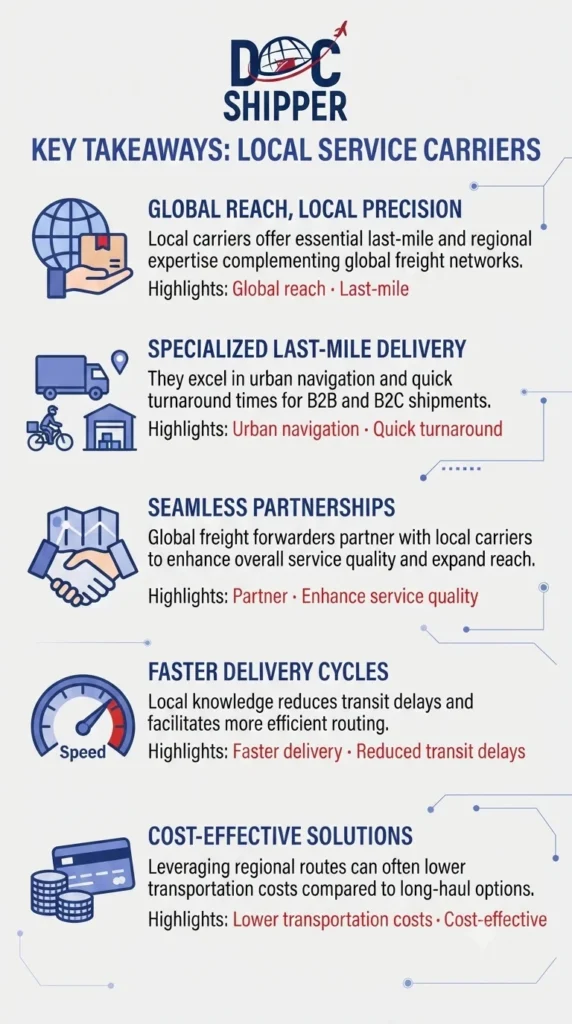
Local Service Carriers are transportation companies operating within specific geographic zones, handling short-distance freight movements between ports, warehouses, and final delivery points. These carriers bridge the gap between international transport and last-mile distribution, ensuring goods reach their destination efficiently.
Introduction
Many importers struggle to understand who handles their cargo after customs clearance. The confusion between international carriers and local distributors creates delays and unexpected costs. Local Service Carriers solve this problem by specializing in regional transport operations.
In international logistics, these carriers play a critical role in the supply chain. They operate where global shipping lines and air freight forwarders cannot reach. Their expertise ensures seamless transitions from ports to distribution centers or end customers.
Key characteristics of Local Service Carriers include:
- Geographic specialization: Operations limited to defined regional zones
- Infrastructure knowledge: Deep understanding of local roads, regulations, and delivery constraints
- Flexible fleet: Vehicles adapted to urban delivery, warehouse transfers, or regional distribution
- Rapid response: Shorter lead times compared to international carriers
- Customs integration: Coordination with customs brokers for seamless cargo release
Operational Framework & Expertise
Local Service Carriers operate within a defined regulatory and operational framework. Their services begin where ocean freight or air cargo operations end. Understanding their role prevents logistical bottlenecks and ensures timely delivery.
These carriers typically handle drayage operations, moving containers from ports to nearby facilities. This initial step is critical for deconsolidation and inventory management. At DocShipper, we coordinate with trusted local carriers to ensure zero delays between customs clearance and warehouse arrival.
The licensing requirements vary significantly by country. In the European Union, carriers must comply with EU road transport regulations, including operator licensing and vehicle standards. US-based carriers require DOT numbers and insurance certifications.
Service scope determines carrier selection. Some specialize in refrigerated transport for perishables. Others focus on oversized cargo requiring special permits. Understanding these specializations prevents mismatches between cargo requirements and carrier capabilities.
Technology integration distinguishes modern Local Service Carriers. Real-time tracking systems provide visibility throughout the regional journey. GPS monitoring, electronic proof of delivery, and automated customs notifications improve efficiency. Companies like DocShipper integrate these systems to offer clients complete supply chain transparency.
The cost structure differs from international shipping. Local carriers charge based on distance, weight, and handling requirements. Urban deliveries often incur congestion fees or restricted access charges. Understanding these variables helps importers budget accurately for the complete door-to-door journey.
Practical Examples & Data
Real-world applications demonstrate how Local Service Carriers impact import operations. Consider these scenarios across different logistics contexts.
Case Study: Electronics Import to Los Angeles
A technology company imports 500 pallets of consumer electronics monthly through the Port of Long Beach. After customs clearance, a local carrier moves containers to a warehouse in Ontario, California—approximately 60 miles inland. The local carrier completes delivery within 4 hours of port release, enabling same-day inventory processing. Total drayage cost: $275 per container, significantly lower than keeping inventory at port facilities charging $150 daily demurrage.
Comparison: Local vs. National Carriers
| Criteria | Local Service Carrier | National Carrier |
|---|---|---|
| Coverage Area | 50-150 mile radius | Nationwide network |
| Response Time | Same-day pickup available | 24-48 hours scheduling |
| Cost Structure | Flat rate per zone | Mileage-based pricing |
| Specialized Equipment | Limited availability | Extensive fleet options |
| Port Relationships | Established terminal access | Variable by location |
Key Industry Statistics:
- 68% of port delays result from inadequate local carrier coordination
- Local carriers handle 23% of total logistics costs in typical import operations
- Average drayage distance in major US ports: 47 miles
- Peak season rate increases average 35-50% for local services
- Digital tracking adoption among local carriers: 82% as of 2024
Scenario: Temperature-Controlled Pharmaceuticals
A pharmaceutical importer requires cold chain integrity from Hamburg port to a German distribution center. The local carrier provides refrigerated containers maintaining 2-8°C throughout the 120km journey. Real-time temperature monitoring alerts prevent product loss. Without specialized local carriers, companies would need expensive port storage facilities, adding €200-400 daily to logistics costs.
Conclusion
Local Service Carriers represent the critical link between international transport and final delivery. Their regional expertise, rapid response capabilities, and specialized equipment ensure smooth cargo transitions from ports to destinations.
Understanding when and how to engage these carriers prevents costly delays and optimizes your supply chain efficiency. Need expert guidance on selecting and coordinating local carriers for your imports? Contact DocShipper for comprehensive logistics support.
📚 Quiz
Test Your Knowledge: Local Service Carriers
What is the primary operational scope of Local Service Carriers?
A freight forwarder and a local service carrier have the same responsibilities in the supply chain.
Your electronics shipment just cleared customs at the Port of Long Beach and needs delivery to a warehouse 60 miles away. Which service would be most appropriate?
🎯 Your Result
📞 Free Quote in 24hFAQ | Local Service Carriers: Definition, Operations & Practical Examples
A freight forwarder coordinates multiple transport modes and handles documentation, while a local carrier physically transports goods within a specific region. Forwarders often contract local carriers for regional delivery segments. Local carriers focus exclusively on moving cargo short distances, typically 50-200 miles from ports or consolidation centers.
Evaluate carriers based on geographic coverage, equipment availability, insurance levels, and technology integration. Verify licensing credentials and check references from similar industries. Consider specialized requirements like refrigeration, hazmat certification, or oversized cargo capability. At DocShipper, we maintain vetted networks of local carriers across major trade routes.
Rates vary significantly by region, distance, and cargo type. US port drayage averages $200-400 per container for 30-60 miles. European local delivery ranges €150-350 for similar distances. Specialized services like refrigerated transport or hazardous materials add 25-50% to base rates. Always request detailed quotes including fuel surcharges and accessorial fees.
Most local carriers transport cleared cargo only. They coordinate with customs brokers but typically don't provide clearance services directly. Some larger regional carriers offer bundled services including customs brokerage. Clarify responsibilities during contract negotiations to avoid delays when cargo arrives at the port or border crossing point.
Carrier liability depends on contract terms and insurance coverage. Standard cargo liability ranges from $0.60-2.00 per pound. Inspect goods immediately upon delivery and document any damage with photos. File claims within 48-72 hours per carrier policy. Proper insurance through your freight forwarder or separate cargo policy provides additional protection beyond carrier liability limits.
Response times vary by port congestion and carrier availability. Major ports like Los Angeles or Rotterdam typically offer same-day or next-day pickup if scheduled 24 hours in advance. Peak seasons may extend this to 2-3 days. Demurrage charges begin 3-5 days after cargo availability, making prompt local carrier coordination financially critical.
Not necessarily. Many importers work through freight forwarders who contract local carriers as subcontractors. This simplifies administration and provides single-point accountability. However, high-volume shippers often negotiate direct contracts with local carriers for better rates and priority service. Evaluate your shipment frequency to determine the optimal contracting approach.
Essential documents include the delivery order from your freight forwarder, customs release notification, and bill of lading. For specialized cargo, provide material safety data sheets (MSDS) for hazmat or temperature requirements for perishables. Proper documentation prevents pickup delays and ensures carriers have correct delivery addresses and contact information.
Some regional carriers operate cross-border services in specific corridors like US-Mexico or within the EU. These require additional permits, customs bonds, and compliance expertise. Most local carriers operate within a single country. For cross-border movements, freight forwarders coordinate multiple carriers or engage specialized border-crossing operators.
Peak seasons (pre-holiday periods, harvest times) strain local carrier capacity significantly. Rates increase 30-60% during peaks, and booking lead times extend from 24 hours to 3-5 days. Smart importers establish preferred carrier relationships and book capacity weeks in advance during known peak periods. Flexible delivery schedules reduce costs during these high-demand windows.
Professional local carriers offer GPS tracking, electronic proof of delivery (ePOD), and automated status notifications. Advanced systems integrate with freight forwarder platforms for real-time visibility. Expect digital invoicing, online scheduling portals, and exception alerts. Technology adoption indicates operational sophistication and improves supply chain predictability for importers managing complex logistics networks.
Specialized equipment and routing permits are required for cargo exceeding standard dimensions or weight limits. Local carriers charge premium rates for oversize loads due to permit costs, escort vehicles, and route restrictions. Some carriers specialize in heavy haul services with hydraulic trailers and experienced drivers. Always disclose exact dimensions and weight when requesting quotes to avoid refused pickups or additional charges.
Need Help with
Logistics or Sourcing ?
First, we secure the right products from the right suppliers at the right price by managing the sourcing process from start to finish. Then, we simplify your shipping experience - from pickup to final delivery - ensuring any product, anywhere, is delivered at highly competitive prices.


Fill the Form
Prefer email? Send us your inquiry, and we’ll get back to you as soon as possible.
Contact us




