


In short ⚡
A Low-Boy is a specialized flatbed trailer with an extremely low deck height, designed to transport oversized, heavy, or tall cargo that exceeds standard road clearance limits. Its unique dropped platform allows hauling equipment up to 12 feet tall while remaining under bridge and power line restrictions, making it essential for construction machinery and industrial freight.
Introduction
Standard flatbed trailers fail when transporting excavators, cranes, or agricultural harvesters—not due to weight capacity, but because of vertical clearance restrictions. Many logistics providers quote projects without verifying equipment dimensions, causing expensive delays at highway checkpoints.
The low-boy trailer solves this critical challenge in heavy haul logistics. By positioning cargo closer to the road surface, it enables legal transport of machinery that would otherwise require route modifications or disassembly. This capability directly impacts project timelines in construction, mining, and industrial relocation sectors.
Key characteristics defining low-boy operations:
- Deck height: 18-24 inches from ground versus 60 inches on standard flatbeds
- Load capacity: 40,000 to 150,000 pounds depending on axle configuration
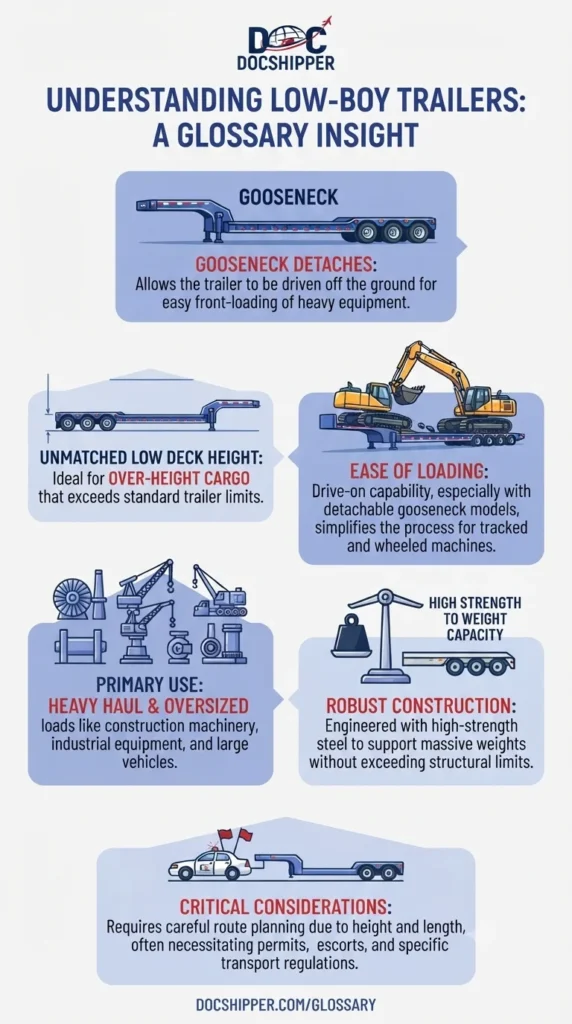
- Gooseneck design: Detachable front section for loading tall equipment
- Axle arrangements: 2 to 9+ axles for weight distribution compliance
- Ramp systems: Hydraulic tilt mechanisms for self-loading capabilities
Technical Specifications & Regulatory Framework
The engineering distinction between low-boys and conventional trailers lies in well deck construction. The cargo area sits between axle assemblies rather than above them, creating a recessed platform. This design sacrifices some load flexibility but gains critical vertical space for oversized freight.
Regulatory compliance for low-boy operations requires understanding dimensional thresholds. In the United States, the Federal Motor Carrier Safety Administration enforces height limits typically set at 13.5 to 14 feet, though state-specific variations exist. Low-boys enable cargo up to 11-12 feet tall while maintaining 2-3 feet of clearance buffer.
Axle configuration determines legal weight distribution. A 2-axle low-boy handles 40,000 lbs, while 9-axle configurations support 150,000+ lbs. The Federal Bridge Formula calculates maximum allowable weight based on axle spacing: W = 500[(LN/(N-1)) + 12N + 36], where W equals weight in pounds, L is distance between outer axles in feet, and N represents axle count.
Three primary low-boy variants serve different needs:
- Fixed-neck low-boys: Non-detachable gooseneck for lighter loads under 50,000 lbs
- Removable gooseneck (RGN): Detachable front for drive-on loading of wheeled equipment
- Hydraulic tail low-boys: Tilting rear section for tracked machinery loading
At DocShipper, we verify dimensional compliance before dispatch, cross-referencing state route restrictions with cargo specifications. Our pre-transport surveys identify potential clearance issues, from low-hanging utility lines to narrow underpass sections, preventing costly mid-route interventions.
The well depth—the vertical distance from trailer frame to deck surface—ranges from 24 to 29 inches on standard models. Specialized deep-well versions reach 36+ inches for extremely tall loads like wind turbine components. However, deeper wells reduce structural rigidity, requiring reinforced I-beam construction for heavy machinery.
Practical Applications & Case Studies
Low-boy applications span industries requiring movement of non-divisible loads. The construction sector accounts for 62% of low-boy utilization, primarily transporting excavators, bulldozers, and crane components between job sites.
| Equipment Type | Typical Dimensions | Low-Boy Configuration | Transport Considerations |
|---|---|---|---|
| Excavator (90,000 lbs) | 11’6″ H × 10’2″ W | 4-axle RGN | Requires bucket removal, 13’8″ total clearance |
| Mobile Crane | 12’4″ H × 11’6″ W | 6-axle RGN | Outriggers folded, counterweight separate shipment |
| Bulldozer (D9T) | 11’10” H × 10’4″ W | 3-axle fixed-neck | Blade lowered, ripper attachment removed |
| Generator (400 kW) | 9’8″ H × 8’6″ W | 2-axle low-boy | Enclosed transport, vibration dampening required |
Case Study: Mining Equipment Relocation
A copper mining operation required moving a 120,000-lb haul truck from Nevada to Arizona. Standard routing via I-15 presented bridge clearance issues at the Virgin River Gorge (13’2″ clearance). The solution involved a 9-axle RGN low-boy with 20-inch deck height, providing 13’6″ total height including truck cabin. Alternative routing analysis identified US-93 with consistent 14’6″ clearances, adding 87 miles but eliminating permit complications. Total transport cost: $18,400 versus $31,200 for disassembly/reassembly approach.
The renewable energy sector increasingly relies on extendable low-boys for wind turbine components. Nacelles measuring 15 feet in diameter require specialized hydraulic suspension systems that adjust deck height dynamically, lowering to 16 inches during underpass navigation. This technology reduced turbine installation timelines by 23% in 2023 compared to segmented transport methods.
Five critical planning factors for low-boy operations:
- Route surveying: Physical inspection of bridge clearances, road width restrictions, and turning radii
- Permit acquisition: Oversized load permits vary by state; multi-state moves require coordination across jurisdictions
- Escort requirements: Most states mandate pilot vehicles for loads exceeding 12 feet wide or 14 feet high
- Loading logistics: RGN trailers require 100+ feet of staging area for gooseneck detachment
- Securement protocols: Chain-grade specifications (Grade 70 minimum for 15,000 lbs working load limit) prevent load shifts
DocShipper’s heavy haul division maintains partnerships with specialized low-boy carriers across North America and Europe, ensuring equipment availability within 48-72 hours of booking confirmation. We coordinate all permitting, route planning, and insurance documentation, reducing client administrative burden by 78% compared to self-managed transport.
Conclusion
The low-boy trailer remains the only viable solution for legally transporting tall heavy equipment across regulated roadways. Its specialized design transforms logistical impossibilities into routine operations, supporting industries where downtime costs exceed $10,000 hourly.
Need expert guidance on oversized load transport? Contact DocShipper’s heavy haul specialists for route analysis and equipment recommendations tailored to your cargo specifications.
📚 Quiz
Test Your Knowledge: Low-Boy Trailer Specifications
What is the primary purpose of a low-boy trailer's design?
A client needs to transport a 90,000-lb excavator measuring 11'6" tall. Which statement is correct?
What distinguishes a removable gooseneck (RGN) low-boy from a fixed-neck model?
🎯 Your Result
📞 Free Quote in 24hFAQ | Low-Boy: Definition, Specifications & Practical Examples
Standard low-boy trailers with 2-3 axles handle 40,000-60,000 lbs. Heavy-duty configurations with 6-9 axles support 100,000-150,000 lbs. Specialized multi-axle combinations exceed 200,000 lbs for industrial modules, though requiring extensive permitting and route modifications.
RGN trailers feature detachable front sections that unhook and pivot to ground level, creating a ramp for wheeled equipment to drive aboard. Fixed-neck models require crane loading but cost 15-20% less and offer greater stability for non-mobile cargo.
Low-boy deck heights range from 18-24 inches from pavement. Adding cargo height, total clearance typically reaches 11-13 feet for large construction equipment, staying within the 13.5-14 foot legal limits in most jurisdictions without special permits.
Low-boys primarily serve domestic overland transport. For international moves, equipment is typically driven onto low-boys for port delivery, then loaded into flat-rack containers or RoRo vessels. European regulations differ significantly, with stricter dimensional limits requiring specialized low-loaders.
Rates vary based on axle count, permit complexity, and cargo weight. Standard 2-axle low-boys average $2.50-3.50 per mile. Heavy-haul 6+ axle configurations range from $4.50-8.00 per mile, plus permit fees ($150-500 per state) and pilot car costs ($1.50-2.00 per mile).
Low-boys exclude divisible loads (cargo that can be broken into smaller units), liquids requiring tanker certification, and hazardous materials needing specialized containment. Extremely wide loads (16+ feet) may require beam trailers instead, while exceptionally long cargo needs stretch trailers.
Oversized loads travel slower due to escort requirements and restricted hours (typically no night/weekend travel in many states). A 500-mile trip taking 8-10 hours via standard truck extends to 14-18 hours with low-boy configurations, plus permit processing time (3-7 business days).
Drivers need commercial driver's licenses (CDL) with appropriate endorsements. Oversized load operations typically require additional training certification, with many carriers mandating 2+ years of flatbed experience before assigning low-boy routes. Some states require specific oversized load endorsements.
RGN trailers detach the gooseneck, allowing equipment to drive or be pushed onto the deck. Fixed-neck models use cranes or forklifts for top loading. Hydraulic tail low-boys tilt the rear deck to ground level for tracked vehicle loading. Securement involves Grade 70+ chains at specific anchor points per FMCSA regulations.
Yes, provided total weight and dimensional limits are respected. A single low-boy can haul two compact excavators (20,000 lbs each) or three skid-steer loaders. However, each piece requires independent securement meeting DOT chain/strap specifications, and combined dimensions cannot exceed permit thresholds.
High winds (35+ mph) halt transport of tall loads due to rollover risk. Heavy snow/ice closes many oversized load routes since reduced visibility and traction jeopardize escort vehicle coordination. Most states prohibit oversized moves during severe weather advisories, adding 24-72 hours to schedules during winter months.
Standard cargo insurance covers $100,000 per incident. Low-boy transport of heavy equipment typically requires $250,000-1,000,000 coverage depending on cargo value. Additional liability insurance protects against infrastructure damage (bridge strikes, road damage), with premiums 40-60% higher than conventional freight due to elevated risk profiles.
Need Help with
Logistics or Sourcing ?
First, we secure the right products from the right suppliers at the right price by managing the sourcing process from start to finish. Then, we simplify your shipping experience - from pickup to final delivery - ensuring any product, anywhere, is delivered at highly competitive prices.


Fill the Form
Prefer email? Send us your inquiry, and we’ll get back to you as soon as possible.
Contact us




