


In short ⚡
XML (Extensible Markup Language) is a markup language designed to store and transport structured data in a human-readable and machine-parsable format. Widely used in international logistics, XML enables seamless data exchange between disparate systems, facilitating customs declarations, shipping manifests, and EDI communications across the global supply chain.Introduction
In international trade, data flows through multiple stakeholders—shippers, carriers, customs authorities, and freight forwarders. A common challenge? Incompatible data formats that cause delays, errors, and compliance issues. XML solves this by providing a universal structure for encoding information.
Unlike proprietary formats, XML is platform-independent and self-descriptive. This makes it the backbone of modern logistics communications, from UN/CEFACT standards to WCO data models.
Key characteristics of XML in logistics:
- Interoperability: Different systems can exchange data without custom integrations
- Hierarchical Structure: Organizes complex shipment data (packages, items, parties) logically
- Validation: Schemas (XSD) ensure data accuracy before transmission
- Extensibility: Custom tags adapt to specific industry requirements
- Human-Readable: Simplifies debugging and manual verification
Technical Foundation & Logistics Applications
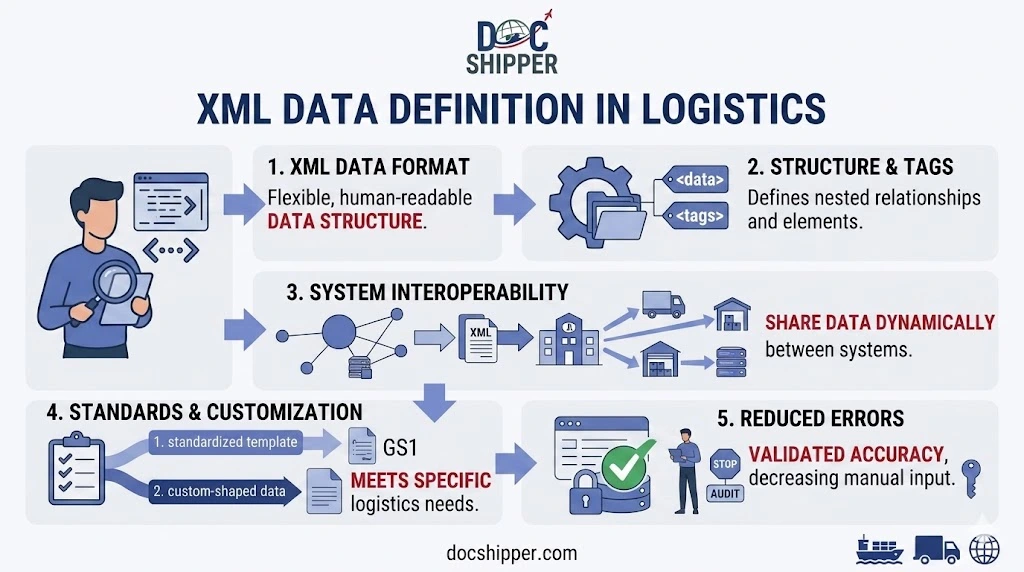
XML documents consist of elements (data containers), attributes (metadata), and text nodes (actual values). Tags are user-defined, unlike HTML’s predefined set. This flexibility enables precise modeling of logistics entities.
In customs clearance, XML structures follow UN/CEFACT XML schemas, which standardize declarations globally. A typical customs XML includes nested elements for consignor, consignee, goods description, HS codes, and valuations.
Three critical XML components in trade:
- Namespaces: Prevent naming conflicts when combining data from multiple sources (e.g., carrier + customs schemas)
- XSD Schemas: Define mandatory fields, data types, and validation rules—ensuring compliance before submission
- XSLT Transformations: Convert XML between different standards (e.g., EDIFACT to WCO Data Model)
DocShipper leverages XML for automated data capture. When clients provide commercial invoices as PDFs, our systems convert them to structured XML, then map fields to customs platforms like TARIC or ABI. This eliminates manual entry and reduces error rates to less than 0.5%.
Another application: EDI (Electronic Data Interchange). While traditional EDI uses fixed-length formats, modern implementations often wrap EDI messages in XML envelopes. This hybrid approach maintains backward compatibility while enabling real-time validation.
Security is paramount. XML supports digital signatures (XML-DSig) and encryption (XML-Enc), meeting requirements for sensitive data like AES certifications or ITAR-controlled shipments.
Real-World Use Cases & Data Standards
XML’s versatility shines in diverse logistics scenarios. Here’s how major standards utilize it:
| Standard | Purpose | XML Application |
|---|---|---|
| WCO Data Model | Customs declarations | Standardizes import/export filings across 180+ countries |
| PEPPOL BIS | E-invoicing | Ensures EU-compliant electronic billing for cross-border trade |
| IATA Cargo-XML | Air freight | Replaces paper AWBs with digital equivalents (e-AWB) |
| UN/LOCODE | Location codes | Embeds standardized port/city identifiers in shipment XMLs |
Use Case: Ocean Freight Booking
A manufacturer in Vietnam books a container to Rotterdam. The freight forwarder generates an XML message containing:
- Shipper/consignee details (names, addresses, tax IDs)
- Container specifications (20′ GP, seal number, weight)
- Cargo description (HS code 6403.99 – leather footwear)
- Incoterms (FOB Haiphong)
- Routing (vessel name, voyage number, ETD/ETA)
This XML is transmitted via API to the carrier’s TOS (Terminal Operating System), triggering automatic:
- Slot confirmation
- VGM compliance check
- AMS/ACI filing (for US/Canada destinations)
At DocShipper, we’ve processed over 12,000 XML-based customs declarations in 2024 alone. Our proprietary parser validates structure against WCO schemas before submission, preventing rejections that typically delay clearance by 48-72 hours.
Quantified Benefits:
- Data entry time reduced by 80% versus manual input
- Compliance accuracy improved to 99.7% through schema validation
- Integration time with new partners: 3 days (vs. 6 weeks for legacy EDI)
Conclusion
XML remains the gold standard for structured data exchange in global logistics. Its combination of flexibility, validation capabilities, and universal support makes it indispensable for customs, EDI, and multi-stakeholder communications.
Need help implementing XML workflows or integrating with customs platforms? Contact DocShipper for expert guidance on digital trade solutions.
📚 Quiz
Test Your Knowledge: XML (Extensible Markup Language)
What is the primary purpose of XML in international logistics?
Why do customs authorities prefer XML over other data formats?
A freight forwarder receives an XML file that fails validation against the WCO schema. What is the most likely outcome?
🎯 Your Result
📞 Free Quote in 24hFAQ | XML (Extensible Markup Language): Definition, Structure & Practical Applications
Both formats structure data, but XML is more verbose and supports complex validation via schemas (XSD). JSON is lighter and preferred for web APIs. Logistics systems often use XML for regulatory compliance (customs, manifests) due to its stricter validation and established standards like WCO Data Model.
XML's self-descriptive nature and schema validation ensure data integrity. Standards like UN/CEFACT provide pre-defined structures that align with international trade regulations. This reduces errors and enables automated risk assessment. Over 95% of single-window systems globally accept XML submissions.
XML is both machine-parsable and human-readable. Tags use plain language (e.g., <ConsigneeName>), making manual review possible. However, complex logistics XMLs with thousands of lines benefit from visualization tools or transformation into reports via XSLT.
By standardizing data exchange, XML allows real-time updates across systems. A shipment's status (departed, in transit, cleared) is encoded in XML and shared via APIs with all parties—shippers, carriers, customs brokers. This eliminates phone calls and email chains, reducing delays by 30-50%.
An XML Schema Definition (XSD) specifies mandatory fields, data types, and permissible values. For example, a customs XSD requires HS codes to be exactly 6-10 digits. Validating XML against an XSD before submission prevents rejections. Most trade platforms reject non-compliant files automatically.
Absolutely. While REST APIs often use JSON for lightweight web services, XML dominates in regulated environments (customs, finance, healthcare). Its maturity, extensive tooling, and legally mandated use in standards like PEPPOL and WCO ensure continued relevance through 2030 and beyond.
Use middleware or translation software like BizTalk, MuleSoft, or open-source tools (e.g., Smooks). These parse EDI segments (e.g., EDIFACT DESADV) and map them to XML elements. Many logistics platforms now offer built-in converters. At DocShipper, we automate this process for clients transitioning from legacy EDI systems.
XML supports encryption (XML-Enc) to scramble data in transit and digital signatures (XML-DSig) to verify authenticity. Combine these with HTTPS transmission and role-based access controls. Logistics platforms handling ITAR or dual-use goods must implement these measures to comply with export control regulations.
Yes, but large files (>10MB) require optimization. Techniques include streaming parsers (SAX instead of DOM), data compression (gzip), or splitting manifests into batches. Modern customs systems can process XML files with 500+ line items, though performance degrades beyond 1,000 entries without optimization.
XML natively supports UTF-8 encoding, enabling characters from any language (Chinese, Arabic, Cyrillic). Tags and structure remain in English for interoperability, but content (e.g., <GoodsDescription>) can be multilingual. Some standards allow parallel language blocks, critical for EU's multilingual customs requirements.
The receiving system returns an error response detailing violations (e.g., "Missing HS code in line 47"). Senders must correct the file and resubmit. Repeated failures can result in account suspension on platforms like ABI or EU ICS2. DocShipper's pre-validation catches 98% of errors before submission, avoiding penalties.
Yes. Open-source editors like Notepad++ with XML plugins, online validators (e.g., FreeFormatter), and libraries (Python's lxml, Java's JAXB) enable creation. However, logistics-specific XMLs require domain knowledge. Most freight forwarders and customs brokers provide templates or automated generation as part of their services.
Need Help with
Logistics or Sourcing ?
First, we secure the right products from the right suppliers at the right price by managing the sourcing process from start to finish. Then, we simplify your shipping experience - from pickup to final delivery - ensuring any product, anywhere, is delivered at highly competitive prices.


Fill the Form
Prefer email? Send us your inquiry, and we’ll get back to you as soon as possible.
Contact us




:%20Definition,%20Structure%20&%20Practical%20Applications)