


In short ⚡
Engineering Change (EC) is a formal modification process applied to product design, specifications, or documentation after initial approval. It ensures controlled updates throughout the product lifecycle while maintaining traceability, compliance, and supply chain continuity in international trade.
Introduction
In global supply chains, a single specification error can halt production, trigger customs delays, or violate safety regulations. Engineering changes address this challenge by providing a structured framework for modifying products without disrupting manufacturing or compliance.
Whether adjusting component dimensions, substituting materials, or updating certification documents, the Engineering Change process is essential for manufacturers, importers, and logistics providers managing complex international operations.
Key characteristics of Engineering Change management:
- Formal approval workflow: Multi-stakeholder review before implementation
- Version control: Documented history of all modifications
- Impact assessment: Evaluation of cost, compliance, and timeline effects
- Supplier coordination: Synchronized updates across the supply chain
- Regulatory alignment: Ensures continued certification and customs clearance
In-Depth Analysis & Expert Insights
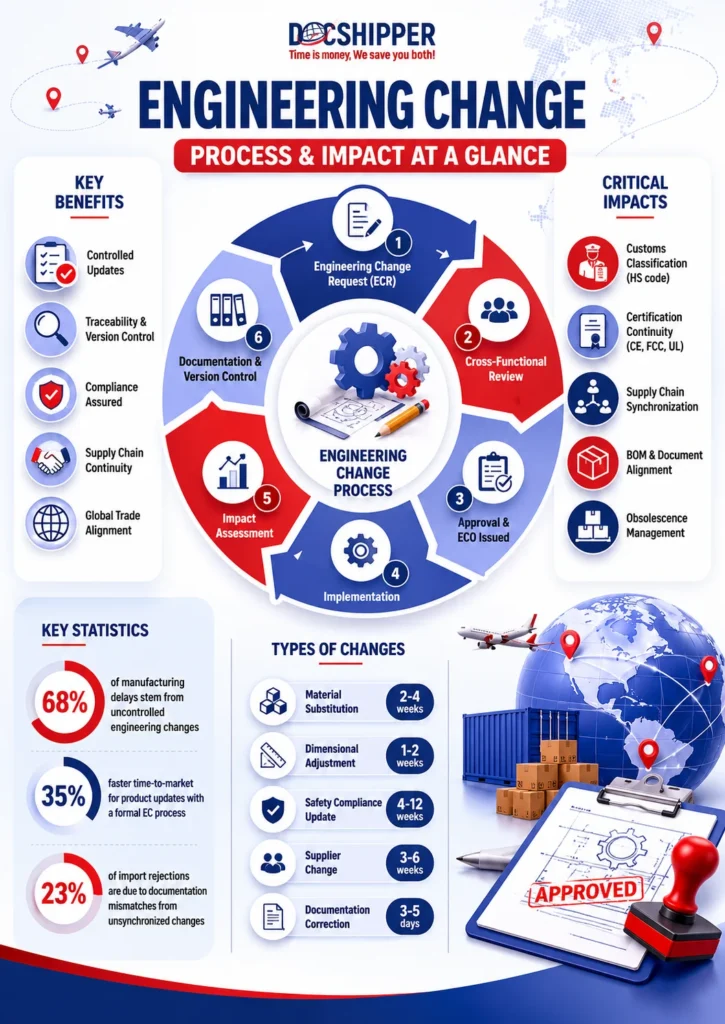
The Engineering Change process typically begins with an Engineering Change Request (ECR), which documents the proposed modification and its justification. This request undergoes evaluation by cross-functional teams including design, manufacturing, quality, and logistics departments.
Once approved, the ECR becomes an Engineering Change Order (ECO), which authorizes implementation. The ECO specifies affected components, revision levels, effective dates, and transition strategies for existing inventory.
In international logistics, three critical dimensions require careful management:
Customs classification impacts: Material or design changes may alter HS codes, affecting duty rates and import permissions. A shift from steel to aluminum components, for example, changes tariff treatment and requires updated customs documentation.
Certification continuity: Product modifications can invalidate existing certifications (CE, FCC, UL). The European Union regulatory framework requires re-certification for changes affecting safety or electromagnetic compliance.
Supply chain synchronization: Changes must cascade through multiple tiers of suppliers. At DocShipper, we coordinate with manufacturers to ensure revision-controlled shipments align with destination requirements, preventing mismatched components at assembly facilities.
Bill of Materials (BOM) management: Every change generates a new BOM revision, which must be reflected in purchase orders, packing lists, and commercial invoices. Misalignment causes customs disputes and production delays.
Obsolescence handling: Companies must decide whether to phase out old revisions immediately or deplete existing stock. This decision affects inventory valuation, warehousing costs, and logistics planning.
Concrete Examples & Data
Engineering Change management becomes tangible through real-world applications and measurable impacts on international operations.
Use Case: Electronics Manufacturer Component Substitution
A European electronics company needed to replace a discontinued microchip in 15,000 units destined for Asian markets. The Engineering Change process required:
- ECR submission: 3 days for technical evaluation and supplier confirmation
- Compliance review: 7 days to verify new component met CE and RoHS directives
- HS code verification: 2 days to confirm tariff classification remained unchanged
- Documentation update: 4 days to revise technical data sheets and declarations of conformity
- Implementation: Phased over 6 weeks to avoid production stoppage
Total cost impact: €47,000 (re-certification + documentation + expedited supplier coordination) versus €340,000 in potential delays without structured change management.
Comparative Impact Table
| Change Type | Typical Duration | Customs Impact | Cost Range |
|---|---|---|---|
| Material substitution | 2-4 weeks | Potential HS code change | $15,000-$50,000 |
| Dimensional adjustment | 1-2 weeks | Packaging/transport only | $5,000-$20,000 |
| Safety compliance update | 4-12 weeks | Re-certification required | $30,000-$150,000 |
| Supplier change | 3-6 weeks | Origin marking revision | $10,000-$40,000 |
| Documentation correction | 3-5 days | Minimal | $2,000-$8,000 |
Industry Statistics
According to supply chain management research, 68% of manufacturing delays stem from uncontrolled engineering changes. Companies with formal EC processes report 35% faster time-to-market for product updates.
In customs operations, 23% of import rejections relate to documentation mismatches caused by unsynchronized engineering changes between suppliers and importers.
At DocShipper, we implement revision-tracking protocols that ensure 100% alignment between production batches and import documentation, eliminating costly customs holds.
Conclusion
Engineering Change management is not merely an internal process—it directly impacts customs clearance, compliance, and supply chain efficiency. Structured change control prevents costly disruptions while maintaining product integrity across borders.
Need expert support managing engineering changes in your international supply chain? Contact DocShipper for end-to-end change coordination and compliance verification.
📚 Quiz
Test Your Knowledge: Engineering Change
What is the primary purpose of Engineering Change management?
A company changes a product's material from steel to aluminum. What is the most critical customs consideration?
Your supplier implements an engineering change mid-shipment. What is the correct action for international logistics?
🎯 Your Result
📞 Free Quote in 24hFAQ | Engineering Change: Definition, Process & Concrete Examples
Requests originate from design improvements, component obsolescence, cost reduction initiatives, regulatory updates, customer feedback, or supplier capability changes. Any modification affecting form, fit, function, or documentation requires formal processing.
An Engineering Change Request (ECR) is the proposal stage, documenting the suggested modification. Once approved, it becomes an Engineering Change Order (ECO), which authorizes implementation and provides execution instructions.
Approval typically requires sign-off from engineering, manufacturing, quality assurance, procurement, and compliance teams. For international shipments, logistics and customs specialists review impact on documentation and classification.
Yes. Material composition, product function, or manufacturing origin changes may alter HS code classification, directly impacting duty rates, trade agreements eligibility, and import restrictions. Always verify classification before implementing changes.
Simple documentation updates may complete in 3-5 days, while complex design changes requiring re-certification can take 4-12 weeks. International coordination adds 10-15 days for supplier alignment and customs documentation updates.
Companies choose between immediate obsolescence (scrapping old versions), phased transition (depleting stock before switching), or parallel production (maintaining both versions temporarily). The decision affects warehousing, logistics planning, and financial reporting.
Minor aesthetic changes that don't affect performance, safety, or compliance may bypass full ECO processes. However, any modification impacting certifications, customs classification, or supplier specifications requires formal documentation.
Updated commercial invoices showing correct part numbers, revised technical data sheets, certificates of conformity reflecting new specifications, and declarations of compliance. Mismatched documents cause customs delays and potential penalties.
Changing manufacturing locations, material sources, or production processes can affect rules of origin calculations. Products previously qualifying for preferential tariffs under FTAs may lose eligibility, requiring reclassification and duty payment.
Once goods clear customs, further modifications require re-importation or local processing permits. Post-clearance changes affecting safety or compliance necessitate notifying customs authorities and potentially undergoing re-inspection.
PLM (Product Lifecycle Management) systems like Siemens Teamcenter, PTC Windchill, or Dassault ENOVIA provide structured workflows. These integrate with ERP systems to automatically update BOMs, purchase orders, and supply chain documentation.
We maintain real-time communication between manufacturers and customs brokers, updating documentation mid-transit when necessary. Our revision-tracking protocols ensure that physical goods, commercial documents, and compliance certificates always match destination requirements.
Need Help with
Logistics or Sourcing ?
First, we secure the right products from the right suppliers at the right price by managing the sourcing process from start to finish. Then, we simplify your shipping experience - from pickup to final delivery - ensuring any product, anywhere, is delivered at highly competitive prices.


Fill the Form
Prefer email? Send us your inquiry, and we’ll get back to you as soon as possible.
Contact us




