


In short ⚡
A flat car is a railroad freight wagon with no sides or roof, designed to transport heavy, oversized, or irregularly shaped cargo that cannot fit in standard enclosed railcars. Widely used in intermodal logistics, flat cars facilitate the movement of containers, machinery, vehicles, and construction materials across continental rail networks.
Introduction
Many shippers struggle to transport equipment that exceeds the dimensional limits of standard shipping containers. The flat car solves this challenge by providing an open platform for unconventional loads.
In international freight, flat cars serve as the backbone of intermodal transportation, seamlessly linking ocean shipping, road haulage, and rail networks. Understanding their specifications ensures optimal load planning and compliance with transport regulations.
Key characteristics of flat cars include:
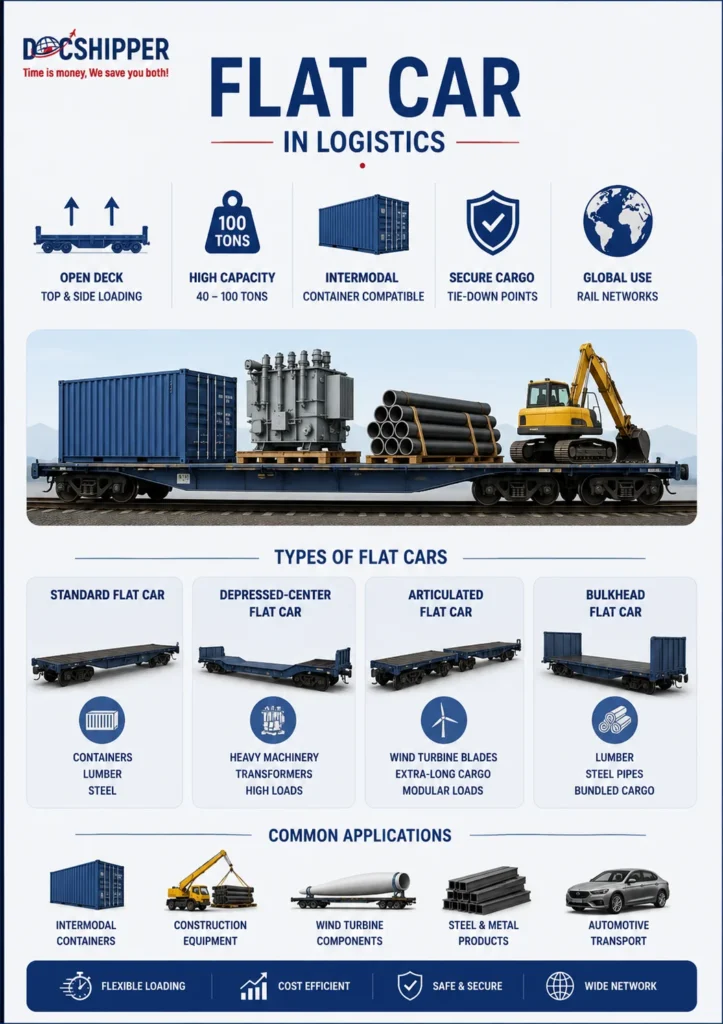
- Open deck design allowing top and side loading without dimensional restrictions
- High load capacity typically ranging from 40 to 100 tons depending on model
- Standardized dimensions compatible with ISO containers and international rail gauges
- Modular configurations including articulated, depressed-center, and bulkhead variants
- Securing mechanisms such as stake pockets, tie-down points, and lashing tracks
Technical Specifications & Types
Flat cars come in multiple configurations tailored to specific cargo types. The most common variant is the standard flat car, measuring 40 to 89 feet in length with load capacities between 50 and 70 tons. These units handle containers, lumber, steel coils, and general freight.
Articulated flat cars consist of multiple connected platforms sharing bogies, allowing the transport of extra-long items like wind turbine blades or prefabricated bridge sections. Their modular design reduces track wear and improves fuel efficiency on long-haul routes.
For exceptionally heavy loads, depressed-center flat cars (also called well cars) feature a lowered middle section. This design lowers the center of gravity, enabling the safe transport of transformers, generators, and other high-clearance equipment under bridges and tunnels.
Bulkhead flat cars incorporate reinforced end walls to prevent cargo shifting during transit. These are mandatory for transporting bundled steel pipes, lumber stacks, and other longitudinally arranged loads. According to Association of American Railroads standards, bulkhead strength must withstand forces up to 250,000 pounds.
Specialized variants include spine cars designed exclusively for containers, featuring raised pedestals that lock ISO corner castings. These dominate intermodal corridors, with double-stack configurations increasing volumetric efficiency by 60% compared to single-level transport.
At DocShipper, we assess cargo dimensions and weight distribution to recommend the appropriate flat car type, ensuring regulatory compliance and cost-effective routing across North American and European rail networks.
Practical Applications & Data
Flat cars dominate the transport of 42% of all intermodal containers in North America, according to 2023 rail freight statistics. Their versatility makes them indispensable for industries ranging from automotive to renewable energy.
Use Case: Wind Turbine Component Transport
A wind farm developer needs to move 65-meter turbine blades from a manufacturing facility in Spain to an installation site in Poland. Standard enclosed railcars cannot accommodate the length or height. The solution involves:
- Three articulated flat cars configured in a 180-foot continuous platform
- Specialized securing cradles distributing the 12-ton blade weight across multiple pivot points
- Route clearance verification ensuring 5.2-meter vertical clearance at 47 identified bridge crossings
- Transit time of 96 hours versus 144 hours for road transport with police escorts
- Cost savings of €8,400 compared to specialized road haulage
Comparative analysis shows that flat car transport reduces fuel consumption by 37% per ton-kilometer compared to heavy-duty trucking for loads exceeding 25 tons. This efficiency translates to lower carbon emissions and operational costs for long-distance freight.
| Flat Car Type | Typical Length | Load Capacity | Primary Cargo |
|---|---|---|---|
| Standard Flat | 50-89 feet | 50-70 tons | Containers, lumber, steel |
| Depressed-Center | 60-80 feet | 80-100 tons | Transformers, heavy machinery |
| Articulated | 120-280 feet | 40-60 tons per section | Turbine blades, bridge beams |
| Bulkhead Flat | 50-73 feet | 60-75 tons | Bundled pipes, lumber stacks |
| Spine Car (Container) | 90-300 feet | 50-65 tons per platform | 20’/40’/45′ containers |
In the automotive sector, flat cars transport assembled vehicles from production plants to distribution hubs. A typical consist (train formation) includes 20 to 30 flat cars, each carrying 12 to 15 vehicles in specialized racks, moving up to 450 cars per journey.
Construction projects rely on flat cars for oversized loads like prefabricated concrete panels, excavators, and steel framework. The ability to load from overhead cranes or side-mounted forklifts reduces terminal handling time by 40% compared to enclosed railcars.
Conclusion
The flat car remains an essential asset in modern logistics, enabling efficient transport of cargo that defies conventional shipping methods. Its open design, high capacity, and modular adaptability make it the preferred choice for heavy industry and intermodal operations.
Need assistance planning rail freight for oversized or heavy cargo? Contact DocShipper for expert guidance on flat car selection, route optimization, and end-to-end logistics coordination.
📚 Quiz
Test Your Knowledge: Flat Car
What is the primary defining characteristic of a flat car?
A shipper believes flat cars can protect sensitive electronics from weather during transit. Is this correct?
You need to transport a 65-meter wind turbine blade from Spain to Poland. Which flat car configuration is most appropriate?
🎯 Your Result
📞 Free Quote in 24hFAQ | Flat Car: Definition, Uses & Practical Examples in Logistics
Standard flat cars handle 50 to 70 tons, while heavy-duty depressed-center variants accommodate up to 100 tons. Actual capacity depends on axle configuration, rail gauge, and track weight limits. Always verify load distribution to prevent exceeding single-axle weight restrictions.
Yes. Spine cars and articulated flat cars are specifically designed for ISO containers, using twist-lock mechanisms to secure 20-foot, 40-foot, and 45-foot units. Double-stack configurations are common on North American intermodal routes, maximizing volumetric efficiency.
Use chains, straps, or wire ropes anchored to stake pockets and tie-down points along the car's deck. Cargo must be blocked, braced, or cradled to prevent shifting. Follow AAR guidelines requiring minimum breaking strength of 50% of cargo weight for each securement device.
Width typically cannot exceed 10 feet 8 inches, and height is constrained by bridge and tunnel clearances along the route. Length depends on the flat car type—standard cars handle up to 89 feet, while articulated units accommodate loads exceeding 200 feet when properly configured.
No. Flat cars offer no protection from rain, snow, or UV exposure. Sensitive cargo requires tarpaulins, shrink wrap, or weather-resistant packaging. For moisture-sensitive goods like electronics or machinery, consider enclosed boxcars or climate-controlled transport alternatives.
Rail transport via flat car costs 20-40% less than trucking for distances over 500 miles, with savings increasing on longer routes. Factors include fuel surcharges, terminal handling fees, and whether cargo requires specialized loading equipment. Volume discounts apply for full trainload shipments.
Shippers need a bill of lading specifying cargo description, weight, and dimensions. Hazardous materials require additional placarding and shipping papers per DOT regulations. Overweight or oversized loads demand route clearance permits obtained through the railroad's engineering department.
Yes, when routes cross borders with compatible rail gauges. North America uses standard gauge (4 feet 8.5 inches), matching most European networks. Customs documentation, including commercial invoices and certificates of origin, must accompany cross-border rail freight alongside standard rail waybills.
Transit times vary by distance and route priority. Intermodal flat car shipments average 1,000 to 1,500 miles in 48-72 hours on mainline corridors. Congestion at rail yards, classification delays, and scheduled maintenance windows can extend transit by 12-24 hours on secondary routes.
Flat cars have no sides or roof, ideal for top or side loading of oversized items. Gondola cars feature fixed or removable sides, containing loose bulk materials like coal, scrap metal, or aggregate. Gondolas prevent spillage but restrict loading methods to overhead dumping or conveyors.
Most flat car shipments use overhead cranes, forklifts, or ramps for loading. Heavy machinery may need hydraulic trailers or rail-mounted gantries. Terminals equipped with intermodal cranes expedite container transfers, achieving loading cycles of 60-90 seconds per container on dedicated spine cars.
Rail transport emits 75% less CO2 per ton-mile than trucking, according to EPA data. A single freight train can replace 280 truck loads, reducing highway congestion and fuel consumption. For companies pursuing carbon neutrality, flat car logistics significantly lowers the environmental footprint of heavy cargo transport.
Need Help with
Logistics or Sourcing ?
First, we secure the right products from the right suppliers at the right price by managing the sourcing process from start to finish. Then, we simplify your shipping experience - from pickup to final delivery - ensuring any product, anywhere, is delivered at highly competitive prices.


Fill the Form
Prefer email? Send us your inquiry, and we’ll get back to you as soon as possible.
Contact us




