


In short ⚡
Fulfillment is the comprehensive process of receiving, processing, packaging, and shipping orders to end customers. It encompasses inventory management, order processing, quality control, and last-mile delivery, serving as the operational backbone of e-commerce and retail logistics worldwide.Introduction
Many businesses confuse fulfillment with simple shipping, missing the strategic complexity behind successful order delivery. This misconception costs companies millions annually in inefficiencies and customer dissatisfaction.
In international trade and e-commerce logistics, fulfillment represents the critical bridge between inventory and customer satisfaction. A robust fulfillment strategy directly impacts delivery speed, operational costs, and brand reputation.
Key characteristics of modern fulfillment include:
- Inventory synchronization across multiple channels and locations
- Order accuracy with real-time tracking and verification systems
- Packaging optimization balancing protection with dimensional weight costs
- Returns management enabling reverse logistics and customer retention
- Scalability adapting to seasonal fluctuations and business growth
Fulfillment Operations & Expertise
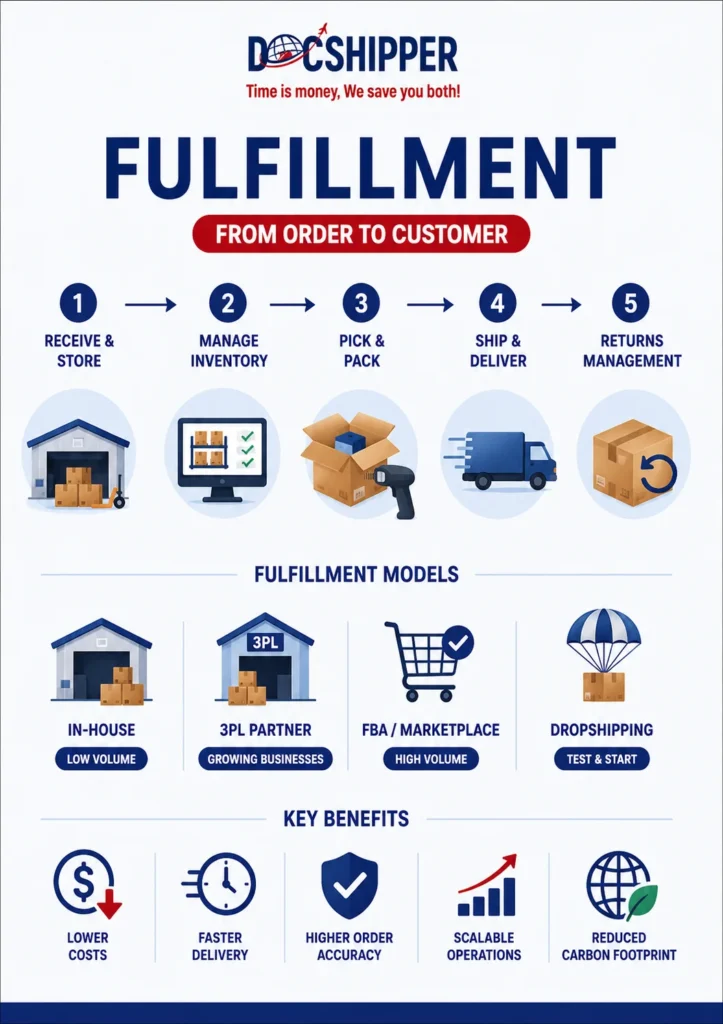
The fulfillment process operates through five interconnected operational phases that determine overall efficiency. Each phase requires specific expertise and technology integration to maintain competitive service levels.
Receiving and warehousing form the foundation of fulfillment operations. Incoming inventory undergoes verification against purchase orders, quality inspection, and systematic storage using warehouse management systems (WMS). Location optimization algorithms determine placement based on velocity, size, and handling requirements.
Inventory management leverages real-time tracking to prevent stockouts and overstocking. Modern systems employ predictive analytics to forecast demand patterns, automatically triggering reorder points. Multi-location inventory distribution enables faster regional delivery while reducing transportation costs.
Order processing automation eliminates manual errors through integrated systems connecting sales channels, inventory databases, and shipping platforms. Pick-and-pack operations utilize barcode scanning, RF technology, or automated robotic systems depending on operation scale. At DocShipper, we implement customized fulfillment workflows that reduce processing time by up to 40% through strategic automation.
Packaging and labeling must comply with carrier specifications and international shipping regulations. Dimensional weight calculations, customs documentation preparation, and hazmat classifications require specialized knowledge. According to World Trade Organization standards, proper labeling prevents 78% of customs delays in cross-border fulfillment.
Shipping and delivery coordination involves carrier selection based on cost, speed, and reliability metrics. Multi-carrier integration provides flexibility while negotiated rates reduce per-unit shipping costs. Track-and-trace systems provide customers visibility while enabling proactive exception management.
Concrete Examples & Data
Understanding fulfillment economics requires examining real-world cost structures and performance benchmarks across different operational models.
Fulfillment Model Comparison
| Model | Cost per Order | Delivery Speed | Scalability | Best For |
|---|---|---|---|---|
| In-house | $8-12 | 3-5 days | Limited | Low volume, high margins |
| 3PL Partner | $5-8 | 2-4 days | High | Growing businesses |
| FBA/Marketplace | $6-10 | 1-2 days | Very High | High volume, marketplace-focused |
| Dropshipping | $2-4 | 7-14 days | Unlimited | Testing markets, minimal investment |
Real-World Use Case: Electronics E-commerce Fulfillment
A mid-sized electronics retailer processing 2,500 orders daily transitioned from in-house fulfillment to a specialized 3PL partner. The implementation involved:
- Warehouse network optimization: Strategic inventory distribution across three regional fulfillment centers reduced average delivery time from 4.2 to 2.1 days
- Technology integration: API connections between Shopify, WMS, and carrier systems eliminated 94% of manual data entry errors
- Packaging standardization: Custom-designed boxes reduced dimensional weight charges by $1.80 per shipment, saving $164,250 annually
- Returns processing: Dedicated reverse logistics protocol increased resalable return rate from 62% to 89%
- Peak season flexibility: Scalable labor and space agreements accommodated 340% volume increase during Q4 without service degradation
The results demonstrated 31% reduction in total fulfillment costs while improving customer satisfaction scores from 3.8 to 4.6 stars. Order accuracy improved from 96.2% to 99.7%, significantly reducing costly re-shipments and customer service interventions.
Industry data reveals that businesses optimizing fulfillment operations experience average cart abandonment reduction of 18% when offering transparent delivery timelines and free shipping thresholds. DocShipper’s fulfillment solutions integrate customs clearance expertise for international shipments, eliminating border delays that traditionally extend delivery windows by 5-7 days.
Conclusion
Fulfillment represents far more than shipping logistics—it constitutes a comprehensive operational strategy directly impacting profitability, customer retention, and competitive positioning in global commerce.
Need expert fulfillment support for your international logistics operations? Contact DocShipper for customized solutions tailored to your business requirements.
📚 Quiz
Test Your Knowledge: Fulfillment
What is the primary scope of fulfillment in logistics operations?
According to industry data, what is the typical order accuracy target for professional fulfillment operations?
A business processes 250 monthly orders and wants to optimize costs. Which fulfillment approach is most appropriate?
🎯 Your Result
📞 Free Quote in 24hFAQ | Fulfillment: Definition, Process & Concrete Examples
Shipping refers specifically to transporting packages from point A to point B. Fulfillment encompasses the entire order lifecycle including inventory storage, order processing, picking, packing, shipping, and returns management. Shipping is one component within the broader fulfillment process that also includes warehouse operations and inventory control.
Third-party logistics (3PL) fulfillment typically costs between $5-8 per order, including pick-pack fees ($2-4), storage ($0.50-2 per cubic foot monthly), and shipping pass-through costs. Pricing varies based on order volume, product dimensions, storage requirements, and value-added services like kitting or custom packaging. High-volume shippers negotiate better rates through economies of scale.
Fulfillment time measures the duration from order placement to shipment departure from the warehouse. Standard fulfillment times range from 24-72 hours for in-stock items. This metric excludes transit time to the customer. Fast fulfillment operations achieve same-day processing for orders received before cutoff times, typically 2-4 PM local warehouse time.
Yes, modern fulfillment providers offer tiered pricing accommodating businesses processing as few as 50-100 orders monthly. Many 3PLs have eliminated minimum volume requirements, charging slightly higher per-unit fees for smaller operations. The break-even point typically occurs around 200-300 monthly orders when comparing outsourced fulfillment costs against in-house labor, space, and shipping inefficiencies.
International fulfillment requires additional steps including customs documentation preparation, harmonized tariff code classification, export compliance verification, and international carrier coordination. Cross-border fulfillment partners handle commercial invoices, certificates of origin, and duty/tax calculations. Strategic inventory positioning in destination countries enables domestic fulfillment speeds while avoiding lengthy customs clearance processes.
Core fulfillment technology includes Warehouse Management Systems (WMS) for inventory control, Order Management Systems (OMS) for channel integration, Transportation Management Systems (TMS) for carrier coordination, and Enterprise Resource Planning (ERP) for financial integration. Advanced operations incorporate automated picking systems, RFID tracking, predictive analytics platforms, and robotic process automation for repetitive tasks.
Returns management (reverse logistics) significantly impacts customer lifetime value and operational costs. Effective fulfillment strategies include clear return policies, prepaid return labels, quality inspection protocols, and rapid restocking procedures. Industry data shows 92% of customers will repurchase after positive return experiences. Optimized returns processing recovers 75-90% of product value versus 40-60% with poor systems.
Professional fulfillment operations employ flexible staffing models, temporary storage expansion agreements, and predictive inventory positioning to manage peak seasons. Technology enables workload forecasting based on historical patterns and current order trends. Scalable partnerships allow businesses to increase capacity by 200-400% during Q4 holidays without long-term overhead commitments or service quality degradation.
Critical fulfillment KPIs include order accuracy rate (target: 99.5%+), fulfillment speed (order-to-ship time), inventory turnover ratio, storage cost per unit, shipping cost as percentage of order value, on-time delivery rate, return rate, and customer satisfaction scores. Advanced operations track pick efficiency (units per hour), dock-to-stock time, and forecast accuracy to optimize continuous improvement initiatives.
Efficient fulfillment directly reduces customer acquisition costs by improving conversion rates through fast delivery promises, decreasing cart abandonment via transparent shipping options, and increasing repeat purchase rates through positive delivery experiences. Studies indicate that reducing delivery time by one day increases conversion rates by 8-12% while free shipping offers boost average order values by 30-50%, offsetting fulfillment cost increases.
Inadequate fulfillment operations create cascading business impacts including negative reviews damaging online reputation, high return rates eroding margins, inventory obsolescence from poor turnover, customer churn to competitors offering superior delivery experiences, and increased operational costs from expedited shipping corrections. Research shows 69% of customers avoid retailers after poor delivery experiences, making fulfillment excellence a competitive imperative rather than operational detail.
Multi-location fulfillment strategies benefit businesses shipping 500+ daily orders across wide geographic areas. Distributed inventory reduces average shipping zones, lowering costs by $1-3 per package while enabling 1-2 day delivery coverage for 80-95% of customers. However, inventory complexity increases, requiring sophisticated systems to prevent stockouts. The optimal approach balances delivery speed improvements against inventory carrying cost increases and system complexity.
Need Help with
Logistics or Sourcing ?
First, we secure the right products from the right suppliers at the right price by managing the sourcing process from start to finish. Then, we simplify your shipping experience - from pickup to final delivery - ensuring any product, anywhere, is delivered at highly competitive prices.


Fill the Form
Prefer email? Send us your inquiry, and we’ll get back to you as soon as possible.
Contact us




