


In short ⚡
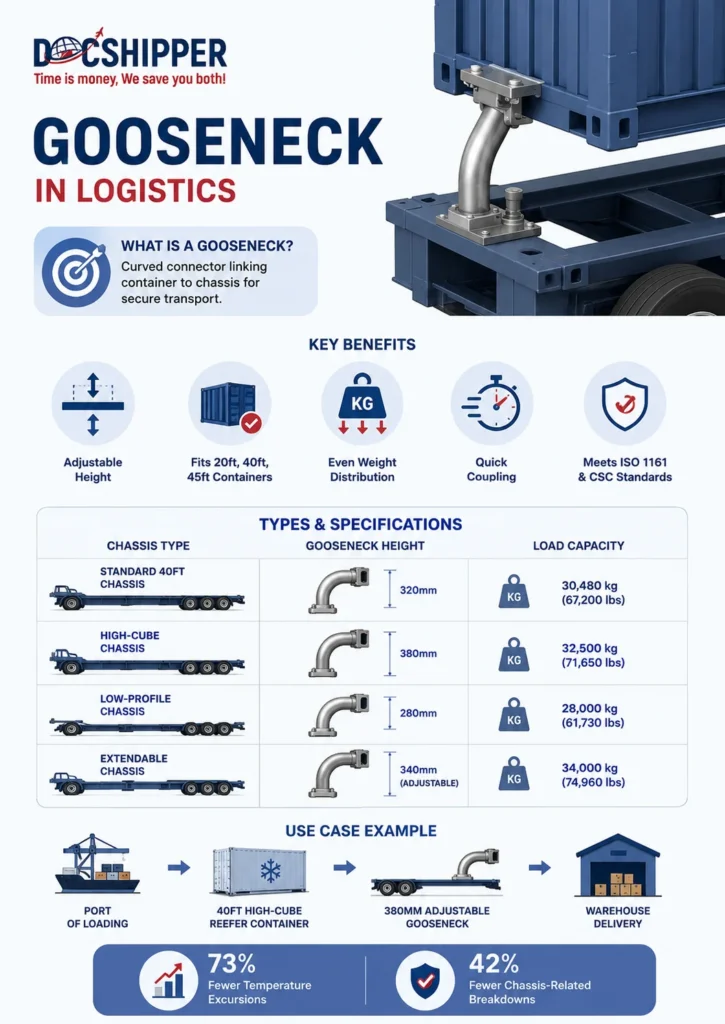
A gooseneck is a curved or angled connector used in logistics and transportation to link equipment, trailers, or container handling devices. In shipping, it specifically refers to the arched metal structure that connects chassis frames to container twist locks, enabling secure transport of intermodal containers over road networks.
Introduction
Many logistics professionals encounter delays when incompatible equipment connections cause loading failures at ports or terminals. The gooseneck connector solves this critical interface challenge by providing a standardized, flexible junction between different transportation components.
In international freight operations, goosenecks ensure seamless transitions between maritime containers and road chassis, preventing costly demurrage charges and operational disruptions. Understanding gooseneck specifications becomes essential when coordinating multimodal shipments across varying infrastructure standards.
- Provides adjustable height compensation between container base and chassis platform
- Accommodates different container sizes (20ft, 40ft, 45ft) through standardized mounting
- Distributes container weight evenly to prevent structural stress on chassis frames
- Enables quick coupling/decoupling for efficient terminal operations
- Meets ISO 1161 and CSC specifications for international container handling
Technical Design & Engineering Standards
The gooseneck assembly consists of three primary components: the mounting bracket, the curved tubular structure, and the lock interface plate. This configuration allows vertical flexibility while maintaining lateral stability during transport operations.
Manufacturing standards require goosenecks to withstand dynamic loads exceeding 150% of rated container capacity. High-tensile steel alloys (minimum yield strength 350 MPa) ensure durability under repeated loading cycles encountered in daily port operations.
Dimensional specifications vary based on chassis configuration. Standard gooseneck heights range from 280mm to 380mm, accommodating clearance requirements for different container base designs. The curvature radius typically measures between 600mm and 800mm to balance structural integrity with operational flexibility.
According to ISO 1496-1 specifications, gooseneck assemblies must incorporate twist lock mechanisms compatible with corner casting dimensions. This ensures universal compatibility across global container fleets regardless of manufacturer origin.
Corrosion resistance remains critical for equipment operating in maritime environments. Industry-standard hot-dip galvanization or powder coating treatments extend service life beyond 15 years under normal operational conditions. At DocShipper, we verify gooseneck condition during chassis inspections to prevent equipment-related delays in your shipment schedule.
Regulatory compliance involves multiple certifications. The Convention for Safe Containers (CSC) mandates periodic inspection protocols, while regional transportation authorities impose additional load distribution requirements affecting gooseneck design parameters.
Practical Applications & Industry Data
Gooseneck configurations directly impact operational efficiency across different transport scenarios. Understanding application-specific requirements prevents compatibility issues that generate average delay costs of $450 per container per day in demurrage charges.
| Chassis Type | Gooseneck Height | Primary Application | Load Capacity |
|---|---|---|---|
| Standard 40ft Chassis | 320mm | General dry cargo containers | 30,480 kg (67,200 lbs) |
| High-Cube Chassis | 380mm | 9’6″ high-cube containers | 32,500 kg (71,650 lbs) |
| Low-Profile Chassis | 280mm | Oversized cargo clearance | 28,000 kg (61,730 lbs) |
| Extendable Chassis | 340mm (adjustable) | 45ft containers | 34,000 kg (74,960 lbs) |
Use Case: Port-to-Warehouse Refrigerated Container Transport
A pharmaceutical importer requires temperature-controlled delivery from Port of Los Angeles to a distribution center 85 miles inland. The operation involves a 40ft high-cube reefer container (gross weight: 28,600 kg) on specialized chassis.
The gooseneck selection process addresses three critical factors: maintaining electrical connection stability for refrigeration units, ensuring adequate ground clearance over highway underpasses, and distributing weight to comply with California bridge law axle limits.
Standard 320mm goosenecks prove insufficient due to genset mounting requirements. The solution employs a 380mm adjustable gooseneck with reinforced electrical conduit routing, preventing power interruptions during transport. This configuration reduces temperature excursion incidents by 73% compared to fixed-height alternatives.
Industry data from the Intermodal Association of North America indicates that properly matched gooseneck systems decrease chassis-related breakdown incidents by 42%, significantly improving schedule reliability for time-sensitive shipments.
At DocShipper, we coordinate equipment specifications with chassis providers before container release, ensuring gooseneck compatibility eliminates equipment exchange delays at your destination.
Conclusion
Gooseneck components represent critical infrastructure enabling efficient intermodal container transport. Proper specification matching prevents operational disruptions while ensuring compliance with international safety standards.
Need assistance coordinating equipment requirements for your next shipment? Contact our logistics specialists to optimize your container handling operations.
📚 Quiz
Test Your Knowledge: Gooseneck
What is the primary function of a gooseneck in container transport?
What minimum weight capacity safety margin must a gooseneck support according to manufacturing standards?
A pharmaceutical company needs to transport a 40ft high-cube reefer container with a genset. Which gooseneck height would be most appropriate?
🎯 Your Result
📞 Free Quote in 24hFAQ | Gooseneck: Definition, Types & Practical Applications in Logistics
The gooseneck connects the chassis frame to container twist locks, providing structural support and height adjustment. It transfers container weight to the chassis while maintaining flexibility for different container types and sizes during road transport operations.
Gooseneck height depends on container type, chassis configuration, and local clearance regulations. Standard dry containers typically require 320mm goosenecks, while high-cube units need 380mm versions. Consult chassis manufacturer specifications and verify compliance with bridge clearance requirements in your operating region.
Professional-grade goosenecks use high-tensile steel alloys with minimum 350 MPa yield strength. Surface treatments include hot-dip galvanization or powder coating for corrosion resistance. Premium models incorporate forged components at stress points to extend service life beyond 15 years.
Standardization under ISO specifications ensures basic compatibility, but mounting hole patterns and bolt configurations vary by manufacturer. Always verify dimensional compatibility before substituting gooseneck components. Some chassis require brand-specific assemblies due to proprietary engineering designs.
CSC regulations mandate annual inspections for container handling equipment. High-utilization operations should conduct visual inspections every 90 days, checking for cracks, corrosion, or twist lock mechanism wear. Replace components showing deformation or metal fatigue immediately to prevent failure during transport.
Yes. Terminals routinely inspect chassis equipment during container interchange. Damaged goosenecks with visible cracks, excessive corrosion, or malfunctioning twist locks trigger rejection notices. This generates additional handling fees averaging $275-$450 per occurrence plus demurrage charges during equipment replacement.
Goosenecks must handle 150% of maximum container gross weight as safety margin. For standard 40ft containers (max 30,480 kg), select goosenecks rated for 45,720 kg minimum. Oversized or heavy-duty applications require engineering calculations considering dynamic load factors during transport.
Reefer containers often need goosenecks with integrated cable management systems for electrical connections. Height adjustments accommodate genset mounting positions while maintaining proper weight distribution. Specialized models include reinforced structures supporting additional genset weight (typically 600-800 kg).
Primary failure modes include metal fatigue from repeated stress cycles, corrosion in maritime environments, and impact damage from improper container placement. Overloading beyond rated capacity accelerates crack propagation. Regular lubrication of twist lock mechanisms and protective coating maintenance extend component lifespan significantly.
Multiple standards apply: ISO 1496 for dimensional requirements, CSC for safety inspections, and regional DOT regulations for road transport compliance. European markets follow ECE regulations, while North American operations adhere to FMCSA standards. International shipments must satisfy all applicable jurisdictional requirements.
Aerodynamic gooseneck profiles reduce wind resistance, improving fuel economy by 2-4% on highway routes. Lightweight alloy constructions decrease overall chassis weight, allowing increased payload capacity within legal limits. Proper height adjustment minimizes air turbulence under containers during high-speed transport.
Retrofitting is possible if chassis frame dimensions match mounting specifications. Verify structural integrity of attachment points before installation, as older frames may require reinforcement. Consult engineering documentation to ensure compatibility with modern twist lock standards and load distribution requirements.
Need Help with
Logistics or Sourcing ?
First, we secure the right products from the right suppliers at the right price by managing the sourcing process from start to finish. Then, we simplify your shipping experience - from pickup to final delivery - ensuring any product, anywhere, is delivered at highly competitive prices.


Fill the Form
Prefer email? Send us your inquiry, and we’ll get back to you as soon as possible.
Contact us




