


In short ⚡
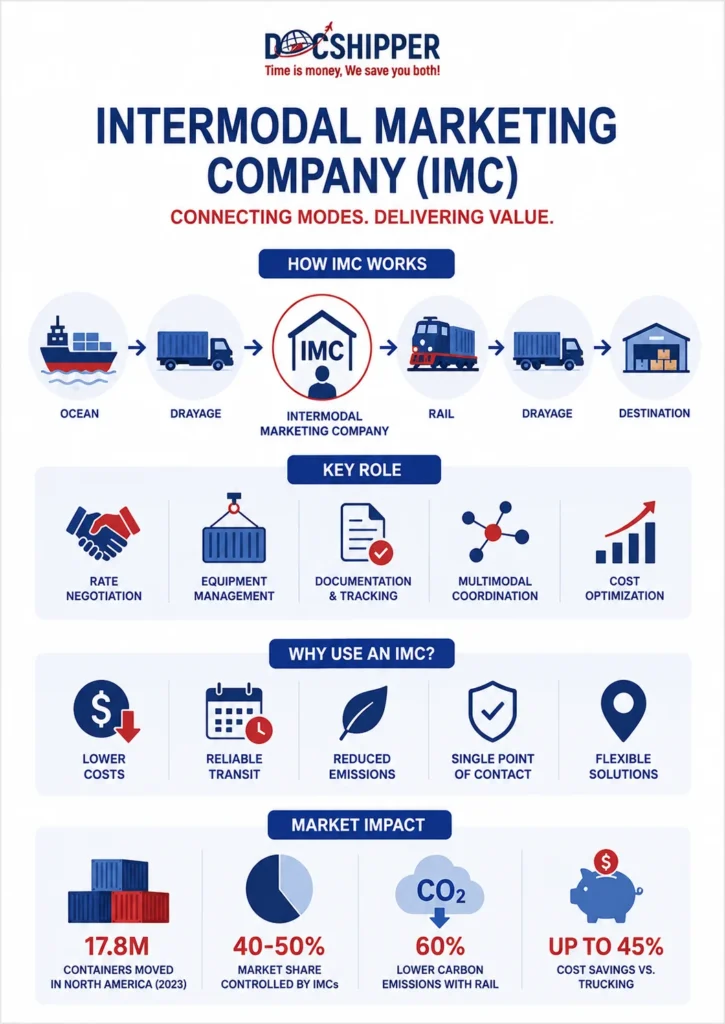
An Intermodal Marketing Company (IMC) is a logistics intermediary that arranges intermodal transportation by contracting with rail carriers, drayage providers, and ocean carriers to move containerized freight using multiple transport modes without handling the freight itself.
Introduction
Many shippers confuse IMCs with freight forwarders or brokers, leading to mismatched service expectations and contract disputes. Understanding what an Intermodal Marketing Company does is crucial for optimizing supply chain efficiency in international and domestic freight movements.
IMCs emerged to streamline the complex coordination required for intermodal transport. They provide specialized expertise in rail capacity management, equipment positioning, and multimodal routing without owning transportation assets.
Key characteristics of IMCs include:
- Asset-light model: They don’t own railcars, trucks, or containers but leverage carrier networks
- Rate negotiation: Secure competitive pricing through volume contracts with rail carriers
- Equipment management: Coordinate chassis, containers, and intermodal equipment availability
- Documentation handling: Manage bills of lading, customs paperwork, and shipment tracking
- Multimodal coordination: Bridge rail, truck, and ocean transport segments seamlessly
IMC Operational Framework & Industry Expertise
Intermodal Marketing Companies operate under specific legal and operational frameworks established by the Surface Transportation Board (STB) in the United States. They function as intermediaries between shippers and Class I railroads, creating efficient transport solutions that individual shippers cannot access directly.
The contractual structure of IMCs involves multiple layers. They establish master service agreements with rail carriers like Union Pacific, BNSF, CSX, and Norfolk Southern. These contracts secure equipment pools and capacity commitments. Simultaneously, IMCs contract with drayage providers for first-mile and last-mile trucking segments.
Unlike freight forwarders who often take possession of goods, IMCs maintain a non-asset carrier status. This distinction affects liability, insurance requirements, and operational flexibility. They issue their own bills of lading but rely on underlying carriers for actual transport execution.
The equipment positioning strategy represents a core IMC competency. They forecast container demand across origin-destination pairs, negotiate equipment leases, and coordinate empty container repositioning to minimize delays. This requires sophisticated data analytics and carrier relationship management.
Rate arbitrage and optimization create value for both shippers and IMCs. By aggregating shipments across customers, IMCs achieve volume discounts unavailable to individual shippers. They also optimize routing through backhaul opportunities and equipment balancing.
At DocShipper, we collaborate with established IMCs to secure competitive rail capacity for clients requiring door-to-door intermodal solutions, particularly on high-volume trade lanes where rail offers significant cost advantages over pure trucking.
Practical Applications & Market Data
The North American intermodal market moved approximately 17.8 million containers in 2023, with IMCs controlling an estimated 40-50% of this volume. Understanding how IMCs operate in practical scenarios helps shippers make informed carrier selection decisions.
Cost Comparison: IMC vs. Alternative Transport Modes
| Route (Origin-Destination) | IMC Intermodal Rate | Over-the-Road Truck | Cost Savings | Transit Time Difference |
|---|---|---|---|---|
| Los Angeles to Chicago (40′ container) | $2,400 | $4,200 | 43% savings | +2 days |
| New York to Dallas (53′ container) | $2,800 | $4,800 | 42% savings | +1.5 days |
| Seattle to Atlanta (40′ container) | $3,100 | $5,600 | 45% savings | +2.5 days |
Use Case: Import Distribution Strategy
A consumer electronics importer receives 150 containers monthly at the Port of Long Beach destined for distribution centers in Chicago, Memphis, and Columbus. By partnering with an IMC instead of arranging direct trucking:
- Monthly cost reduction: $270,000 vs. $465,000 (42% savings = $195,000/month)
- Carbon footprint: Reduced by 60% through rail’s superior fuel efficiency
- Equipment availability: Guaranteed container supply through IMC’s equipment pool contracts
- Operational flexibility: Ability to divert shipments to alternate destinations with 72-hour notice
- Documentation simplification: Single point of contact for all three destination markets
Key Performance Considerations
When evaluating IMC partnerships, shippers should assess:
- On-time performance metrics: Leading IMCs achieve 85-92% on-time delivery rates for scheduled services
- Equipment availability guarantees: Contractual commitments for container supply during peak seasons
- Claims handling procedures: Average claims resolution timeframes and settlement rates
- Technology integration: API availability for real-time tracking and automated documentation
- Geographic coverage: Breadth of rail ramp network and drayage provider relationships
Market data indicates that 62% of shippers using IMCs cite cost predictability as the primary benefit, particularly important given the volatility in over-the-road trucking rates which can fluctuate 20-30% seasonally.
Conclusion
Intermodal Marketing Companies fill a critical niche in modern logistics by bridging shippers with complex rail networks and multimodal infrastructure. Their asset-light model creates flexibility while their volume aggregation delivers cost advantages unattainable through direct carrier relationships.
Need assistance evaluating whether an IMC partnership fits your supply chain strategy? Contact DocShipper for a comprehensive analysis of your intermodal opportunities.
📚 Quiz
Test Your Knowledge: Intermodal Marketing Company (IMC)
1. What is the primary operational model of an Intermodal Marketing Company?
2. How does an IMC differ from a freight forwarder in handling cargo?
3. A shipper moves 120 containers monthly from Los Angeles to Chicago. Based on the article's cost data, what would be the approximate monthly savings using an IMC versus over-the-road trucking?
🎯 Your Result
📞 Free Quote in 24hFAQ | Intermodal Marketing Company (IMC): Definition, Role & Practical Examples
An IMC specializes exclusively in intermodal rail-based transportation and doesn't take physical possession of goods. Freight forwarders offer broader multimodal services including air and ocean, often consolidate shipments, and typically act as carriers issuing their own house bills of lading with associated cargo liability. IMCs coordinate but don't warehouse or handle freight directly.
Most IMCs operate an asset-light model and don't own equipment. Instead, they contract with equipment leasing companies and rail carriers for container and chassis access. Some larger IMCs maintain limited equipment pools for strategic lanes, but their core value proposition centers on negotiating capacity and equipment access rather than asset ownership.
IMCs generate revenue through the margin between rates they negotiate with rail carriers and drayage providers versus rates charged to shippers. Their profitability depends on volume aggregation, efficient equipment utilization, backhaul optimization, and value-added services like shipment tracking and documentation management. Typical margins range from 8-15% depending on lane density and service complexity.
Requirements vary significantly. Tier-1 IMCs often prefer shippers moving 50+ containers monthly to justify dedicated account management. Regional IMCs may accommodate smaller volumes (10-20 containers/month), especially on established lanes. Some IMCs offer transactional services for occasional shippers, though rates are less competitive than volume commitment contracts.
Most IMC agreements run 1-3 years with volume commitments and fixed base rates subject to fuel surcharge adjustments. Contracts typically include force majeure clauses, equipment shortage provisions, and rate escalation triggers based on underlying rail tariff changes. Month-to-month arrangements exist but lack the rate stability and equipment guarantees of longer-term agreements.
Yes, many IMCs coordinate domestic intermodal segments of international moves, particularly import distribution from coastal ports to inland destinations. They partner with ocean carriers and customs brokers to provide seamless door-to-door service. However, they don't typically manage ocean freight booking or international documentation—those services require freight forwarder or NVOCC partnerships.
Liability depends on contractual terms. IMCs issue bills of lading but underlying carrier liability (rail and drayage) applies. Most IMC contracts limit liability to $0.50 per pound unless higher declared value insurance is purchased. Shippers should maintain cargo insurance for full replacement value. Claims must be filed within specified timeframes (typically 9 months) with supporting documentation.
IMCs with strong carrier relationships and contracted capacity offer more rate stability than spot market trucking, which can spike 40-60% during peak seasons. However, IMCs may implement temporary surcharges for equipment shortages or congested ramps. Volume commitment contracts typically provide better peak season protection than transactional arrangements.
Modern IMCs provide web portals with real-time GPS tracking, automated shipment updates, electronic document management, and API integration for ERP systems. Leading providers offer predictive analytics for transit time estimation, proactive exception alerts, and carbon footprint reporting. Technology sophistication varies significantly—evaluate platforms during vendor selection.
IMC effectiveness depends on rail infrastructure density. They excel on major trade lanes between metropolitan areas with established intermodal ramps. Remote or rural destinations lacking nearby rail facilities may require extensive drayage, reducing cost advantages. IMCs typically perform best on lanes exceeding 750 miles where rail economics become favorable versus trucking.
Most IMCs offer expedited intermodal services with guaranteed transit times, typically 12-24 hours faster than standard rail schedules. These services cost 15-25% more than economy options but remain cheaper than dedicated trucking. For truly urgent shipments requiring next-day delivery, over-the-road trucking or air freight may be more appropriate than any intermodal solution.
Yes, many large shippers diversify IMC relationships to optimize lane-specific performance and negotiate competitive rates. However, volume fragmentation reduces negotiating leverage with each provider. A strategic approach involves primary IMC partnerships for core lanes supplemented by secondary providers for overflow capacity or specialized services. Effective management requires robust performance tracking across providers.
Need Help with
Logistics or Sourcing ?
First, we secure the right products from the right suppliers at the right price by managing the sourcing process from start to finish. Then, we simplify your shipping experience - from pickup to final delivery - ensuring any product, anywhere, is delivered at highly competitive prices.


Fill the Form
Prefer email? Send us your inquiry, and we’ll get back to you as soon as possible.
Contact us




