


In short ⚡
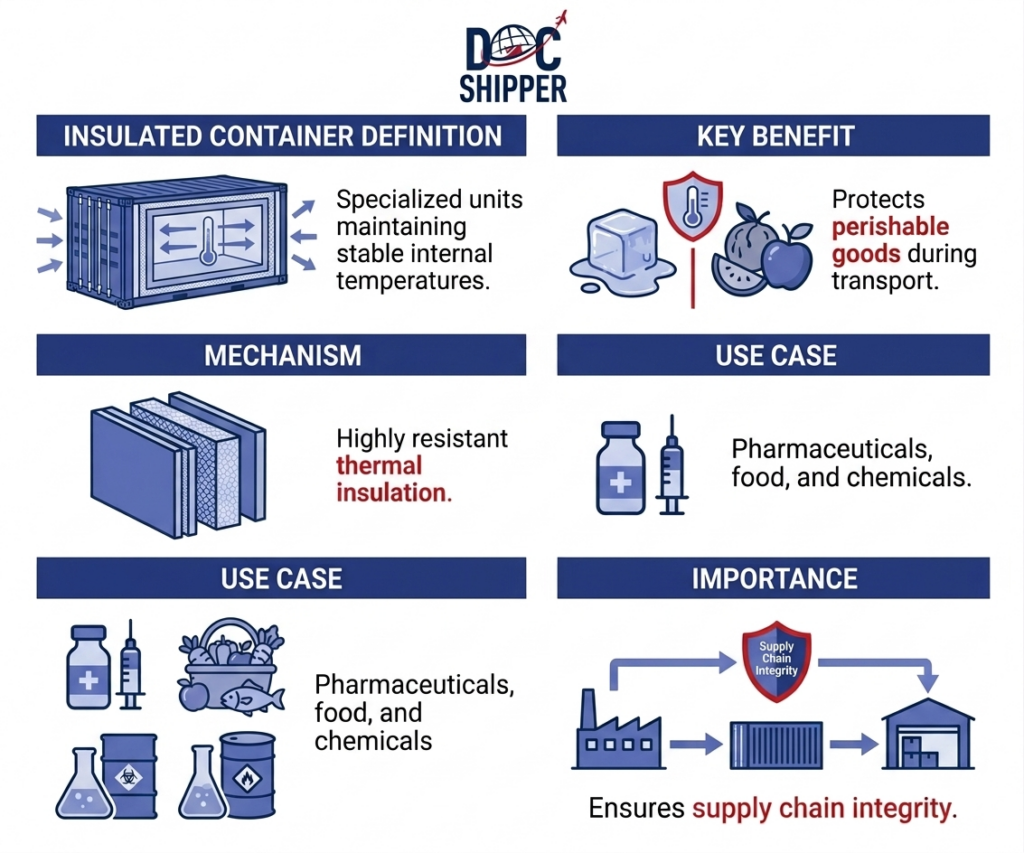
An insulated container is a specialized shipping unit designed with thermal insulation materials to maintain stable internal temperatures during transport. Used primarily for temperature-sensitive cargo such as pharmaceuticals, perishables, and chemicals, these containers prevent heat transfer between the external environment and goods inside, ensuring product integrity throughout the supply chain without requiring active refrigeration systems.
Introduction
Many shippers confuse insulated containers with refrigerated units (reefers), leading to costly cargo damage or contractual disputes. While both serve temperature-sensitive logistics, insulated containers rely on passive thermal protection rather than active cooling machinery.
In international trade, maintaining product quality during long-haul transport represents a critical challenge. Temperature fluctuations can degrade pharmaceuticals, spoil agricultural products, or alter chemical properties. Insulated containers address this by creating a thermal barrier that slows heat exchange.
Key characteristics of insulated containers include:
- Passive temperature control through advanced insulation materials (polyurethane foam, polystyrene panels)
- No power requirements, reducing operational costs and carbon footprint compared to reefer containers
- Temperature stability duration ranging from 24 hours to several days depending on design and ambient conditions
- ISO compliance with standardized dimensions (20ft and 40ft) for multimodal compatibility
- Cost-effectiveness for goods requiring moderate temperature protection without extreme refrigeration
Technical Mechanisms & Industry Applications
The fundamental principle behind insulated containers involves thermal resistance engineering. Walls, floors, and ceilings incorporate materials with low thermal conductivity coefficients, typically ranging from 0.020 to 0.030 W/(m·K). This creates a barrier that significantly reduces conductive, convective, and radiant heat transfer.
Modern designs feature multi-layer insulation systems. The exterior consists of weather-resistant corrugated steel, followed by vapor barriers preventing moisture infiltration, then high-density insulation cores, and finally interior aluminum or steel linings that protect cargo while reflecting radiant heat. Sealing mechanisms around doors incorporate rubber gaskets and compression latches to eliminate thermal bridges.
Regulatory frameworks govern insulated container standards. The ISO 1496-2 specification defines construction requirements, testing protocols, and performance benchmarks. Containers must demonstrate thermal efficiency through standardized heat transmission coefficient (K-value) testing, typically not exceeding 0.40 W/(m²·K) for certification.
Industry applications span multiple sectors. Pharmaceutical logistics utilize insulated containers for vaccine distribution and biologic transport where strict temperature ranges (2-8°C) must be maintained. Agricultural exports leverage these units for fruits, vegetables, and flowers requiring cool storage without freezing. Chemical manufacturers transport temperature-sensitive compounds that degrade above specific thresholds but don’t require refrigeration-level cooling.
At DocShipper, we systematically assess cargo characteristics before recommending container types. For shipments requiring passive thermal protection, we verify insulation specifications match transit duration and expected ambient conditions, preventing product loss through appropriate equipment selection.
Pre-cooling strategies enhance effectiveness. Shippers often pre-condition cargo to target temperatures before loading, then rely on insulation to maintain those conditions. Gel packs, dry ice, or phase-change materials (PCMs) provide supplementary cooling capacity during transport, extending viable temperature maintenance from hours to days.
Specifications, Performance Data & Use Cases
Understanding technical specifications enables proper container selection. Standard insulated containers come in two primary sizes following ISO dimensions:
| Specification | 20ft Container | 40ft Container |
|---|---|---|
| Internal Volume | 25-27 m³ | 55-58 m³ |
| Insulation Thickness | 60-100 mm | 60-100 mm |
| K-Value | 0.35-0.40 W/(m²·K) | 0.35-0.40 W/(m²·K) |
| Temperature Retention | 24-72 hours (conditions dependent) | 24-72 hours (conditions dependent) |
| Cost vs. Reefer | 40-60% lower | 40-60% lower |
Practical Use Case: Pharmaceutical Export from Europe to Middle East
A pharmaceutical company needs to ship vaccine components requiring 2-8°C from Lyon to Dubai (transit time: 18 days including ocean freight and inland legs). Ambient temperatures along the route range from 15°C to 42°C.
Solution approach: Pre-cool cargo and container interior to 4°C. Load product with calibrated phase-change material packs maintaining 5°C ±3°. The insulated container’s thermal efficiency (K-value 0.38) combined with PCMs maintains acceptable temperature range for 96 hours—sufficient for the critical inland and port handling phases where temperature control is most vulnerable.
Outcome: Temperature loggers confirm product remained within specification throughout transit. Total logistics cost was 52% lower than reefer option, with zero product loss. Carbon emissions reduced by approximately 3.2 tons CO₂ equivalent due to eliminated refrigeration machinery power consumption.
Performance variables affecting insulated containers include:
- Ambient temperature differential: Greater external heat increases internal temperature rise rate
- Cargo thermal mass: Higher product density stabilizes temperature longer
- Door opening frequency: Each opening introduces warm air, reducing effectiveness
- Container condition: Damaged seals or insulation compromises performance significantly
- Loading density: Proper air circulation around products enhances temperature distribution
Industry data indicates insulated containers represent 8-12% of specialized container fleets globally, with demand growing 6-8% annually as pharmaceutical cold chains expand in emerging markets and sustainability pressures reduce reliance on energy-intensive refrigeration.
Conclusion
Insulated containers provide cost-effective, sustainable thermal protection for temperature-sensitive cargo requiring passive cooling rather than active refrigeration. Proper specification, pre-cooling protocols, and transit planning ensure product integrity while reducing operational costs and environmental impact.
Need guidance on selecting appropriate container types for your temperature-sensitive shipments? Contact DocShipper’s logistics experts for customized solutions matching your specific cargo requirements and trade routes.
📚 Quiz
Test Your Knowledge: Insulated Container
What is the primary mechanism by which insulated containers maintain temperature stability?
Which statement correctly describes the relationship between insulated containers and reefer containers?
A pharmaceutical company needs to ship vaccine components requiring 2-8°C across a route with 18-day transit time and ambient temperatures of 15-42°C. Which approach would be most appropriate using an insulated container?
🎯 Your Result
📞 Free Personalized QuoteFAQ | Insulated Container: Definition, Technical Specifications & Practical Applications
Insulated containers use passive thermal protection through insulation materials without refrigeration machinery, maintaining temperature for 24-72 hours depending on conditions. Reefer containers incorporate active cooling/heating systems powered by electricity, maintaining precise temperatures indefinitely during transit. Insulated units cost 40-60% less but suit shorter durations or less critical temperature requirements.
Duration depends on multiple factors: insulation quality (K-value), ambient temperature differential, cargo thermal mass, and supplementary cooling aids. Typically, properly prepared insulated containers maintain acceptable temperatures for 24-72 hours. Using phase-change materials or gel packs can extend this to 96+ hours under favorable conditions, making them suitable for regional transport and short ocean crossings.
Ideal cargo includes pharmaceuticals not requiring strict refrigeration, fresh produce tolerating moderate temperature ranges (10-15°C), chocolate and confectionery, wine and beverages, temperature-sensitive chemicals, electronics requiring heat protection, and industrial materials affected by extreme temperatures. Products requiring precise temperature control below 2°C or above 25°C typically need reefer containers instead.
Standard handling procedures apply, but minimize exposure time during loading/unloading. Unlike reefers, insulated containers don't need power connections at terminals. However, shippers should coordinate fast cargo handoffs, avoid prolonged storage in direct sunlight, and verify seal integrity before loading. Some ports offer climate-controlled warehouses for pre-staging temperature-sensitive cargo before containerization.
Insulated container rates typically run 20-35% higher than standard dry containers but 40-60% lower than refrigerated units. A 40ft insulated container might cost $2,500-3,500 for Asia-Europe routes versus $1,800-2,200 for standard and $5,000-7,500 for reefers. Total cost-effectiveness depends on cargo value, loss risk, and whether passive thermal protection meets product requirements.
Yes, but performance degrades with greater temperature differentials. In extreme heat (40°C+), internal temperatures will gradually rise despite insulation. Pre-cooling cargo and container, maximizing thermal mass, and using supplementary cooling aids become critical. For Arctic conditions, insulated containers prevent freezing of products requiring above-zero temperatures. Route planning should minimize exposure to temperature extremes during critical cargo vulnerability periods.
Legitimate units carry ISO 1496-2 certification demonstrating compliance with international standards for thermal efficiency and structural integrity. The Container Safety Convention (CSC) plate must show current inspection status. For pharmaceutical cargo, some containers hold GDP (Good Distribution Practice) or similar qualifications. Always verify K-value ratings and request recent thermal performance test reports before booking temperature-sensitive shipments.
Pre-cool products to target temperature 12-24 hours before loading. Chill the container interior similarly. Use calibrated phase-change materials or gel packs positioned to ensure even cold distribution. Load cargo densely to maximize thermal mass while allowing minimal air circulation. Install temperature data loggers to monitor conditions throughout transit. Seal the container immediately after loading and verify door gaskets compress properly.
Significantly more sustainable. Insulated containers eliminate continuous electricity consumption required by refrigeration machinery, reducing CO₂ emissions by 2-4 tons per container per long-haul voyage. They have simpler construction with fewer components requiring maintenance or eventual disposal. For cargo not requiring active temperature control, choosing insulated over refrigerated options substantially lowers the shipment's carbon footprint while maintaining product integrity.
Compromised insulation creates thermal bridges allowing rapid heat transfer, potentially causing product degradation or loss. Damage typically occurs from forklift impacts, rough handling, or deteriorated seals. Conduct pre-shipment container surveys verifying insulation integrity and door seal condition. Many insurers require surveyor certificates for high-value temperature-sensitive cargo. If damage occurs in transit, file claims immediately with supporting temperature logger data demonstrating thermal breach.
Yes, through various monitoring technologies. Battery-powered temperature data loggers record internal conditions at preset intervals (typically every 15-60 minutes) throughout the journey. Advanced systems offer real-time GPS tracking with temperature alerts transmitted via cellular or satellite networks. These devices provide documentation for regulatory compliance, insurance claims, and quality assurance. Most pharmaceutical and high-value cargo shipments mandate continuous temperature monitoring regardless of container type.
Cargo insurance for temperature-sensitive goods typically requires specific policy endorsements covering spoilage or degradation. Insurers may mandate pre-shipment container surveys, continuous temperature monitoring, and adherence to documented loading procedures. Premium rates reflect cargo value and temperature sensitivity. Maintaining detailed records—including pre-cooling documentation, logger data, and handling timelines—proves essential for claim validation if product damage occurs despite proper insulated container use.
Need Help with
Logistics or Sourcing ?
First, we secure the right products from the right suppliers at the right price by managing the sourcing process from start to finish. Then, we simplify your shipping experience - from pickup to final delivery - ensuring any product, anywhere, is delivered at highly competitive prices.


Fill the Form
Prefer email? Send us your inquiry, and we’ll get back to you as soon as possible.
Contact us




