


In short ⚡
Intermodal transportation is a freight shipping method that uses two or more modes of transport (truck, rail, ship, air) within a single journey, without handling the goods themselves during mode changes. The cargo remains in the same container or trailer throughout transit, transferred between transport modes via standardized equipment like ISO containers, optimizing cost efficiency and reducing delivery times.
Introduction
Many importers confuse intermodal transportation with multimodal shipping, leading to contract disputes and unexpected costs. While both involve multiple transport modes, intermodal specifically refers to containerized cargo moving seamlessly between carriers without direct cargo handling. This distinction matters significantly for liability, insurance coverage, and cost structure.
In modern global supply chains, intermodal transportation has become the backbone of international trade. It enables businesses to leverage the cost advantages of rail and sea freight while maintaining the flexibility of road transport for first and last-mile delivery. This optimization is particularly crucial as freight volumes increase and environmental regulations tighten.
Key characteristics of intermodal transportation include:
- Standardized equipment: ISO containers (20ft, 40ft, 45ft) compatible across all transport modes
- Single liability framework: Each carrier responsible only for their segment of the journey
- Modal integration: Specialized terminals and handling equipment designed for rapid container transfers
- Cost optimization: Combines lower long-haul costs of rail/sea with flexible road distribution
- Reduced cargo handling: Goods remain sealed in containers, minimizing damage and theft risks
Technical Framework & Operational Expertise
The operational efficiency of intermodal transportation depends on standardized container specifications established by the International Organization for Standardization (ISO). These standards enable seamless transfers between ships, trains, and trucks without repacking cargo. The most common units are the TEU (Twenty-foot Equivalent Unit) and FEU (Forty-foot Equivalent Unit), which serve as universal measurement standards across the logistics industry.
From a legal perspective, intermodal transportation operates under distinct liability rules compared to multimodal shipments. Each carrier issues their own bill of lading covering their specific transport segment. This segmented responsibility means shippers must negotiate with individual carriers for claims, unlike multimodal contracts where a single operator assumes end-to-end liability. The UNECE Intermodal Unit protocols provide international guidelines for these operations.
Infrastructure requirements form the third pillar of intermodal systems. Intermodal terminals require specialized equipment including gantry cranes, reach stackers, and chassis pools. Major hubs like Los Angeles/Long Beach, Rotterdam, and Singapore have invested billions in terminal automation and rail connectivity. Efficient terminals can transfer a container from ship to rail in under 90 minutes, minimizing dwell time and storage costs.
The drayage component—truck transport between terminals and final destinations—represents a critical bottleneck. Chassis shortages, port congestion, and driver availability directly impact intermodal efficiency. At DocShipper, we maintain strategic partnerships with drayage providers across major ports to ensure seamless first and last-mile connectivity for our clients’ intermodal shipments.
Environmental considerations increasingly drive intermodal adoption. Rail transport produces approximately 75% less CO2 emissions per ton-mile compared to trucking. The European Union’s Green Deal and similar regulations worldwide incentivize modal shift from road to rail, making intermodal solutions not just cost-effective but increasingly mandatory for sustainability compliance.
Concrete Examples & Comparative Data
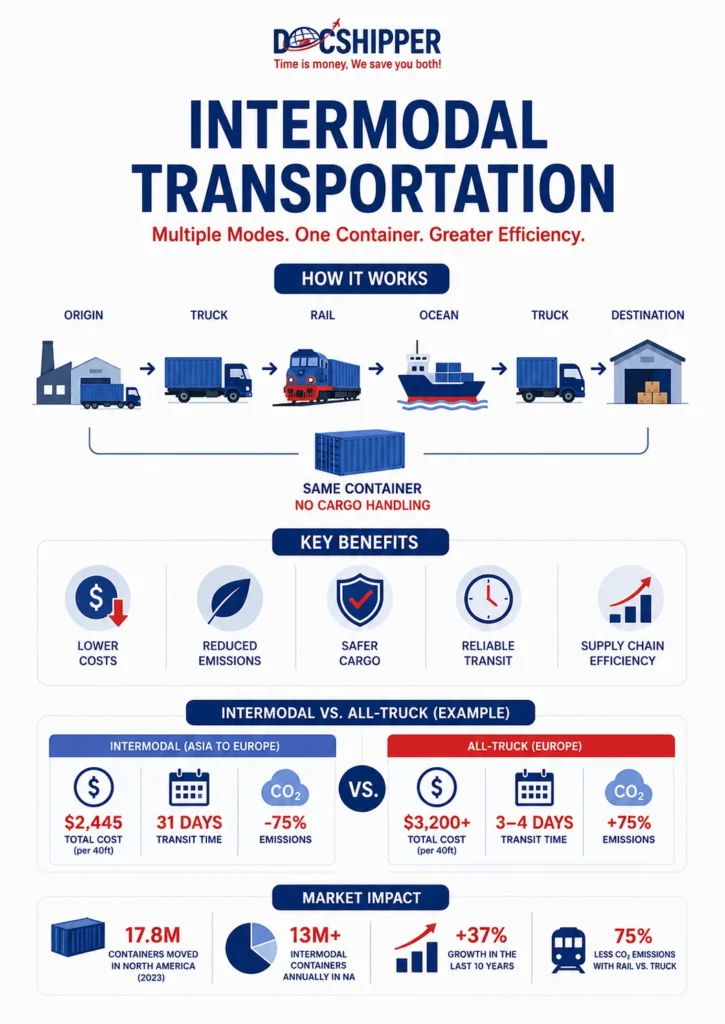
To illustrate intermodal transportation advantages, consider a typical Asia-to-Europe shipment scenario. A manufacturer in Shenzhen needs to deliver automotive parts to a factory in Munich. The intermodal solution involves:
| Transport Segment | Mode | Distance | Transit Time | Cost/TEU |
|---|---|---|---|---|
| Factory to Shenzhen Port | Truck | 50 km | 3 hours | $120 |
| Shenzhen to Rotterdam | Ocean vessel | 19,800 km | 28 days | $1,850 |
| Rotterdam to Munich | Rail | 820 km | 2 days | $380 |
| Rail terminal to factory | Truck | 35 km | 2 hours | $95 |
| TOTAL | Intermodal | 20,705 km | 31 days | $2,445 |
Compare this to an all-truck solution from Rotterdam to Munich, which would cost approximately $1,200 for 820 km—over three times the rail cost. The intermodal approach saves $820 on the European leg alone while reducing carbon emissions by 480 kg CO2.
A North American case study demonstrates similar benefits. A retailer shipping electronics from Los Angeles to Chicago faces this comparison:
- All-truck option: 3,280 km, 3 days transit, $3,800 per 40ft container
- Intermodal option: Truck to rail terminal + Union Pacific rail + final drayage = 5 days transit, $2,100 per container
- Savings: $1,700 per container (45% cost reduction) with 78% lower emissions
Volume requirements significantly impact intermodal economics. The break-even distance for intermodal versus truck-only typically falls around 800-1,000 km, depending on regional fuel costs and rail availability. Below this threshold, additional terminal handling costs negate the per-mile savings of rail transport.
Real-world adoption rates validate these advantages. According to the Association of American Railroads, intermodal traffic has grown by 37% over the past decade, now representing over 13 million containers annually in North America alone. European figures show similar growth, with rail modal share increasing from 8% to 18% of container traffic since 2010.
Conclusion
Intermodal transportation represents the most cost-efficient and environmentally sustainable solution for long-haul freight movements. By combining the economic advantages of rail and ocean transport with the flexibility of trucking, it delivers substantial savings while meeting tightening emission standards.
Need expert guidance on optimizing your intermodal shipping strategy? Contact DocShipper for customized logistics solutions tailored to your supply chain requirements.
📚 Quiz
Test Your Knowledge: Intermodal Transportation
1. What is the defining characteristic of intermodal transportation?
2. What is the typical break-even distance where intermodal becomes more economical than truck-only transport?
3. A manufacturer needs to ship automotive parts from Los Angeles to Chicago (3,280 km). Which statement correctly applies intermodal principles?
🎯 Your Result
📞 Free Personalized QuoteFAQ | Intermodal Transportation: Definition, Benefits & Concrete Examples
Intermodal transportation involves multiple carriers, each responsible for their transport segment and issuing separate contracts. Multimodal uses a single carrier who assumes liability for the entire journey across all transport modes. Intermodal typically offers lower costs but requires coordinating with multiple parties, while multimodal simplifies management with single-point accountability.
Standard ISO containers dominate intermodal shipping: 20ft (TEU), 40ft (FEU), and 45ft high-cube containers. Specialized units include refrigerated containers (reefers), flat racks for oversized cargo, and tank containers for liquids. All meet International Convention for Safe Containers (CSC) safety standards and feature standardized corner castings for lifting and securing across transport modes.
Intermodal reduces costs through modal optimization—using rail or sea for long-haul segments where per-mile costs are 40-60% lower than trucking, while reserving road transport for shorter first/last-mile segments. Additional savings come from reduced fuel consumption, lower labor costs (one train engineer moves 300+ containers versus individual trucks), and minimized handling expenses since cargo remains containerized throughout the journey.
Intermodal generally adds 1-3 days to truck-only transit due to terminal handling and rail schedule constraints. For example, Los Angeles to Chicago takes 3 days by truck versus 5 days intermodal. However, for distances over 1,500 km, this time premium is offset by significant cost savings—typically 35-50% lower rates. Time-sensitive freight may justify truck-only, while cost-focused shippers benefit from intermodal.
Yes, through specialized intermodal equipment. Flat rack containers accommodate machinery and oversized items up to 45 tons. Open-top containers suit tall cargo requiring crane loading. Tank containers transport chemicals and liquids. However, dimensional restrictions apply—cargo must fit within rail clearance limits (typically 4.1m height, 2.6m width in Europe). Extreme dimensions may require dedicated rail cars rather than standard containers.
Intermodal shipments require separate documentation for each transport segment: ocean bill of lading for sea freight, rail waybill for train transport, and truck bill of lading for road segments. Additionally, you need customs documentation (commercial invoice, packing list, certificates of origin), dangerous goods declarations if applicable, and equipment interchange receipts when containers transfer between carriers. Electronic data interchange (EDI) systems increasingly streamline this documentation.
Insurance coverage requires careful attention in intermodal shipping since liability transfers between carriers at each modal change. Standard carrier liability is limited (often $500-$2.75 per kg for ocean, varying by mode). Comprehensive cargo insurance provides continuous coverage across all transport segments regardless of carrier transitions. Policies should specify "warehouse-to-warehouse" coverage and address intermodal-specific risks like terminal handling and mode-transfer damage.
Intermodal transportation significantly reduces carbon footprint—rail produces 75% less CO2 per ton-mile than trucking, while ocean shipping is even more efficient for international legs. A typical intermodal shipment from Los Angeles to New York generates approximately 480 kg less CO2 than truck-only transport. These reductions help companies meet sustainability targets and comply with emissions regulations like the EU Green Deal and California's climate initiatives.
Intermodal terminals are specialized facilities where containers transfer between transport modes. They feature heavy equipment (gantry cranes, reach stackers), extensive container storage yards, rail sidings, and truck gates. Modern terminals process 30-40 container lifts per hour per crane. Operations run 24/7 at major hubs, with terminals using automated systems for container tracking, gate processing, and equipment positioning to minimize dwell time—typically under 48 hours for efficient facilities.
Five key factors determine intermodal viability: distance (typically economical beyond 800-1,000 km), volume consistency (regular shipments justify terminal handling costs), time sensitivity (adds 1-3 days versus truck), origin-destination rail access (proximity to intermodal terminals), and cargo type (containerizable goods versus oversized items). Fuel prices, driver shortages, and emission regulations increasingly favor intermodal even for shorter distances in regions with strong rail infrastructure.
Technology advances transformed intermodal operations through GPS container tracking providing real-time visibility across all transport modes, automated terminal equipment reducing handling times by 40%, blockchain-based documentation streamlining carrier handoffs, and AI-powered route optimization selecting optimal modal combinations. Digital platforms now enable single-window booking across multiple carriers, while IoT sensors monitor container conditions (temperature, humidity, shocks) throughout the intermodal journey, enhancing cargo security and quality control.
Common intermodal challenges include chassis shortages at port terminals causing pickup delays, rail schedule inflexibility compared to dedicated trucking, coordination complexity involving multiple carriers, potential for increased damage claims during container transfers, and capacity constraints during peak seasons. Port congestion can extend dwell times significantly—Los Angeles/Long Beach terminals averaged 6-8 day delays during recent congestion periods. Working with experienced freight forwarders mitigates these risks through established carrier relationships and contingency planning.
Need Help with
Logistics or Sourcing ?
First, we secure the right products from the right suppliers at the right price by managing the sourcing process from start to finish. Then, we simplify your shipping experience - from pickup to final delivery - ensuring any product, anywhere, is delivered at highly competitive prices.


Fill the Form
Prefer email? Send us your inquiry, and we’ll get back to you as soon as possible.
Contact us




