In short ⚡
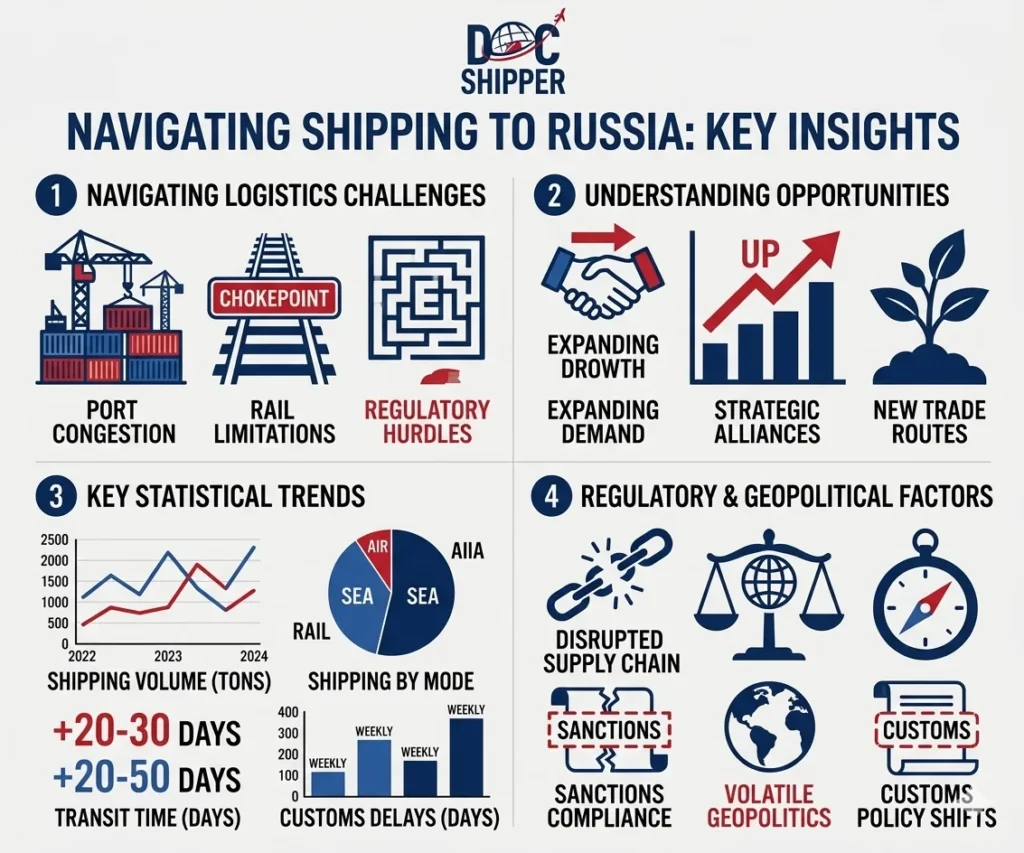
Current Russia shipping market updates show a shift from traditional westbound lanes to corridor-driven, multimodal routes with higher compliance and documentation scrutiny.
Shippers must design flexible rail–road–sea–air chains, strengthen sanctions and dual‑use screening, secure specialized insurance, and use real‑time rail, port, customs, and freight rate data to adjust routes and costs.
We hope you’ll find this article genuinely useful, but remember, if you ever feel lost at any step, whether it’s finding a supplier, validating quality, managing international shipping or customs, DocShipper can handle it all for you!
Key 2025 trends shaping Russia’s shipping and logistics market
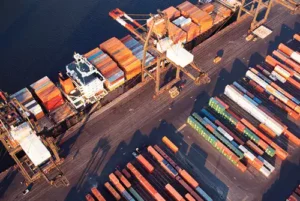
If you’re following shipping Russia market updates closely, you’ll notice fast that 2025 isn’t about “finding one route that works”, it’s about building a supply chain that can reroute in days.
From experience, the importers who keep moving are the ones who treat freight forwarding like a living system, with backup carriers, flexible Incoterms, and a customs clearance plan that doesn’t collapse when a document changes.
Here’s the thing, Russia’s logistics market has become more corridor-driven than port-driven.
You’re not just buying a freight rate anymore, you’re buying lead time stability, tracking and tracing reliability, and a freight forwarder that can negotiate carrier contracts under constraints.
Quick workflow we use to keep your routing realistic (not theoretical):
1) Map your cargo by HS code and sensitivity (sanctions, dual-use perception, licensing risk).2) Shortlist 2 to 3 viable corridors (rail, road, sea feeder, air) and test transit time variance.3) Align Incoterms and responsibilities (export compliance, import compliance, insurance, proof of delivery).4) Lock your operational plan (freight tender, load planning, palletization, containerization, consolidation).5) Run a documentation drill (bill of lading data, packing list, invoice wording, consignee details).6) Execute with milestones (gate-in, customs broker release, bonded warehouse options, final delivery).
Checklist you can use this week:
- Do you have a freight quote for at least two modes (intermodal transport plus a fallback)?
- Can your supplier provide consistent bill of lading and invoice data without “creative edits”?
- Do you know your duty and taxes exposure by HS code and corridor?
- Have you validated a freight insurance solution that actually pays under current constraints?
- Do you have a plan for warehousing, cross-docking, and inventory management if the border slows down?

DocShipper Info
Talk to our logistics experts to stress test your lanes and secure backup options before disruption hits.
Macroeconomic shifts, sanctions, and their impact on cargo flows
These shipping Russia market updates start with one reality, cargo flows follow payment rails, compliance checks, and carrier appetite, not just demand.
You can have a ready shipment, perfect packaging, and still lose a week because the “acceptable” bank, insurer, or carrier list changed overnight.
We’ve seen a simple spare-parts shipment get stuck because the supplier used a product description that sounded dual-use.
The cargo wasn’t restricted, but the wording triggered extra screening and the customs broker asked for clarifications that weren’t prepared.
What changes your day-to-day in freight forwarding and supply chain management:
- Longer compliance lead time before cargo even leaves the warehouse, you’ll spend more time on export compliance, end-use checks, and document review.
- More re-routing, you’ll rely on multimodal transport via third countries, with tighter control on consolidation and deconsolidation steps.
- More scrutiny on paperwork, HS code classification, invoice narratives, and consignee details become “make or break”.
- Freight rate volatility, you’ll see spikes when capacity tightens on specific corridors, even if global rates look calm.
To keep your cargo moving, you want decisions that are operational, not ideological.
That’s why we align your lane design with what authoritative bodies like the World Customs Organization push in terms of classification discipline and compliance fundamentals.
Mini table, what you feel on the ground:
| What shifts | What you’ll see | What you should do |
| Sanctions and screening intensity | Extra questions, document holds, carrier refusals | Pre-screen HS code and product wording, prepare technical sheets, keep a compliance-ready pack |
| Payment and counterparty constraints | Delayed bookings, re-issued invoices, changed consignees | Clarify Incoterms early, lock consignee data, validate routing with your freight broker and bank flow |
| Demand reallocation to specific partners | Congestion on certain borders and hubs | Book earlier, use consolidation, consider bonded warehouse buffers and cross-docking |
Modal split trends: sea, rail, road, air, and multimodal corridors
In today’s shipping Russia market updates, modal split is less about “cheapest mode” and more about which mode survives disruption with predictable tracking and tracing.
You’ll often end up designing a multimodal transport chain where the handoffs matter as much as the line-haul.
A real pattern we keep seeing, you plan sea freight, then you add rail for the “middle”, then you finish with trucking and last-mile delivery once the corridor clears.
And yes, that means more touchpoints where paperwork can go wrong, especially at transshipment and deconsolidation steps.
What’s driving the modal choices right now:
- Sea, often routed through non-traditional transshipment nodes, you must double-check bill of lading instructions and container release rules.
- Rail, attractive for corridor speed on specific lanes, but you need strict load planning and realistic border dwell assumptions.
- Road, flexible for cross-border trucking and quick pivots, but capacity and permits can tighten suddenly.
- Air, used for urgent cargo and high-value SKUs, but freight rates can jump, and screening can be intense.
- Intermodal transport, your best “resilience play” when you design it intentionally, with clear carrier contracts and milestone control.
When we run route optimization with you, we don’t just ask “how fast”.
We ask where you can safely stage inventory, whether you need a bonded warehouse, and how you’ll prove delivery without disputes.
Looking for a Reliable Shipping & Sourcing Partner?
How Russia’s trade reorientation changes your shipping routes
Most shipping Russia market updates you read won’t tell you the uncomfortable part, you’re now managing a network of partnerships and handoffs, not a simple origin-to-destination lane.
If you’ve ever had a supplier promise “we ship like before”, you already know how fast that promise breaks once the first booking gets rejected.
We typically rebuild your routing around the corridor’s practicalities, customs clearance behavior, carrier availability, and what your cargo can tolerate in lead time and handling.
That includes choosing when to use a 3PL for warehousing and cross-docking, versus pushing direct to final delivery.
Checklist for reoriented trade lanes:
- Do you have at least one alternative freight forwarder option for the same corridor?
- Have you defined who acts as customs broker on each side, and who owns import compliance tasks?
- Can your cargo handle extra handling from consolidation and deconsolidation?
- Do your Incoterms match reality (control of export docs, insurance, and proof of delivery)?
- Have you planned a buffer using warehousing or a bonded warehouse to protect inventory management?
Corridor selection workflow (simple, but it works):
1) Confirm your trade party setup (shipper, consignee, notify, payment flow).2) Validate HS code, duty and taxes assumptions, and clearance constraints.3) Choose 2 corridors and get bookable freight quotes, not “indicative”.4) Decide your handling plan (palletization, containerization, load securing, labeling).5) Assign control points (handover docs, tracking events, proof of delivery format).6) Execute with a contingency plan (alternative hub, alternate mode, temporary warehousing).
DocShipper Advice
Request a corridor feasibility review to validate carriers, brokers, and warehousing before your next booking.
Eastern corridors with China, Turkey, Central Asia and India
In practical shipping Russia market updates, the “East and South” story is about capacity, borders, and paperwork consistency more than geography.
You’re often routing via China, Turkey, Central Asia, or India because those lanes offer workable combinations of carriers, consolidation options, and customs processes.
We’ve handled shipments where the supplier insisted on one direct route, then the carrier asked to rebook via a different hub two days before cutoff.
The cargo moved only because the shipper accepted a fast Incoterms adjustment and we had the trucking plus warehousing slots ready for the new handoff.
What you should watch on these corridors:
- Border behavior, queues can create lead time swings, so you need buffers in inventory management and realistic ETAs.
- Document discipline, any mismatch in consignee data or commodity description can trigger holds.
- Consolidation strategy, smart consolidation reduces cost, but too many mixed items can complicate inspections and clearance.
- Last-mile delivery constraints, plan the final trucking leg early, not after the cargo arrives.
When you design these lanes with us at DocShipper, we treat each border crossing like a mini-project.
That’s also why we stay aligned with guidance and statistical signals from the International Trade Centre to sanity-check where trade volumes are actually shifting.
DocShipper Info
Secure compliant routing with DocShipper and lock trucking, warehousing, and documentation before border pressure builds.
New oil, gas and sanctioned cargo patterns you must monitor
Any serious shipping Russia market updates has to address energy and sanctioned cargo patterns, because they reshape carrier networks, port calls, and insurance behavior.
Even if you ship “normal” goods, you’ll feel the knock-on effects through freight rate moves, equipment availability, and carrier risk appetite.
We’ve seen a non-energy containerized shipment face delays simply because the route overlapped with a high-scrutiny region and the insurer demanded extra confirmations.
The cargo was clean, but the corridor got crowded and the documentation checks turned painfully slow.
What you should monitor without turning it into a full-time job:
- Carrier and insurer restrictions, they can change faster than official notices reach your inbox.
- Equipment imbalances, container availability can tighten when trade patterns skew toward certain exports.
- Port and terminal policies, acceptance rules and transshipment options can shift with geopolitical pressure.
- Compliance spillover, sanctioned cargo scrutiny increases checks on neighboring categories, especially ambiguous HS codes.
If you want a simple rule, avoid ambiguity.
Clear HS code logic, precise product descriptions, and a documented chain of custody protect your shipment, your customs clearance timeline, and your freight insurance claimability.
DocShipper Alert
Run a pre shipment compliance check to protect transit time and insurance validity.
Tactical opportunities for global shippers in the Russian market

You are operating in a market where traditional West bound lanes have contracted, but Eastern and South bound corridors are expanding structurally. If you position correctly, you can capture margin where competitors hesitate.
You should focus on corridors supported by political alignment and infrastructure investment. We help you redesign your routing with cost simulations and compliance screening from day one.
| Opportunity | Why it matters for you | Operational tip |
| China Russia rail growth | Stable volumes via Trans Siberian and land bridges | Secure rail slots early, plan 14 to 25 days transit |
| North South Corridor via Iran and India | Alternative to Suez for specific commodities | Verify multimodal handover points and customs brokers |
| Turkey and Central Asia hubs | Re export platforms with flexible trade structures | Use bonded warehouses and structured trade finance |
| E commerce and parallel imports | Strong domestic demand for consumer goods | Combine air plus road for high value SKUs |
You can also optimize your cost structure through tactical sourcing and supplier consolidation. This is where our China sourcing expertise connects directly with shipping Russia market updates.
- Negotiate EXW or FCA in China, control your freight end to end
- Consolidate SKUs in Shenzhen or Ningbo before rail dispatch
- Implement pre shipment inspection to avoid customs disputes
- Structure Incoterms to shift sanctioned risk away from you
If you manage multimodal correctly, you gain flexibility. If you leave it to fragmented intermediaries, you lose visibility and control.

DocShipper Advice
Optimize sourcing and multimodal design to capture growth while competitors hesitate.
Risk, compliance and insurance considerations for shipping to and from Russia
You cannot treat Russia like a standard emerging market. Sanctions screening and dual use verification are non negotiable.
You must check counterparties, banks, vessels and even container operators. We integrate compliance screening before booking any freight capacity.
| Risk area | What you must verify | Mitigation strategy |
| Sanctions exposure | EU, US, UK, secondary sanctions lists | Automated denied party screening |
| Dual use goods | HS code classification accuracy | Pre shipment compliance audit |
| Insurance gaps | War risk and territorial exclusions | Specialized cargo insurance endorsements |
| Payment risk | Restricted banking channels | Alternative currencies and secured LCs |
You should also review Incoterms with extreme precision. CIF or DAP without insurance clarity can expose you to uncovered geopolitical risk.
- Confirm insurer acceptance of Russian destination
- Validate port and terminal operational status
- Secure written freight forwarder liability scope
- Align contract clauses with sanction evolution
In our operations, we never book cargo to Russia without a documented compliance checklist. You should adopt the same discipline.
DocShipper Alert
Implement a documented sanctions checklist before booking any capacity to or from Russia.
Data sources, indicators and tools to track Russia shipping market updates
If you rely on outdated routing maps, you will misprice your freight. You need real time shipping Russia market updates supported by data.
You should combine public statistics with operational intelligence from forwarders and rail operators. We build dashboards for clients who need continuous visibility.
| Source | What it tells you | How to use it |
| Russian Railways data | Container volume trends East bound | Forecast rail capacity constraints |
| Port throughput reports | Shifts from Baltic to Far East ports | Adjust port of loading strategy |
| Customs trade statistics | Commodity level trade reorientation | Identify growth sectors |
| Freight rate indices | Spot and contract volatility | Time your contract negotiations |
- Track Vladivostok and Novorossiysk congestion weekly
- Monitor China Russia rail transit time deviations
- Review sanction package updates monthly
- Benchmark multimodal cost per CBM quarterly
If you integrate these indicators into your sourcing workflow, you move from reactive to strategic. That is how you protect margin in volatile corridors.
DocShipper Info
Build a real time dashboard with us and anticipate capacity, rate, and compliance shifts.
Conclusion
You are navigating one of the most complex logistics environments in the world. Yet complexity creates opportunity if you structure your operations correctly.
- Reorient your routes toward Eastern and South bound corridors
- Control sourcing and Incoterms to secure freight leverage
- Implement strict sanctions and dual use compliance screening
- Secure specialized insurance adapted to geopolitical risk
- Use data driven shipping Russia market updates to guide decisions
At DocShipper, we combine sourcing in China, multimodal freight management and compliance control under one roof. If you want to ship to or from Russia with clarity and control, we design the full workflow with you.
FAQ | Shipping Russia market updates: how to adapt your logistics strategy in real time
- Russia’s market is now corridor‑driven (via China, Turkey, Central Asia, India, Iran) rather than focused on a few classic ports.
- Instead of one “perfect” route, you need 2–3 viable corridors per lane, mixing sea, rail, road and sometimes air.
- Practically, this means you should:
- Map HS codes and sanctions exposure for each product.
- Get bookable quotes (not estimates) on at least two modes.
- Decide in advance where you’re willing to hold inventory (bonded warehouse, cross‑docking hub).
- Align Incoterms with who really controls export/import compliance and insurance.
- China–Russia rail:
- Stable volumes via Trans‑Siberian and land bridges.
- Plan 14–25 days transit and book rail slots early.
- North–South corridor via Iran and India:
- Alternative to Suez for specific commodities.
- Requires tight control of multimodal handovers and customs brokers.
- Turkey and Central Asia hubs:
- Used as re‑export platforms with flexible trade structures.
- Combine bonded warehouses with structured trade finance to manage risk.
- Hybrid lanes (air + road, sea + rail + truck):
- Useful for high‑value SKUs and urgent flows.
- Design the handoffs (who is responsible at each stage) as carefully as the main haul.
- You’ll face more pre‑shipment checks and document scrutiny than in “normal” markets.
- Expect:
- Extra questions from carriers, banks and insurers about counterparties and cargo use.
- Rejections of bookings or payments if any party appears on sanctions lists.
- Longer lead time just for export compliance and end‑use verification.
- To stay operational:
- Screen all parties (shipper, consignee, banks, vessels) against EU/US/UK and secondary sanctions lists.
- Validate HS codes and check if your goods could be perceived as dual‑use.
- Prepare a compliance pack (technical sheets, end‑use statements, contracts) before booking.
- Treat Incoterms as a risk‑allocation tool, not a formality.
- Pay attention to:
- Who carries sanctions and dual‑use risk (seller vs buyer).
- Who arranges freight insurance and what territories are excluded.
- Where risk transfers if a corridor suddenly becomes unusable.
- Practical steps:
- Avoid “default” CIF/DAP without confirming insurer acceptance of Russian legs.
- Get written confirmation of your forwarder’s liability scope and exclusions.
- Build in clauses that allow routing or carrier changes if sanctions evolve.
- Consider EXW/FCA from Asia to control routing and screening end‑to‑end.
- Combine public stats with on‑the‑ground intel from forwarders and carriers.
- Useful sources and how to use them:
- Russian Railways data: forecast East‑bound capacity and transit time trends.
- Port throughput reports (e.g. Vladivostok, Novorossiysk): spot congestion and shift ports of loading/unloading.
- Customs trade statistics: identify which commodities and corridors are growing or contracting.
- Freight rate indices: time your contract negotiations and evaluate multimodal cost per CBM.
- As a routine:
- Check rail and port congestion weekly.
- Review new sanctions packages monthly.
- Re‑benchmark your key corridors’ cost and lead time at least quarterly.
- Design the chain around handovers, not just the main haul.
- To build resilience:
- Use at least two alternative modes or hubs for critical lanes.
- Define clear milestones (gate‑in, customs release, hub arrival, final proof of delivery).
- Decide early where you may use bonded warehouses or cross‑docking as buffers.
- Standardize documentation (bill of lading data, consignee details, product descriptions) across all legs.
- Work with a forwarder that:
- Can contract sea, rail, road and air under one operational plan.
- Runs documentation drills before first shipment.
- Provides live tracking and proactive rerouting options if a corridor is disrupted.
- Move control upstream to your Asian suppliers and hubs.
- Effective tactics:
- Negotiate EXW or FCA in China so you control the full logistics chain.
- Consolidate SKUs in hubs like Shenzhen or Ningbo before rail or sea dispatch to Russia.
- Run pre‑shipment inspections to avoid customs disputes and misdeclared goods.
- Align product descriptions and HS codes during sourcing, not at the last minute.
- Outcome:
- Better freight rates through consolidation, fewer documentation errors, and a cleaner compliance trail from factory to final delivery.
Need Help with
Logistics or Sourcing ?
First, we secure the right products from the right suppliers at the right price by managing the sourcing process from start to finish. Then, we simplify your shipping experience - from pickup to final delivery - ensuring any product, anywhere, is delivered at highly competitive prices.
Fill the Form
Prefer email? Send us your inquiry, and we’ll get back to you as soon as possible.
Contact us